
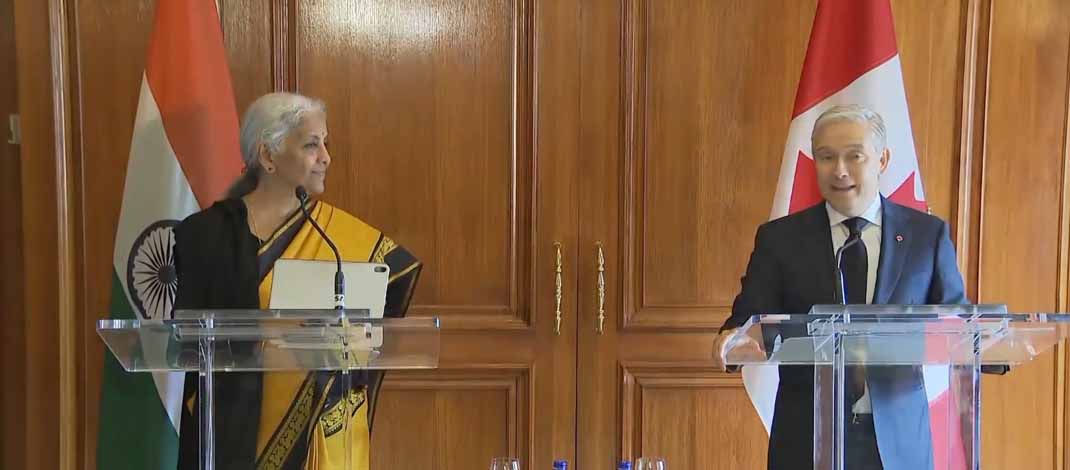
Toronto : India and Canada have taken a fresh step towards rebuilding and expanding their economic partnership with the conclusion of the first-ever India-Canada Finance Ministers’ Economic and Financial Dialogue in Toronto.
The meeting between Union Finance and Corporate Affairs Minister Nirmala Sitharaman and Canada’s Minister of Finance and National Revenue François-Philippe Champagne resulted in a Joint Statement outlining a broader agenda for cooperation covering trade, investment, financial services, digital payments, capital markets, FinTech and critical minerals.
The dialogue follows the commitment made by Prime Minister Narendra Modi and Canadian Prime Minister Mark Carney during their meeting in New Delhi in March 2026 to give fresh momentum to bilateral economic and financial relations. Both countries are also working towards completing negotiations for the Canada-India Comprehensive Economic Partnership Agreement (CEPA) by the end of 2026.
Trade Ambition Set at CAD 70 Billion
A major focus of the Toronto dialogue was the ambition to raise bilateral trade to CAD 70 billion, equivalent to around ₹4.65 lakh crore, by 2030.
The two Ministers discussed ways of strengthening commercial and financial connections so that businesses and investors in both countries can benefit from expanded market opportunities.
India also conveyed its readiness to begin negotiations on a Bilateral Investment Treaty (BIT) at the earliest, signalling an intention to create a more predictable framework for cross-border investment.
Canadian Pension Funds, Institutional Capital in Focus
Investment emerged as an important pillar of the discussions.
The Ministers took note of the significant presence of Canadian pension funds and other institutional investors in India and discussed how greater participation by long-term institutional capital could contribute to economic growth.
The two sides also explored ways to bring Indian and Canadian financial institutions and institutional investors closer together and identify commercially viable opportunities across sectors of mutual interest.
Discussions also touched upon the importance of stable and predictable tax rules for investors and the role of domestic tax legislation in providing greater certainty for long-term investment decisions.
Building on the commitment made by Canadian Prime Minister H.E. Mr. @MarkJCarney and Prime Minister Shri @narendramodi at New Delhi in March 2026 to strengthen bilateral economic and financial cooperation, India and Canada adopted a Joint Statement post the inaugural India-Canada… pic.twitter.com/us8nuB8pXJ
— Ministry of Finance (@FinMinIndia) August 27, 2026
UPI Expansion and Easier Cross-Border Payments
Digital finance and payment connectivity featured prominently in the dialogue.
India and Canada agreed to encourage their relevant authorities and stakeholders to examine opportunities in cross-border remittances and merchant payments.
The two sides also welcomed the possibility of expanding India’s Unified Payments Interface (UPI) in Canada through partnerships with payment service providers.
Greater payment connectivity could make transactions quicker and more economical while supporting trade, tourism, education and small and medium-sized businesses in both countries.
FinTech, Capital Markets and Financial Security
The Finance Ministers also identified several areas where cooperation between the two financial systems could be expanded.
These include payments modernisation, financial stability, FinTech innovation, capital-market development and measures to combat financial crime.
The discussions reflect an effort to take India-Canada economic engagement beyond conventional trade and build stronger institutional links between their financial sectors.
Critical Minerals Join Strategic Agenda
Supply-chain resilience was another important area of discussion.
Recognising the growing importance of secure and diversified supply chains for economic stability and sustainable growth, India and Canada agreed to explore cooperation in strategic sectors, including critical minerals.
The sector has growing importance for advanced manufacturing, clean technologies and other strategic industries, making it a potentially significant area for future bilateral cooperation.
Sitharaman Engages Canadian Business and Technology Leaders
Following the Finance Ministers’ dialogue, Nirmala Sitharaman and François-Philippe Champagne held joint engagements with representatives from Canada’s financial services, FinTech, technology, Artificial Intelligence, infrastructure, energy and natural resources sectors.
The interactions provided an opportunity to identify areas where businesses, investors and financial institutions from both countries can develop longer-term partnerships.
Sitharaman is currently on an official visit to Canada and the United States, with investment and business outreach forming an important part of her engagement. During her Canada visit, she has also been highlighting India’s expanding opportunities in production, innovation, services and exports.
A New Institutional Mechanism for India-Canada Economic Relations
The inaugural Finance Ministers’ dialogue provides a new institutional platform for regular discussions on economic and financial issues between the two countries.
Both Ministers agreed to maintain regular engagement and work towards converting the areas identified during the meeting into concrete cooperation and measurable outcomes.
The next India-Canada Economic and Financial Dialogue will be held in 2027.
In essence, the Toronto dialogue signals a broader reset in India-Canada economic engagement—moving beyond traditional trade towards investment, digital payments, financial-sector cooperation, critical minerals and institutional capital, with the ambitious CAD 70-billion trade target by 2030 providing a clear benchmark for the partnership.
Related
Table of Contents
Toggle