
New Delhi : A pioneering scientific breakthrough has provided researchers with a new method to distinguish between pollen from cultivated crops and wild grasses, offering fresh insights into the origins of agriculture in India—particularly in the Central Ganga Plain.
India, one of the world’s leading producers of staple crops like wheat and rice, has long faced challenges in tracing its agricultural history due to the difficulty of differentiating crop pollen from that of wild grasses. Since most cereals—including wheat, rice, barley, and millets—belong to the grass family (Poaceae), their pollen appears nearly identical under conventional microscopic observation.
The new study addresses this gap by establishing region-specific biometric thresholds that enable scientists to reliably identify cultivated versus wild grass pollen. This advancement is expected to significantly improve reconstructions of ancient human settlements, land use patterns, and agricultural practices, particularly during the Holocene epoch spanning the last 11,700 years.
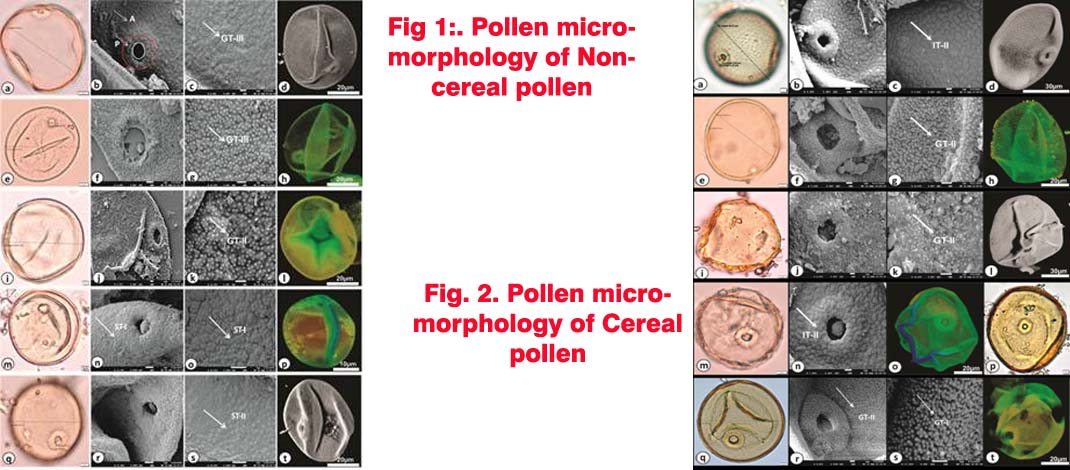
Researchers focused on pollen micro-morphology—especially grain size and annulus diameter (the ring around the pollen pore)—as key distinguishing features. Until now, the absence of a comprehensive, India-specific pollen reference framework limited the accuracy of such studies.
In a first-of-its-kind effort, scientists from the Birbal Sahni Institute of Palaeosciences (BSIP), an autonomous institute under the Department of Science and Technology (DST), along with collaborating institutions, analysed 22 cereal and non-cereal grass species. The team employed advanced imaging techniques, including Light Microscopy, Confocal Laser Scanning Microscopy, and Field Emission Scanning Electron Microscopy, to establish a reliable classification system.
The study, conducted in the agriculturally rich Central Ganga Plain, identified a clear “paired biometric threshold.” It found that cereal pollen typically exceeds 46 micrometres in grain size and 9 micrometres in annulus diameter (with pearl millet as an exception), while wild grass pollen generally falls below these values.
Published in the journal The Holocene, the findings provide a robust, region-specific framework for distinguishing cereal from non-cereal pollen. This enables researchers to more accurately trace the onset and intensity of ancient farming practices and human influence on the landscape.
Importantly, this is the first such framework developed using indigenous data from India, reducing reliance on European pollen databases and ensuring greater contextual accuracy for Indian conditions.
The study was led by Dr. Swati Tripathi of BSIP, Lucknow, in collaboration with scientists from the Botanical Survey of India, Indian Institute of Geomagnetism, and Lucknow University.
This breakthrough is expected to significantly enhance research on ancient agriculture, environmental change, and human settlement patterns. It offers archaeologists and environmental historians a powerful new tool to understand how human societies gradually transformed the fertile Ganga plains into one of the world’s most productive agricultural regions.
Overall, the study marks a major step forward in reconstructing India’s agricultural past with greater scientific precision and regional relevance.