
New Delhi : A new study by an international team of researchers has found a key limitation of classical communication: it cannot fully copy how quantum communication works, no matter how much classical information is used. This discovery is important for both understanding physics and developing future quantum technologies.
The question of whether quantum systems can be recreated using only classical methods was first raised by Richard P. Feynman. It is a central idea behind “quantum advantage,” which explains why quantum systems can perform certain tasks better than classical ones.
In this study, researchers Sahil Gopalkrishna Naik and Manik Banik from the S. N. Bose National Centre for Basic Sciences worked with international collaborators to explore this question. Their findings were published in the journal Proceedings of the Royal Society A.
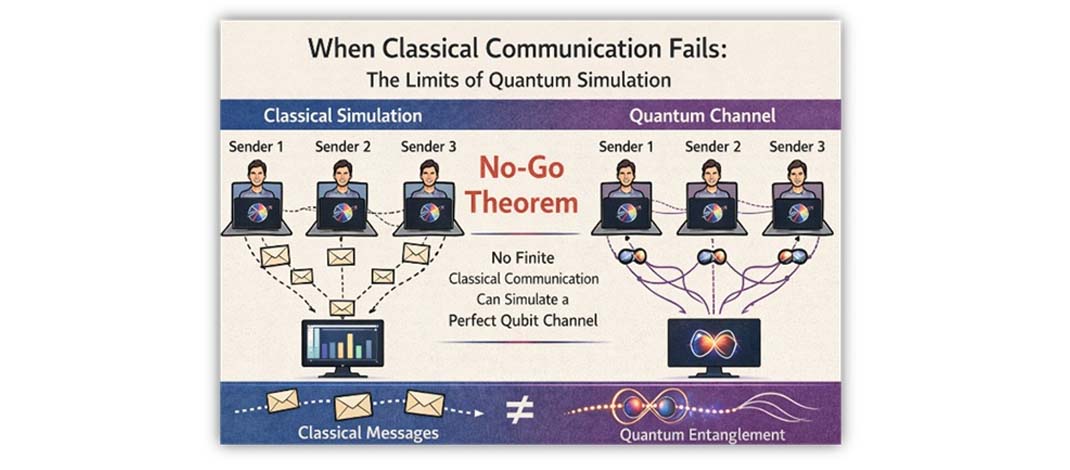
The team studied situations where multiple distant participants try to recreate quantum results at a central location using only classical communication. While this is possible in simple cases with two participants, the researchers found that it fails in more complex networks.
They showed that when many senders are involved, no limited amount of classical communication can perfectly reproduce the behavior of a quantum system. This is mainly because of “entanglement,” a unique quantum feature that has no true classical equivalent.
As a result, the study establishes an important principle: a quantum communication channel cannot be perfectly simulated using finite classical communication, even with advanced methods.
The findings also suggest that quantum states are not just theoretical ideas or information—they may represent something physically real. Overall, the study strengthens the concept of quantum advantage and highlights that quantum systems have capabilities that classical systems simply cannot match.
Publication Link: https://doi.org/10.1098/rspa.2025.0831