
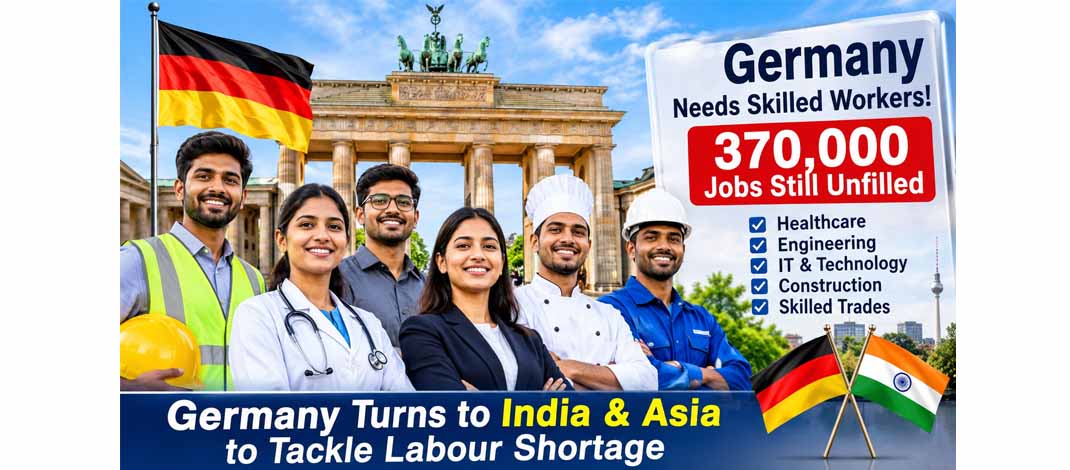
Europe’s Largest Economy Looks Beyond Its Borders to Address Labour Shortages | Healthcare, Engineering, IT, Construction and Skilled Trades Among Key Recruitment Sectors
New Delhi : Germany is strengthening its efforts to attract skilled professionals from across the world as employers continue to face difficulties filling vacancies in several sectors of the economy. With an estimated 370,000 positions reportedly remaining unfilled, German companies are increasingly looking towards international labour markets, particularly India, Vietnam and other Asian countries, to meet their workforce requirements.
The recruitment drive reflects Germany’s wider effort to address an ageing population, a shrinking domestic workforce and persistent shortages of qualified professionals. International recruitment is becoming an increasingly important component of the country’s labour-market and economic strategy, with skilled Indian professionals emerging as an important potential source of talent.
Labour shortages persist across 157 occupational categories
According to the German Federal Employment Agency’s (Bundesagentur für Arbeit) latest annual Skilled Labour Bottleneck Analysis, published on September 2, 2026, Germany faced shortages in 157 occupational categories in 2025, compared with 163 in 2024 and 183 in 2023.
The analysis identifies particularly acute recruitment challenges in:
-
Healthcare and nursing: Nurses, healthcare professionals and elderly-care specialists.
-
Engineering and manufacturing: Technical professionals, electrical engineering and specialised industrial occupations.
-
Construction and skilled trades: Construction workers, craft professionals and surveying technicians.
-
Transport and logistics: Professional drivers and other transport-related occupations.
-
Hospitality: Qualified chefs and hospitality professionals.
-
Education and social services: Early-childhood educators, social workers and social-pedagogical professionals.
The Federal Employment Agency also reported that approximately 402,000 registered vacancies for skilled workers, specialists and experts were recorded on an annual average in 2025. Around half of the reported vacancies were in occupations identified as experiencing labour shortages.
However, the agency’s assessment also makes an important distinction: Germany is not experiencing a general shortage of workers across every occupation. The challenge is particularly pronounced in specific professions, qualifications and geographical regions.
Federal Employment Agency+1
Why Germany is increasingly looking towards India and Asia
Demographic changes are among the major reasons behind Germany’s growing dependence on international skilled labour.
According to Germany’s Federal Statistical Office (Destatis), the country had approximately 83.5 million residents at the end of 2025, following a population decline of around 110,000 during the year. The number of people aged 60 and above increased by 387,000.
Destatis also estimates that around 40% of Germany’s working-age population (20–66 years) was already older than 49 in 2024. The retirement of the large baby-boomer generation is expected to put further pressure on the country’s workforce over the coming years.
The demographic challenge is particularly significant because Germany has fewer young workers entering the labour market to replace experienced employees approaching retirement. International recruitment is therefore becoming an important part of its long-term strategy to maintain industrial productivity, healthcare services and economic competitiveness.
Statistisches Bundesamt+1
India has emerged as an important partner in this strategy. In October 2024, Germany’s Federal Ministry of Labour and Social Affairs published its Skilled Labour Strategy: India, identifying India as a particularly important partner for skilled immigration.
The strategy recognises the potential of India’s large pool of young, educated and professionally trained people to address Germany’s workforce requirements. It also seeks to establish structured and mutually beneficial recruitment arrangements between the two countries.
Source : BMAS
Official recruitment programmes connecting India with German employers
Germany has already established several programmes to facilitate the recruitment of qualified Indian professionals.
1. Triple Win Programme – Nursing professionals
The German Federal Employment Agency, in cooperation with the German Agency for International Cooperation (GIZ), operates the Triple Win Programme to recruit qualified nurses from selected countries, including India.
The programme currently covers nursing professionals from Kerala and Telangana, as well as nursing trainees from Kerala. It provides support with German-language training, professional preparation, qualification recognition and integration into the German healthcare system.
2. Hand in Hand for International Talents
This initiative connects German companies with qualified professionals from countries including India and Brazil. Its focus areas include:
-
Electrical engineering
-
Metalworking and mechatronics
-
Computer science and IT
-
Professional cooking and hospitality
The programme supports employers and candidates through recruitment and placement.
3. APAL – Vocational Training Partnerships
Germany is also facilitating international vocational training partnerships involving India and several other countries. These initiatives offer opportunities in healthcare, industrial-technical occupations and skilled trades, with language training and assistance in recognising educational qualifications.
Source : Make It In Germany
Germany’s immigration framework and opportunities for foreign professionals
Germany has introduced several changes to its immigration framework to make it easier for qualified professionals from outside the European Union to enter its labour market.
Some important routes include:
-
EU Blue Card: Designed for qualified professionals with recognised qualifications and eligible employment offers meeting applicable salary requirements.
-
Opportunity Card (Chancenkarte): Allows eligible skilled professionals to enter Germany to search for employment, subject to qualification, points or other applicable eligibility requirements.
-
Skilled Immigration Act: Provides expanded opportunities for qualified professionals, including certain applicants with vocational qualifications and relevant work experience.
-
Recognition of qualifications: Germany has streamlined certain procedures for recognising foreign professional qualifications, although regulated professions continue to require applicable recognition and licensing.
The official German government portal, Make it in Germany, reported that 214,034 work visas were issued in 2025. It also reported that approximately 307,000 foreign healthcare workers were employed in Germany in 2024, highlighting the growing contribution of international professionals to essential services.
Source : Make It In Germany+1
An important qualification: 370,000 unfilled jobs versus the latest official estimate
The figure of 370,000 unfilled positions should be treated with caution because it does not appear to be the latest confirmed official count of all vacancies.
In a research update published on November 3, 2026, Germany’s state-owned development bank KfW reported that the country had approximately 1.1 million vacancies in 2025, alongside 4.6 million people seeking employment. Of these vacancies, approximately 360,000 were difficult to fill.
This distinction is important: difficult-to-fill vacancies are not necessarily the same as jobs that remain entirely unfilled, and not every vacancy is suitable for international recruitment.
Source : KfW
Furthermore, research published by Germany’s Institute for Employment Research (IAB) in 2026 indicates that although German companies show interest in recruiting from countries outside the EU, only a relatively small proportion actually undertake such recruitment. Larger companies and employers experiencing skills shortages are more likely to recruit internationally.
Source : Institut für Arbeitsmarkt- und Berufsforschung
India-Germany partnership: Opportunities and challenges ahead
The increasing demand for skilled professionals in Germany presents an opportunity to strengthen India-Germany economic cooperation beyond traditional areas such as trade, manufacturing, defence, technology and investment.
For Indian professionals, Germany offers potential employment opportunities, international exposure and access to advanced industrial and technological ecosystems. However, candidates must carefully examine qualification recognition, German-language requirements, employment contracts, salary conditions and visa eligibility before accepting employment.
For Germany, attracting skilled professionals from India and other countries could help address demographic pressures, support critical industries and maintain the competitiveness of its economy.
The success of this recruitment strategy will depend not merely on attracting international workers but also on ensuring fair recruitment practices, professional integration, language training and long-term career opportunities.