
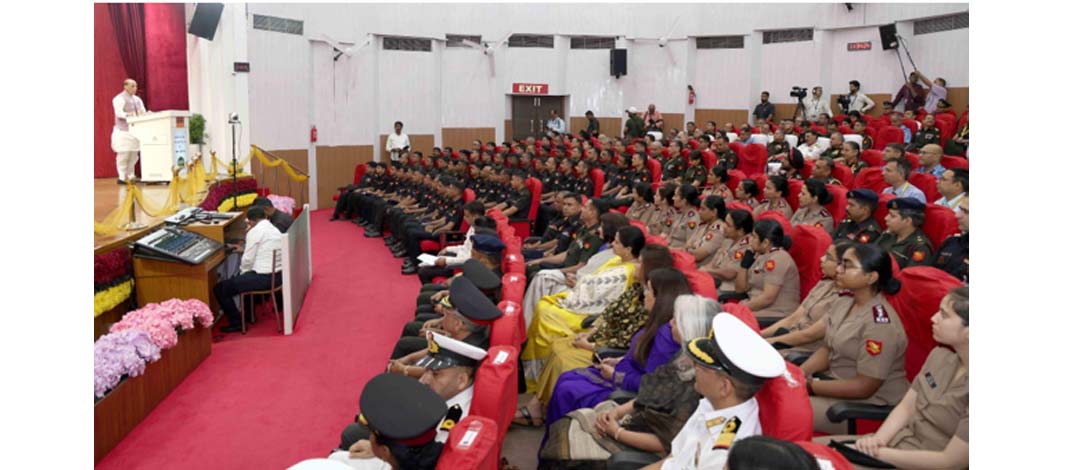
New Delhi : Raksha Mantri Rajnath Singh on April 6, laid the foundation stones for new Ophthalmology, Oncology and Joint Replacement Centres at Army Hospital (Research and Referral), along with additional infrastructure at Base Hospital Delhi Cantt, as part of the 262nd Army Medical Corps Raising Day celebrations.
The upcoming state-of-the-art facilities at Army Hospital (R&R) are expected to significantly enhance tertiary care capabilities of the Armed Forces Medical Services, particularly in advanced eye care, cancer treatment and complex joint replacement surgeries. Meanwhile, the upgraded Base Hospital is being developed with a capacity of 998 beds, along with 100 additional crisis expansion beds, to cater to both routine and emergency healthcare needs of defence personnel.
Focus on Innovation and Research
Addressing the gathering, Raksha Mantri Rajnath Singh emphasised the need for continuous innovation, capacity building and integration of modern technologies to tackle emerging challenges in military medicine. He expressed confidence that the new infrastructure will ensure high-quality healthcare for serving personnel, veterans and their families.
He commended the dedication of AFMS personnel for delivering healthcare services across diverse and challenging terrains, as well as for conducting medical outreach in neighbouring countries such as Nepal. Highlighting initiatives like glaucoma surgeries and eye care camps, he noted that such efforts enhance India’s global goodwill and reflect the country’s growing “soft power.”
Push for Research and Self-Reliance
Reaffirming the government’s commitment to world-class healthcare for armed forces, the Defence Minister stressed the importance of research, including integrating modern medicine with traditional knowledge systems. He highlighted the need to strengthen capabilities in advanced fields such as early cancer detection, personalised medicine, cardiovascular predictive models, and neuro-research.
Singh also called for greater self-reliance in pharmaceuticals, noting that while India is a major supplier of generic medicines, it must advance in high-end drug innovation and original research. He advocated for stronger clinical research, global quality standards, and deeper involvement of MSMEs and start-ups in the pharmaceutical ecosystem.
Strengthening Clinical Systems and Data Sharing
Underscoring the importance of clinical trials, he pointed out the need for reforms to enhance research, treatment and innovation. He also proposed the creation of standardised treatment protocols and a national-level medical data pool to enable evidence-based care, faster knowledge dissemination, and improved policy formulation.
Acknowledging the heavy workload on doctors, he urged the AFMS to strike a balance between clinical duties, research, and training.
Expanding Advanced Military Healthcare
Raksha Mantri Rajnath Singh suggested upgrading existing command and base hospitals across the country to match the standards of Army Hospital (R&R), ensuring access to high-quality medical facilities for soldiers in all regions.
He also highlighted the critical role of health security in national security, stating that confidence in robust medical support enables armed forces to perform effectively during operations.
Recognition and Innovations
During the event, Raksha Mantri Singh witnessed a live technology demonstration showcasing advancements in trauma care, battlefield evacuation, prosthetics, telemedicine and critical care technologies.
He presented the Best Hospital Trophy of AFMS to Command Hospital (Southern Command), while the second-best hospital award went to INHS Asvini, recognising excellence in patient care, innovation and administration.
The Defence Minister also released a book titled “Precision Protocols in Early Neurodevelopmental Intervention,” highlighting AFMS’s growing focus on research-driven and evidence-based medical practices.
Senior Leadership in Attendance
The event was attended by senior defence leadership, including General Anil Chauhan, Admiral Dinesh K Tripathi, General Upendra Dwivedi, Defence Secretary Rajesh Kumar Singh, and DG AFMS Vice Admiral Arti Sarin, among others.