
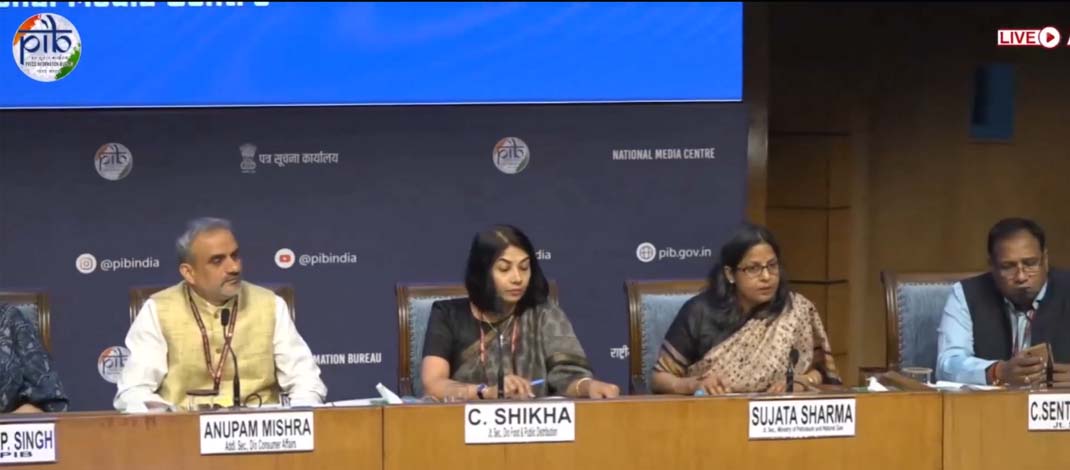
Inter-Ministerial Briefing on Recent Developments in West Asia
New Delhi : The Government of India on Monday held a high-level media briefing at the National Media Centre to provide updates on the evolving situation in West Asia and its impact on key sectors. Representatives from multiple ministries, including petroleum, shipping, external affairs and consumer affairs, outlined measures to ensure stability in food supply, fuel availability, maritime operations and the safety of Indian nationals abroad.
Food Security and Prices Remain Stable
The Ministry of Consumer Affairs, Food and Public Distribution stated that the government is closely monitoring the food security situation amid global uncertainties. Adequate buffer stocks of rice and wheat are available to meet requirements under the Public Distribution System as well as any emergency needs.
Foodgrain prices continue to remain stable, with no signs of unusual volatility or supply stress. The government is prepared to intervene through the Open Market Sale Scheme (Domestic), under which surplus stocks are released into the market to control prices and inflation.
Pulses production is estimated to rise to around 266 lakh metric tonnes, while edible oil availability remains comfortable due to steady imports and improved domestic output. Similarly, sugar stocks and production levels are sufficient, with exports continuing to key regions including West Asia and East Africa.
Production of key horticultural crops—potato, tomato and onion—remains adequate to meet domestic demand. Procurement measures are being undertaken to maintain price stability, particularly for onions.
Fuel Supply Under Control Despite Global Pressures
The Ministry of Petroleum and Natural Gas assured that adequate supplies of petrol, diesel and LPG are being maintained despite disruptions linked to developments around the Strait of Hormuz.
Citizens have been advised against panic buying and encouraged to rely on official information. The government has prioritised supply for essential sectors such as hospitals and educational institutions, while also promoting alternative fuels like PNG, electricity and induction cooking.
Domestic LPG distribution remains stable, with over 18 crore cylinders delivered since March 1, 2026. Enforcement actions to curb hoarding and black marketing have intensified, with over one lakh inspections conducted nationwide.
To protect consumers from rising crude prices, the government has reduced excise duty on petrol and diesel by ₹10 per litre, while imposing export levies to ensure adequate domestic availability.
Natural Gas and PNG Expansion Accelerated
Efforts to expand piped natural gas (PNG) infrastructure have been stepped up, with priority supply maintained for domestic households and transport (CNG). The government has introduced policy measures to fast-track pipeline approvals and expand last-mile connectivity.
Since March 2026, over 3.6 lakh new PNG connections have been activated, with additional registrations underway. The move is expected to support India’s transition towards cleaner energy and strengthen long-term energy security.
Maritime Operations and Seafarer Safety Monitored
The Ministry of Ports, Shipping and Waterways confirmed that maritime operations remain normal, with no congestion reported at Indian ports. Shipping movements and the safety of Indian seafarers in the Persian Gulf are being closely monitored.
Indian-flagged vessels continue to operate safely, with recent successful transits of LPG carriers through the Strait of Hormuz. Over 1,500 Indian seafarers have been repatriated so far, while control rooms remain operational round the clock to assist those in the region.
Assistance to Indian Nationals Intensified
The Ministry of External Affairs highlighted ongoing efforts to ensure the safety and evacuation of Indian nationals from affected areas. So far, over 1,700 Indians have been moved from Iran to neighbouring countries such as Armenia and Azerbaijan for onward travel home.
Indian missions across West Asia are operating 24×7 helplines, providing consular assistance, and facilitating travel through alternative routes amid airspace restrictions. Coordination with foreign governments continues to ensure safe transit.
The External Affairs Minister has also engaged with counterparts from countries including Qatar, the UAE and Iran to discuss the evolving situation.
Government Focused on Stability and Public Assurance
The government emphasised that coordinated efforts across ministries and states are underway to maintain stability, counter misinformation, and ensure uninterrupted supply of essential commodities and services.
Authorities reiterated that there is no cause for concern, urging citizens to remain calm and rely on official updates as India continues to manage the situation proactively.