
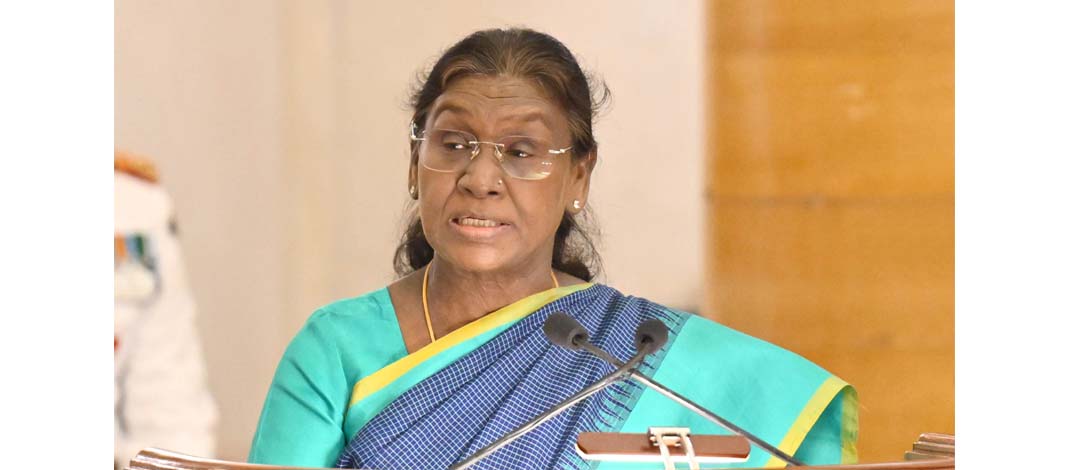
New Delhi: On the occasion of Teachers’ Day, President Droupadi Murmu has paid tribute to teachers across the country, describing teaching as a responsibility that goes far beyond imparting academic knowledge and calling upon educators to nurture capable, ethical and compassionate citizens.
In an article released for Teachers’ Day, President Murmu said teachers influence the lives and destinies of millions of students by giving them not only knowledge and skills, but also values, confidence and motivation. She expressed gratitude to teachers for their contribution to nation-building.
Recalling the origins of Teachers’ Day in India, the President noted that former President and renowned philosopher Dr. Sarvepalli Radhakrishnan had wished that his birthday be observed as Teachers’ Day. Despite his achievements as an intellectual, author and statesman, he considered teaching his most important role.
President Murmu also recalled Dr. A.P.J. Abdul Kalam, who, when asked whether he would prefer to be remembered as a scientist or President, had expressed his desire to be remembered as a teacher.
‘Acharyadevo Bhava’ — The Teacher as a Guiding Force
The President highlighted India’s ancient tradition of placing teachers in a position of great respect. Referring to the Taittiriya Upanishad, she cited the timeless teaching of “Acharyadevo Bhava”, which emphasises the revered place of a teacher.
She said India’s traditional understanding of a good teacher remains relevant even today. Teachers are expected to care for students like their own children, treat them fairly, remain patient and put their well-being first.
President Murmu drew from her own childhood experiences, recalling the teachers who guided and encouraged her during her education. She said their support played an important role in giving her the confidence to continue her studies after becoming the first girl from her village to leave home after Class VII for further education.
According to her, these experiences demonstrated how affection, encouragement and dedication from a teacher can unlock a student’s potential and give them the courage to pursue ambitious goals.
Teachers Must Encourage Questions and Independent Thinking
The President emphasised that educators have a role that extends well beyond completing a prescribed curriculum. Their behaviour and personal example can teach students important lessons about how to approach life.
She referred to Mahakavi Kalidas’s play ‘Malavikagnimitram’, noting the traditional understanding that an effective teacher must possess deep knowledge as well as the ability to communicate that knowledge successfully.
She also referred to the Sanskrit maxim “Sarvatra vijayam icchet, shishyat icchet parajayam”, conveying the idea that a teacher should welcome being surpassed by their own students.
President Murmu said teachers should encourage curiosity, questioning, independent thinking, reasoning and sound judgement. Such an approach, she said, can help nurture future entrepreneurs, scientists, artists and citizens capable of developing innovative solutions to emerging challenges.
President Recalls Her Own Experience as a Teacher
The President also reflected on her own experience of teaching at the Sri Aurobindo Integral School in Rairangpur, Odisha.
She recalled participating not only in classroom teaching but also in students’ musical performances, sports activities and plays. She fondly remembered preparing for Independence Day and Republic Day celebrations and taking students on outings where they could learn about nature, animals, birds and plants.
President Murmu said she continues to remember many of her former students and that some of them still invite her to family occasions. She added that teaching had also taught her important lessons, as children can themselves become a source of learning through their curiosity and spontaneity.
She further recalled spending time with students at a school on the premises around Rashtrapati Bhavan, where she spoke to them about environmental conservation.
School for Disadvantaged Children
The President also highlighted a residential school she established at her village home around 11 years ago for children from disadvantaged families and those who have lost their parents.
She said she continues to visit the school and recalled meeting the children there on June 20 this year, on her birthday. Prime Minister Narendra Modi also visited the school with her and encouraged the students, an experience she said would remain an important source of inspiration for them.
Teachers Must Uphold Parents’ Trust
President Murmu stressed that educating children is a shared responsibility involving teachers, parents and society.
She said parents and guardians place enormous faith in teachers when they send their children to school, trusting educators to care for their safety, development and well-being.
“It is the dharma of every teacher to uphold this sacred trust,” she said, while stressing that teachers’ behaviour should never create fear, anxiety or a sense of inferiority among students.
She said a good teacher should instead help every child discover their potential and become the best version of themselves.
Education and the Goal of a Developed India
The President said the ultimate responsibility of teachers is to help students become good human beings, with success measured not merely by professional achievement but also by ethical conduct.
As India works towards becoming a developed nation with social inclusion at its core, President Murmu called upon teachers to nurture young people who respect India’s cultural heritage, develop a scientific outlook, work for the welfare of humanity, uphold the principle of Antyodaya, protect the environment and other living beings, pursue excellence and remain committed to the spirit of “Nation First.”
She also appealed to citizens to continue holding sincere and dedicated teachers in the highest regard.
President Murmu concluded with a vision of an India that not only continues to learn through its teachers, but also develops the knowledge, values and confidence to lead the world.
