
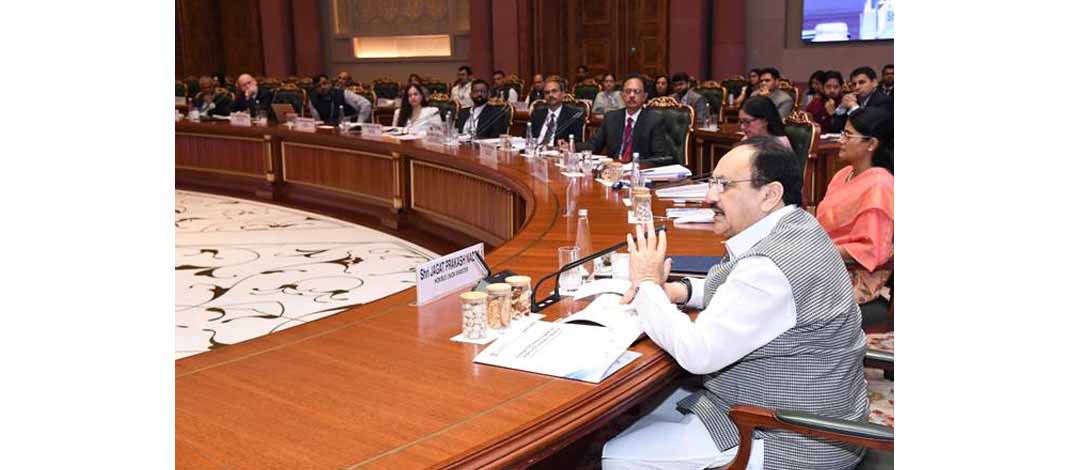
The roundtable, titled “India’s Chemicals Sector: Charting the Path to USD 1 Trillion by 2040,” was chaired by Union Minister for Health and Family Welfare and Chemicals and Fertilizers J.P. Nadda, in the presence of Minister of State for Health and Family Welfare and Chemicals and Fertilizers Anupriya Patel.
More than 100 delegates, including representatives of over 30 leading Indian and global chemical companies, participated in the deliberations. Major industry players represented included BASF, Tronox, ExxonMobil, Fujifilm, Lubrizol, Dow Chemicals, UPL, Reliance Industries, DCM Shriram, HMEL, SABIC and Haldia Petrochemicals, among others.
Focus on making India a global chemicals hub
The discussions centred on measures required to transform India into a globally competitive manufacturing, innovation and investment hub for chemicals and petrochemicals. Industry leaders highlighted the need for coordinated policy interventions, stronger infrastructure, technology development and greater investment support to unlock the sector’s potential.
Among the key issues raised were the creation of appropriate financing and investment-support mechanisms for capital-intensive upstream projects and the transformation of existing Petroleum, Chemicals and Petrochemicals Investment Regions (PCPIRs) into large-scale chemical manufacturing hubs with world-class infrastructure and utilities.
Industry representatives also called for stronger trade-remedial measures to ensure a level playing field for domestic manufacturers and protection against unfair trade practices.
Push for R&D, technology and global talent
Greater emphasis was placed on research and development, innovation and technology acquisition. Industry suggested introducing special tax incentives to attract global scientific and technical talent, along with the creation of a Sovereign Fund for technology acquisition, drawing on models followed by countries such as South Korea and the United States.
Participants also sought time-bound single-window clearances for chemical and petrochemical projects, given the multiple approvals required at both the Central and State levels.
Another major recommendation was the development of a comprehensive National Feedstock Policy to reduce the sector’s exposure to geopolitical uncertainties and disruptions in global supply chains.
Nadda calls for sustained investment and institutional dialogue
Addressing the gathering, J.P. Nadda reiterated the Government’s commitment to achieving the USD 1 trillion chemicals sector target by 2040. He stressed that reaching this milestone would require sustained investment, technological advancement and stronger domestic manufacturing capabilities.
Nadda said the Government would work towards establishing a continuous and institutionalised dialogue with the chemical industry to identify bottlenecks and translate industry suggestions into time-bound action.
He emphasised that the Government, under the leadership of Prime Minister Narendra Modi, is focused on creating an enabling environment for investment, innovation, sustainability and long-term industrial growth. He also assured industry representatives that the issues raised during the consultation would be taken up with the relevant stakeholder Ministries.
Government shifts from regulator to growth partner
Anupriya Patel highlighted recent Government initiatives aimed at strengthening domestic manufacturing, including measures related to Bhavya Rasayan, coal gasification, rare earth corridors, the Critical Mineral Mission, tax reforms and labour reforms.
She said the Government is committed to moving from being merely a regulatory facilitator to an active growth partner for industry, while reducing administrative burdens and creating greater certainty for long-term investments.
Tejveer Singh, Secretary, Department of Chemicals and Petrochemicals, underlined the significant opportunities emerging from India’s expanding domestic demand across downstream industries. He reaffirmed the Department’s commitment to working closely with industry in shaping future policy interventions and also responded to concerns raised by industry representatives.
India could increase global chemicals share from 3% to 10%
Nivruti Rai, MD & CEO, Invest India, said chemicals form the foundation of almost every major industry expected to drive growth over the coming decade.
She noted that India’s chemicals demand is growing at nearly twice the global rate, supported by emerging sectors such as electric vehicles, semiconductors, renewable energy and textiles.
According to Rai, the opportunity for India lies not merely in increasing production but in developing the chemicals required by next-generation industries. With appropriate technology partnerships, shared capital investment and deeper government-industry collaboration, she said India could potentially raise its share of global chemicals production from around 3% to 10%.
States pitch investment opportunities
The roundtable also featured discussions on global investment trends, foreign direct investment flows, State-level competitiveness and sector-specific opportunities. Invest India presented findings from an industry survey indicating strong interest among companies in making fresh investments in India’s chemicals sector.
Representatives from the governments of Odisha, Gujarat, Tamil Nadu and Andhra Pradesh also showcased policy packages and incentives offered by their respective States to attract chemical and petrochemical investments.
The recommendations emerging from the CEO roundtable are expected to contribute to future policy formulation, institutional reforms and investment facilitation measures. The consultation is aimed at promoting a coordinated “Whole of Government” approach to support India’s transformation into a globally competitive chemicals manufacturing and innovation hub and advance the country towards its USD 1 trillion chemicals sector ambition by 2040.
Related
Table of Contents
Toggle