
Anant Kumar /The Public World
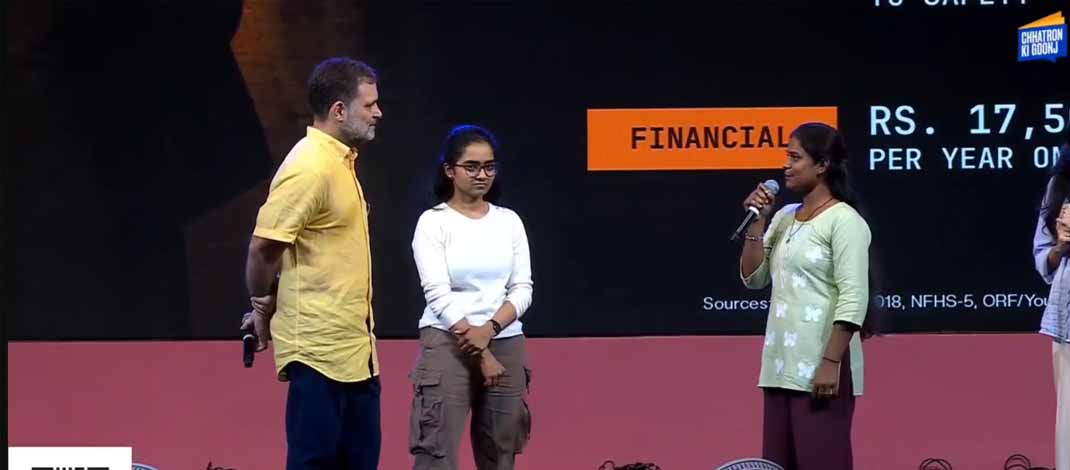
Pune : Leader of Opposition in the Lok Sabha and Congress MP Rahul Gandhi addressed a large gathering of women students in Pune under the ‘Chhatron Ki Goonj’ programme, urging young women to challenge social restrictions, assert their individuality and pursue their aspirations without being defined by traditional gender roles.
Speaking on the theme “Break the Cage”, Rahul Gandhi said the central message of the programme was that every woman is an individual with her own identity, dreams and vision for life.
He told the gathering that India’s greatest strength lies in the diverse aspirations, imagination and individual journeys of its women. He argued that women should not be defined solely through their relationships as daughters, wives or mothers, but should also be recognised as professionals, entrepreneurs, sportspersons, leaders and creators.
‘Women Should Be Independent’
 Rahul Gandhi said society often places women within narrowly defined roles and uses different forms of social pressure to influence their choices. Referring to his interpretation of the Manusmriti, he argued that India’s progress depends on ensuring that women are able to live independently, make their own decisions and have confidence in themselves.
He said women may have relationships with their fathers, brothers, husbands or sons, but their identity should not be reduced to those relationships.
Four Forms of Social Control
During his presentation, Rahul Gandhi spoke about what he described as four mechanisms through which women are controlled — violence, disrespect, restrictions on time and control over personal choices.
He said such restrictions are sometimes presented as concern for women’s safety and welfare, but can ultimately limit their freedom and opportunities.
On violence, he referred to several figures concerning female foeticide, harassment, physical violence and sexual violence against women. He also spoke about what he termed “opportunity violence”, where women may be prevented from pursuing education or employment in the name of security.
He further highlighted financial restrictions, including additional expenses women may have to bear for safer travel, which can affect their economic independence.
Restrictions on Mobility, Education and Property Rights
Rahul Gandhi also cited figures related to women’s mobility, education and financial ownership. He argued that restrictions on women’s ability to travel independently, continue education after marriage or family responsibilities and acquire property can limit their economic and social empowerment.
He called for a society in which women have greater freedom to determine their own futures rather than having major life decisions shaped by social expectations.
Women Students Share Personal Experiences
During the programme, women students also spoke about gender-based discrimination and the challenges they face in professional and personal life.
Law student and advocate Ramaprasad shared her experience of encountering stereotypes in the legal profession. She said women often receive fewer professional opportunities, networking opportunities and cases compared with men. She also recalled being told that investing in her LLM education was unnecessary because she might eventually leave legal practice to raise a family.
She said reducing her educational qualification to merely a line on her CV was deeply discouraging and delivered a message of self-confidence: “I don’t have to prove myself to any man.”
Another participant, Dhyaneshwari from Pune, who holds a Master’s degree in Culture, Media and Governance from Jamia University, Delhi, spoke about her experience following the death of her father from cancer three years ago.
She said that when women seek their rightful share in family property, their claims can become a source of conflict, whereas a brother’s claim is often treated as an unquestioned right.
Describing the situation as a manifestation of patriarchal attitudes, she argued that women continue to be treated as a secondary gender rather than as equal citizens.
The interaction in Pune focused on women’s independence, equal opportunities, personal choice and breaking social stereotypes, with Rahul Gandhi encouraging young women to recognise their individual potential and challenge barriers that restrict their aspirations.