
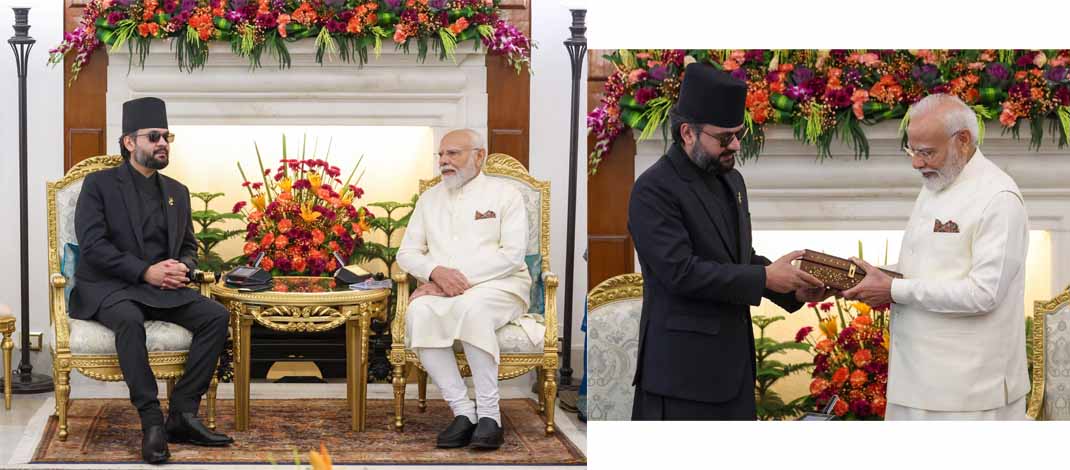
New Delhi: Nepali Prime Minister Balendra Shah is on an official visit to India. During the visit, he held talks with Prime Minister Narendra Modi, which produced the following outcomes.
Delegations
The Indian side included Foreign Minister Dr. S. Jaishankar, National Security Advisor Ajit Doval, Minister of State Jitin Prasada, Prime Minister Modi’s Principal Secretaries Dr. P. K. Mishra and Shaktikanta Das, Foreign Secretary Vikram Misri, Indian Ambassador to Nepal Sudhakar Dalela, and Additional Secretary Manu Mahawar, among others.
The Nepali delegation included Finance Minister Dr. Swarnim Wagle, Foreign Minister Shishir Khanal, the Prime Minister’s Chief Advisor Kumar Byanjankar, Political Advisor Asim Shah, Foreign Secretary Amrit Bahadur Rai, and Nepal’s Ambassador to India Dr. Nishchal Nath Pandey, among others.
Outcomes of the talks
1. Sarayu-Kamala Express flagged off. The rail service between Ayodhya and Janakpur will improve connectivity and boost religious and cultural tourism along the Ramayana Circuit. It also shows practical cooperation in railway services.
2. New border check posts. The foundation stone was laid for a new Integrated Check Post (ICP) at Banbasa, and construction is progressing at Bhairahawa, Sunauli and Dodhara Chandani. The upgrades will ease customs, immigration and logistics, make cross-border trade and movement of people more efficient, and strengthen economic links with far-western Nepal.
3. Cross-border bridge inaugurated. The new motorable bridge between Dharchula (India) and Darchula (Nepal) improves direct connectivity between western Nepal and India. It supports local trade, mobility, and social and cultural interaction.
4. Lower Arun Hydroelectric Project begins. The foundation stone was laid for the 669 MW project, which strengthens cooperation on electricity and transmission links. It also supports longer-term regional energy connectivity and hydropower development.
5. Motihari-Amlekhgunj Pipeline Phase II dedicated. The dedication consolidates petroleum supply and energy infrastructure cooperation between India and Nepal. It enables reliable and cost-effective movement of petroleum products through the cross-border pipeline.
6. Jhapa Petroleum Terminal foundation laid. The project strengthens India-Nepal cooperation in energy infrastructure. Through Indian grant assistance, it supports Nepal’s petroleum storage and distribution capacity.
7. Rs 15,000 crore assistance package. India announced a financial package of about USD 1.6 billion, made up of a Line of Credit and grant assistance. It reinforces India’s economic and development partnership with Nepal and provides a framework for sustained bilateral development engagement.
8. Two more Indian ports for Nepal’s transit cargo. Deendayal port (Kandla, Gujarat) and Paradip port (Odisha) were added. This reinforces India’s role as a key transit and logistics partner for Nepal and eases the movement of Nepal-bound cargo through India.
9. Agro-Industrial Park in Chitwan, Nepal. The park extends the India-Nepal economic and development partnership into agro-industrial activity. It supports cooperation in agricultural investment, production and value addition.
10. Offshore IIT campus in Nepal. The campus deepens cooperation in higher education, science, technology, technical training and research. It also builds stronger institutional and people-to-people links around Indian higher education.
11. Raxaul-Kathmandu rail survey finalised. The Field Location Survey for the proposed electrified broad-gauge line is complete, a preparatory milestone for cross-border rail connectivity. The line will support future trade, mobility and economic links between India and Nepal.
12. Forensic sciences MoU. Gujarat’s National Forensic Sciences University and the Crime Investigation Department of Nepal Police signed an agreement on academic and research collaboration. It promotes cooperation in teaching and research, including forensic biology, forensic chemistry, toxicology, serology, questioned documents and fingerprint examination.
13. Livestock and fisheries MoU. The agreement promotes cooperation in research and development and technology transfer. It also supports higher production and productivity in both sectors.
14. Health and medicine MoU. The agreement promotes pooling of technical, scientific, financial and human resources, and improves the quality and reach of healthcare. It also enhances cooperation in medical education, training and research.
15. Sustainable urban development MoU. The agreement builds long-term cooperation and encourages collaboration on the technical, policy, research and commercial aspects of sustainable urban development.
