
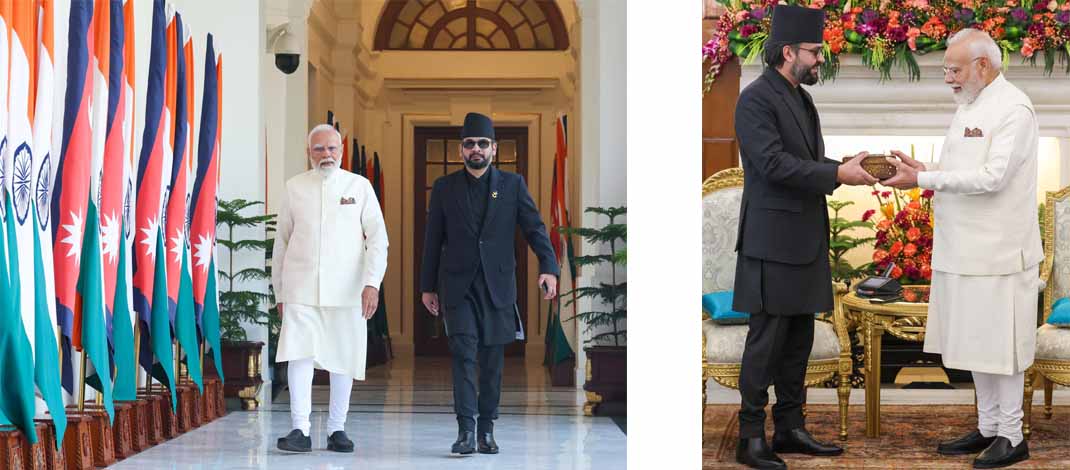
Narendra Modi and Balendra Shah advance bilateral cooperation in railway connectivity, hydropower, petroleum infrastructure and cross-border development
New Delhi : India and Nepal have taken significant steps towards strengthening their bilateral partnership, with Prime Minister Narendra Modi and Nepal Prime Minister Rt. Hon’ble Balendra Shah jointly inaugurating and laying the foundation stones for several development projects, including a new railway service connecting important destinations in the two countries.
The initiatives reflect the commitment of both governments to expanding cross-border connectivity, strengthening infrastructure, promoting economic cooperation and enhancing people-to-people relations.
Major infrastructure and connectivity initiatives
Among the important projects inaugurated and launched by the two Prime Ministers are:
1. Ayodhya–Janakpur Railway Service: The leaders virtually flagged off the Saryu-Kamala Express, connecting Ayodhya Cantonment in Uttar Pradesh with Janakpur Dham in Nepal. The railway connection is expected to facilitate religious tourism and strengthen cultural ties between the two countries.
2. Darchula-Dharchula Motorable Bridge: The inauguration of this bridge across the Mahakali River will improve cross-border transportation and connectivity between India’s Uttarakhand and Nepal.
3. Motihari-Amlekhgunj Petroleum Pipeline, Phase II: The project will further strengthen petroleum transportation infrastructure and facilitate a more efficient supply of fuel to Nepal.
4. Integrated Check Post at Banbasa: The foundation stone was laid for a new Integrated Check Post to improve cross-border trade, customs procedures and movement of people and goods.
5. Petroleum Storage Terminal in Jhapa: The proposed facility will strengthen Nepal’s petroleum storage capacity and improve fuel supply infrastructure.
6. Lower Arun Hydropower Project: The foundation stone was laid for the 669-MW hydropower project in Nepal, marking another important milestone in energy cooperation between the two neighbouring countries.
Cooperation across multiple sectors
The two countries also advanced cooperation through eight bilateral agreements covering areas such as space technology, security, healthcare, agriculture and sustainable urban development.
These agreements are aimed at strengthening institutional cooperation, sharing technical expertise and creating new opportunities for development-oriented partnerships.
India’s development assistance to Nepal
India also announced a development assistance package of approximately Nepalese Rs 240 billion to support reconstruction and development activities in Nepal following the devastating floods of August 2026.
The assistance is intended to support the rebuilding of damaged infrastructure, rehabilitation of affected communities and strengthening of disaster resilience.
Connectivity, energy and economic partnership
During their bilateral discussions, Prime Minister Narendra Modi and Prime Minister Balendra Shah reviewed the entire spectrum of India-Nepal relations and explored opportunities to expand cooperation in trade, investment, energy, hydropower, infrastructure, education, healthcare, agriculture and technology.
Railway connectivity, road infrastructure and cross-border transportation remain important priorities for both countries. Greater cooperation in hydropower generation and electricity trade is also expected to contribute to regional energy security and economic growth.
The Ayodhya-Janakpur railway connection carries particular cultural and religious significance, linking two important destinations associated with the Ramayana tradition. It is also expected to encourage pilgrimage tourism and strengthen the historical and civilisational bonds between India and Nepal.
The latest initiatives demonstrate the expanding scope of India-Nepal cooperation, with a focus on infrastructure development, energy security, trade facilitation, cultural connectivity and mutual economic growth.
