
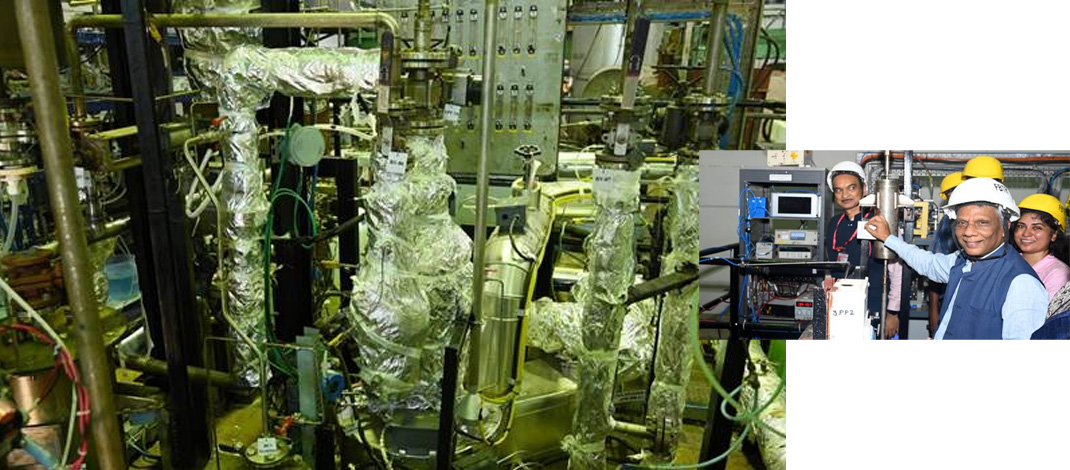
Kalpakkam (Tamil Nadu) : In a major milestone for India’s clean energy and advanced nuclear technology programme, the Department of Atomic Energy (DAE) on Thursday inaugurated the world’s first hydrogen production facility based on the Copper–Chlorine (Cu–Cl) thermochemical cycle using nuclear process heat from the Fast Breeder Test Reactor (FBTR) at the Indira Gandhi Centre for Atomic Research (IGCAR), Kalpakkam.
The facility was inaugurated by DAE Secretary and Chairman, Atomic Energy Commission (AEC), Dr. Ajit Kumar Mohanty, in the presence of IGCAR Director Shri Sreekumar G. Pillai.
Developed as a technology demonstrator, the plant validates hydrogen production through the indigenously designed Cu–Cl thermochemical process developed by the Bhabha Atomic Research Centre (BARC), Mumbai. Officials said the successful coupling of nuclear process heat with hydrogen generation marks a significant technological breakthrough with potential for large-scale, carbon-free hydrogen production using advanced nuclear reactors.
Hydrogen is widely viewed as a critical clean energy carrier for the future, with growing global focus on its role in decarbonisation. Among emerging production pathways, the Cu–Cl cycle is considered promising due to its comparatively lower operating temperatures and higher thermodynamic efficiency. By utilising nuclear heat from fast reactors, the process reduces reliance on fossil fuels and eliminates associated greenhouse gas emissions.
The project represents the outcome of extensive joint work by BARC and IGCAR, covering research, design, engineering, fabrication, installation and commissioning. The facility is expected to generate operational data, help optimise the process further, and support scaling up of nuclear-assisted hydrogen production technologies for future commercial use.
Speaking on the occasion, Dr. Mohanty said the integration of nuclear energy with hydrogen production represents a strategic step toward a sustainable energy future. He said nuclear power’s ability to provide carbon-free electricity and high-temperature process heat makes it uniquely suited for large-scale hydrogen generation, supporting India’s energy security and decarbonisation goals. He congratulated the scientists and engineers of BARC and IGCAR for turning an advanced concept into an operational reality.
IGCAR, a premier DAE research institution, has been central to India’s Fast Breeder Reactor programme since 1971. The centre developed and operated the Fast Breeder Test Reactor, which has played a key role in validating fuels, materials and sodium technologies for over four decades. The expertise gained through FBTR has contributed significantly to the development of the 500 MWe Prototype Fast Breeder Reactor (PFBR), a key component of India’s three-stage nuclear programme.
Director IGCAR, Shri Sreekumar G. Pillai, said the achievement builds on decades of experience in fast reactor technology and demonstrates the potential of advanced nuclear systems in supporting clean energy transitions.
Over the years, IGCAR has developed strong capabilities in reactor physics, thermal hydraulics, advanced materials, sodium technology, fuel cycle research, instrumentation, remote handling and high-temperature engineering, strengthening India’s position in global nuclear research.
The inauguration of the facility is seen as a step forward in aligning nuclear innovation with clean hydrogen development, reinforcing India’s push towards AtmaNirbhar Bharat and a low-carbon energy future under the vision of Viksit Bharat.