
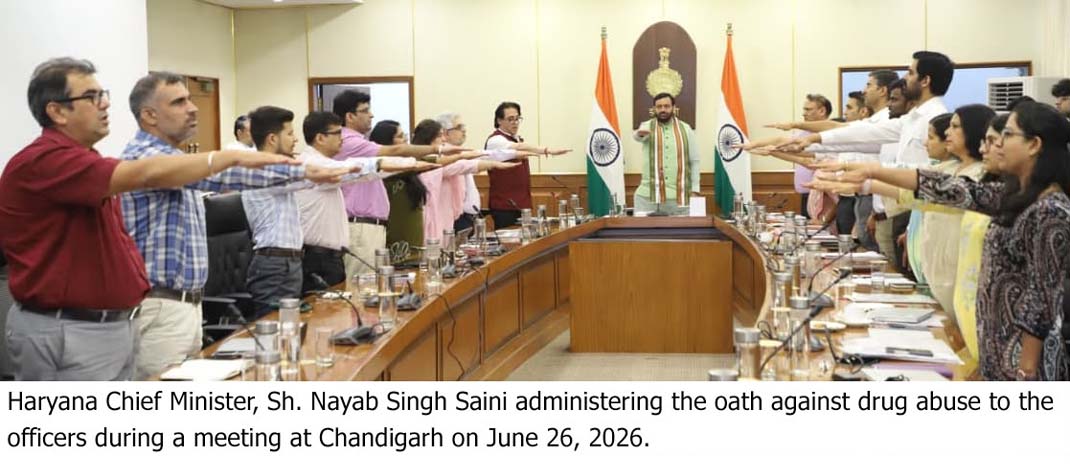
Chandigarh/New Delhi : Haryana Chief Minister Nayab Singh Saini on Thursday announced that Joint Task Forces (JTFs) will be constituted in both rural and urban areas across the state to strengthen the fight against drug abuse and dismantle narcotics networks.
Chairing a review meeting of the Social Justice, Empowerment, Welfare of Scheduled Castes and Backward Classes, and Antyodaya (SEWA) Department under the Haryana Vision-2047 roadmap, the Chief Minister said the task forces would conduct special drives to curb the sale of narcotics and ensure strict action against drug traffickers.
“The task forces will be empowered to such an extent that drug peddlers will fear enforcement and abandon such illegal activities,” he said, while also administering an anti-drug pledge to officials present at the meeting.
The Chief Minister emphasised that breaking the drug supply chain is essential to eliminate drug abuse from the state. He directed that rural-level task forces should comprise Sarpanches, Ward Members, Block Development Officers (BDOs), Station House Officers (SHOs) and representatives of local NGOs. In urban areas, the JTFs will include Municipal Secretaries, Ward Councillors, Health and Hygiene Officers (HHOs), and NGO representatives. These teams will identify drug hotspots and ensure prompt action against those involved in the illegal trade.
To strengthen rehabilitation efforts, the Chief Minister directed that more de-addiction and rehabilitation centres be established across Haryana. He said individuals completing treatment should be monitored for three months after discharge to prevent relapse. He also called for skill development and employment plans to help recovering addicts reintegrate into society.
Additional Chief Secretary of the SEWA Department, G. Anupama, informed that Haryana currently has 119 de-addiction centres, 29 rehabilitation centres and two mental health hospitals. A new rehabilitation centre spread over six acres will be developed in Kurukshetra under the Public-Private Partnership (PPP) model. She also informed that the department has developed a Drug Addict Monitoring System to track recovered individuals and reduce the risk of relapse.
Reviewing welfare schemes, the Chief Minister directed officials to create a mechanism allowing beneficiaries to update their personal and family details to ensure that no eligible person is deprived of pensions or other benefits. Verification of such requests will be carried out under the chairmanship of the Additional Deputy Commissioner in each district. He also expressed satisfaction over the inclusion of 63,000 new beneficiaries under pension schemes during the past three months.
The meeting also reviewed initiatives for persons with disabilities. The Chief Minister directed that institutions working for children with disabilities be registered and a policy be framed to provide grants to organisations undertaking commendable work. He also stressed the need to ensure reservation benefits in government jobs for persons with disabilities and called for specialised training programmes for teachers of children with special needs.
To improve the quality of life for senior citizens, Mr. Saini directed that Senior Citizen Clubs be established in every district. These centres will provide recreational facilities, counselling, physiotherapy services and trained caregivers. In the first phase, 1,000 caregivers will receive training through Shri Vishwakarma Skill University and other private universities. He also directed the registration of NGOs working for senior citizens to facilitate government support.
Reviewing scholarship schemes, the Chief Minister said the application and verification processes for students belonging to Scheduled Castes, Backward Classes and Economically Weaker Sections (EWS) have been digitised to ensure timely disbursement. He directed officials to clear pending scholarship payments from previous years and establish hostels in every district to support students from remote areas pursuing higher education.
The Chief Minister also reviewed the implementation of the Lado Lakshmi Yojana and clarified that women benefiting under the scheme would continue to remain eligible for pensions and other welfare programmes. He urged all eligible women to register, stating that there is no shortage of funds for the scheme. The allocation has been increased from ₹5,000 crore last year to ₹6,500 crore in the current budget.
The meeting further reviewed Chief Minister’s announcements relating to the establishment of a 100-bed de-addiction centre at Sant Sarsai Nath Medical College in Sirsa, expansion of the Dabwali de-addiction centre from 10 to 30 beds, a new 20-bed de-addiction centre in Ellenabad, and the construction of the Samriddh Seva Ashram at Samspur.
In addition, the Chief Minister reviewed several welfare commitments, including linking pension revisions to inflation, setting up a Welfare Board for Backward Classes, providing credit guarantees to entrepreneurs from Backward Classes, strengthening the Mukhyamantri Vivah Shagun Yojana, and increasing family income limits under scholarship schemes. He directed officials to ensure their timely implementation.