
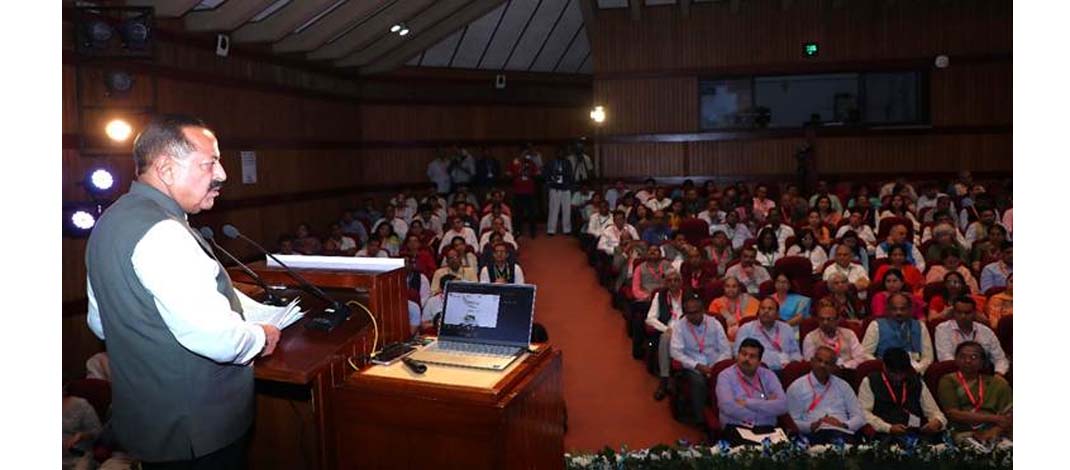
New Delhi : Jitendra Singh, Union Minister of State (Independent Charge) for Science & Technology, Earth Sciences, PMO, Personnel, Public Grievances, Pensions, Atomic Energy and Space, today stated that a major share of independent India’s technological transformation has taken place during the last decade due to decisive policy reforms, strong political backing for science and technology, greater research freedom, and increased participation of the private sector. He noted that while India always possessed exceptional scientific talent and capable human resources, science and innovation received unprecedented national priority after 2014, resulting in rapid technological progress across multiple sectors.
Addressing the inaugural session of “Vigyan TECH 2026” organised on the occasion of National Technology Day at BRIC-NII, Dr. Jitendra Singh highlighted the remarkable expansion of India’s innovation ecosystem over the past decade. He informed that the country’s startup ecosystem has grown from merely 350–400 startups in 2014 to more than two lakh startups today, making India the world’s third-largest startup ecosystem. He also pointed out that India’s ranking in the Global Innovation Index improved significantly from 80 to 38, while the country now ranks sixth globally in patents, with more than one lakh patents filed, over 55 percent of them by Indian residents. According to the Minister, India has also emerged among the world’s leading nations in scientific publications and innovation-driven research.
During the event, Dr. Jitendra Singh inaugurated a technology exhibition and interacted with exhibitors participating in the day-long programme themed “Building India’s Innovation Ecosystem for Viksit Bharat.” The event brought together fourteen Ministries and Departments associated with science, technology, and research on a common platform for the first time, showcasing India’s growing emphasis on collaborative and integrated scientific advancement.
The programme also witnessed the release of the compendium “TECH-संग्रह,” featuring indigenous technologies developed by autonomous institutes and laboratories under participating Ministries and Departments. The event further included technology transfer initiatives and exchange of Memorandums of Understanding aimed at promoting innovation and industry collaboration.
Among the prominent dignitaries present at the event were Ajay Kumar Sood, Principal Scientific Adviser to the Government of India; Rajesh S. Gokhale, Secretary, Department of Biotechnology, DG BRIC and Chairman BIRAC; and M. Ravichandran, Secretary, Ministry of Earth Sciences, along with senior officials from institutions such as DST, CSIR, ICMR, and NITI Aayog.
A special message from Narendra Modi was also read out during the programme by Dr. Rajesh S. Gokhale. In his message, the Prime Minister extended greetings on National Technology Day and appreciated the coming together of multiple science Ministries and Departments on a single platform to strengthen India’s innovation, research, and technology ecosystem.
Highlighting several landmark scientific initiatives launched in recent years, Dr. Jitendra Singh referred to programmes such as the National Quantum Mission, India AI Mission, Anusandhan National Research Foundation, Research Development and Innovation initiative, WISE-KIRAN scheme for women scientists, and the NIDHI programme for startups. He said these initiatives have significantly expanded opportunities for innovation, entrepreneurship, and inclusive scientific growth across the country.
The Minister also spoke about administrative reforms aimed at granting greater autonomy and flexibility to scientific institutions. He highlighted measures such as liberalised procurement norms and delegation of Global Tender Inquiry exemption powers to institute directors, which have accelerated research and innovation activities. Stressing the need for deeper collaboration, Dr. Jitendra Singh called upon scientific institutions to move beyond intra-ministerial coordination and adopt wider inter-science integration so that organisations working on areas such as vaccines, genomics, and emerging technologies can collaborate for larger national outcomes.
Referring to Prime Minister Narendra Modi’s recent seven-point public appeal, the Minister urged the scientific community to adopt responsible and efficient practices, including avoiding unnecessary foreign travel wherever possible. He stated that science and technology would remain central to every aspect of India’s journey towards becoming a developed nation by 2047, adding that every major contribution towards “Viksit Bharat” would be directly or indirectly linked to scientific advancement and innovation.
In his address, Prof. Ajay Kumar Sood described the event as a landmark “whole-of-government” initiative for Indian science and stressed that convergence of technologies and collaborative efforts across Ministries and institutions are essential for addressing national challenges related to health, climate change, defence, agriculture, and emerging technologies.