
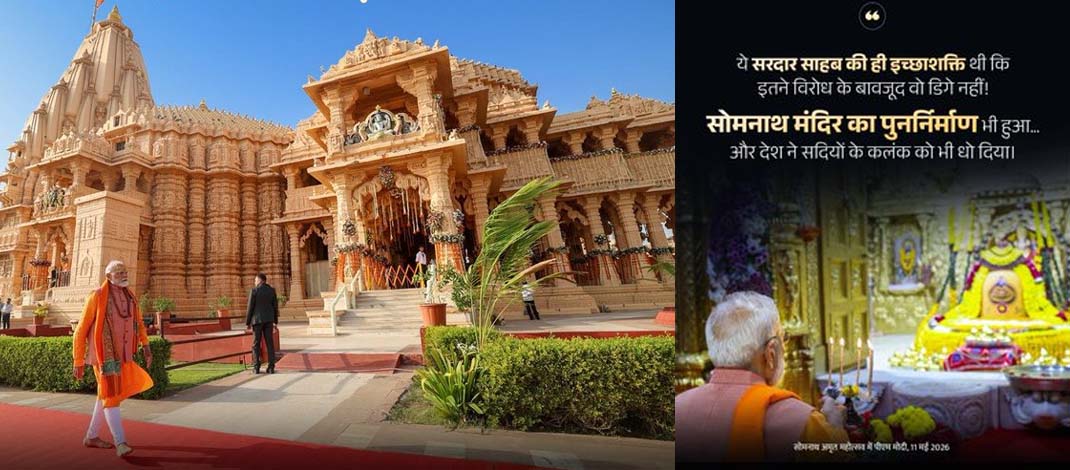
New Delhi : Narendra Modi today participated in the Somnath Amrut Mahotsav, commemorating 75 years since the consecration of the restored Somnath Temple in Gujarat. Addressing a grand gathering at the temple complex, the Prime Minister described the occasion as not merely a ceremonial celebration, but a powerful symbol of India’s enduring civilizational consciousness, spiritual strength, and cultural resilience. Amid Vedic chants, cultural performances, and the rhythmic sound of ocean waves, the celebrations reflected a unique blend of devotion, heritage, and national pride.
Invoking ancient scriptural wisdom, Shri Modi emphasized that Somnath represents the eternal spirit of India that has withstood centuries of destruction and emerged stronger each time. Recalling his personal connection with the sacred shrine, the Prime Minister said he had visited the temple countless times as a devotee and described the occasion as a deeply emotional journey through history and faith. Referring to the significance of the 1951 consecration ceremony, held just a few years after India attained independence, he stated that the restoration of Somnath symbolized the awakening of an independent India’s cultural identity and self-confidence.
The Prime Minister drew parallels between the reconstruction of Somnath and the nation-building vision of Sardar Vallabhbhai Patel, who not only unified more than 500 princely states but also resolved to restore the historic temple. Shri Modi remarked that Somnath’s revival sent a message to the world that India was reclaiming its ancient glory and spiritual heritage after centuries of foreign invasions and suppression. He stated that the temple stands today as a symbol of truth, resilience, and the indestructible spirit of the nation.
Highlighting the broader significance of the celebrations, Shri Modi said the Somnath Amrut Mahotsav was not only a remembrance of the past but also an inspiration for the next thousand years of India’s journey. He noted that the occasion coincided with the anniversary of India’s 1998 Pokhran nuclear tests, also known as Pokhran-II or Operation Shakti. Recalling the leadership of former Prime Minister Atal Bihari Vajpayee, he said the nuclear tests demonstrated India’s scientific capability, strategic confidence, and unwavering resolve in the face of international pressure. The Prime Minister explained that the operation was named “Shakti” to reflect India’s cultural tradition of worshipping both Shiva and Shakti together, symbolizing strength, balance, and progress.
Tracing the thousand-year history of the Somnath Temple, the Prime Minister recalled how the shrine was repeatedly attacked and rebuilt by devoted rulers and communities who preserved the nation’s spiritual identity despite repeated invasions. He paid tribute to the contributions of several rulers, saints, scholars, and social reformers who played a role in preserving Somnath’s legacy over centuries. Shri Modi also remembered modern visionaries such as Sardar Patel, Rajendra Prasad, and K. M. Munshi for their determination and efforts in rebuilding the temple after Independence.
Expressing concern over divisive forces that continue to oppose India’s cultural resurgence, the Prime Minister stressed the need to move forward by balancing development with heritage conservation. He said that cultural and spiritual sites are not obstacles to modern progress but important centers of social, economic, and national transformation. Highlighting the rapid development of pilgrimage infrastructure in recent years, he referred to projects such as the redevelopment of Kedarnath, Kashi Vishwanath Dham, Mahakal Mahalok in Ujjain, the Chardham highway project, the Kartarpur Corridor, and the Buddhist Circuit. According to the Prime Minister, these initiatives have strengthened tourism, generated employment opportunities, and reinforced India’s cultural identity on the global stage.
Calling for the preservation of India’s spiritual and cultural traditions for future generations, Shri Modi emphasized that reconnecting youth with the nation’s heritage would strengthen India’s confidence and unity. He concluded by stating that the journey that began with Somnath’s consecration 75 years ago must now be carried forward with renewed commitment, ensuring that India continues to progress while remaining firmly rooted in its timeless values and traditions.