
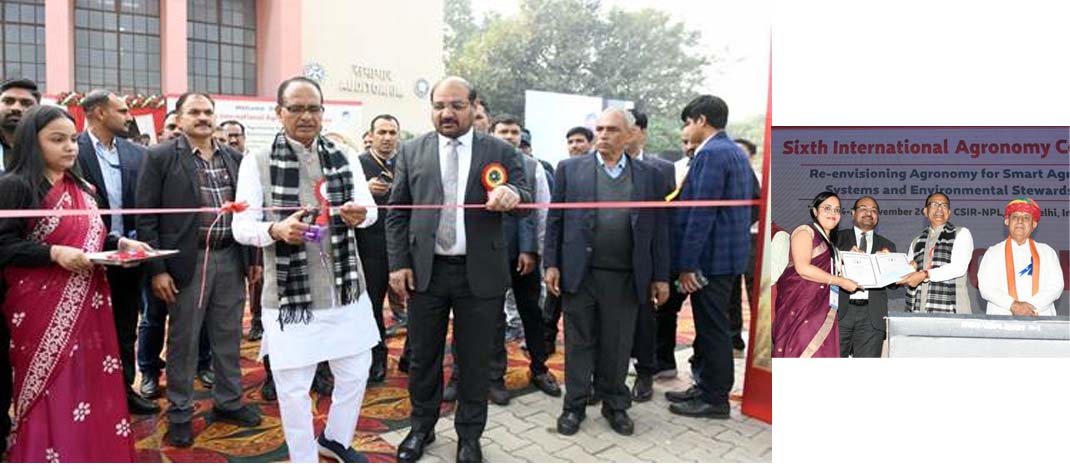
New Delhi : The 6th International Agronomy Congress (IAC–2025) commenced today at the NPL Auditorium, Pusa Campus, New Delhi, in the presence of Union Minister of Agriculture & Farmers’ Welfare, Shivraj Singh Chouhan. The three-day global event, scheduled from 24–26 November, is being organized by the Indian Society of Agronomy (ISA) in collaboration with the Indian Council of Agricultural Research (ICAR), the Indian Agricultural Research Institute (IARI), the National Academy of Agricultural Sciences (NAAS), and the Trust for Advancement of Agricultural Sciences (TAAS).
The Congress has brought together over 1,000 participants, including scientists, policymakers, students, development organizations, and industry leaders from India and across the world. Representatives from leading international institutions—such as FAO, CIMMYT, ICRISAT, IRRI, ICARDA, and the International Fertilizer Development Center (IFDC)—are also taking part in the deliberations.
Delivering the inaugural address, Shivraj Singh Chouhan emphasised that the roadmap for Viksit Bharat @2047 is rooted in smart, sustainable, and profitable agriculture. Highlighting the importance of efficiency and conservation, he stated, “Agriculture must progress toward producing more with fewer resources while preserving the environment for future generations. Agronomy serves as the bridge between scientific innovation and the farmer’s field.” He underscored priority areas including soil health enhancement, improved water-use efficiency, biodiversity conservation, eco-nutrition, and the adoption of digital agriculture. The Minister also announced that the recommendations emerging from the Congress would be incorporated into national agricultural policies and regional developmental strategies.
During the inaugural session, the Union Minister released the IAC–2025 Declaration, outlining key recommendations such as:
-
Advancing soil-carbon sequestration and water-efficient farming
-
Scaling up AI-driven digital agriculture and the Agri-Stack framework
-
Mainstreaming natural and regenerative farming systems
-
Launching targeted innovation programmes for youth and women farmers
-
Introducing next-generation agronomy curricula at schools and universities
-
Promoting One-Health, LiFE Mission, and Net-Zero 2070 aligned agricultural strategies
-
Strengthening India’s global leadership in climate-smart agricultural models
Minister of State for Agriculture, Bhagirath Choudhary, reiterated that agronomy must evolve into a practical solution for farmers’ real-world challenges. He noted that agronomic innovations should aim to improve farmer incomes, environmental sustainability, and nutritional outcomes. He stressed the importance of ensuring that advanced technologies reach diverse agro-ecological regions—from the arid districts of Rajasthan to the hilly terrains of Uttarakhand. He further highlighted the significance of rainfed agriculture, inclusive participation of women and youth, natural resource management, and rural micro-enterprise development.
The Congress features ten thematic symposia, showcasing scientific presentations on:
-
Climate-resilient and carbon-neutral agriculture
-
Nature-based solutions and One-Health approaches
-
Precision input management and resource-use efficiency
-
Harnessing genetic potential for improved productivity
-
Energy-efficient machinery, digital technologies, and post-harvest management
-
Nutrition-sensitive agriculture and eco-nutrition
-
Gender empowerment and livelihood diversification
-
Agriculture 5.0, future-ready education, and Viksit Bharat 2047
-
Young scientists’ and students’ innovations
These sessions aim to outline new pathways for advancing SDG-1, SDG-2, SDG-12, SDG-13, and SDG-15 through agronomy-led solutions.
Speaking on the occasion, Dr. M.L. Jat, Secretary (DARE) & Director General (ICAR), stated that India’s agronomy research continues to propel global climate-smart agriculture. He noted that the outcomes of IAC–2025 will make significant contributions to the ICAR Vision–2050 roadmap.
The Congress is expected to further strengthen international collaborations with G20, FAO, CGIAR, and through various South–South Cooperation initiatives, paving the way for a more resilient and sustainable global agricultural future.