
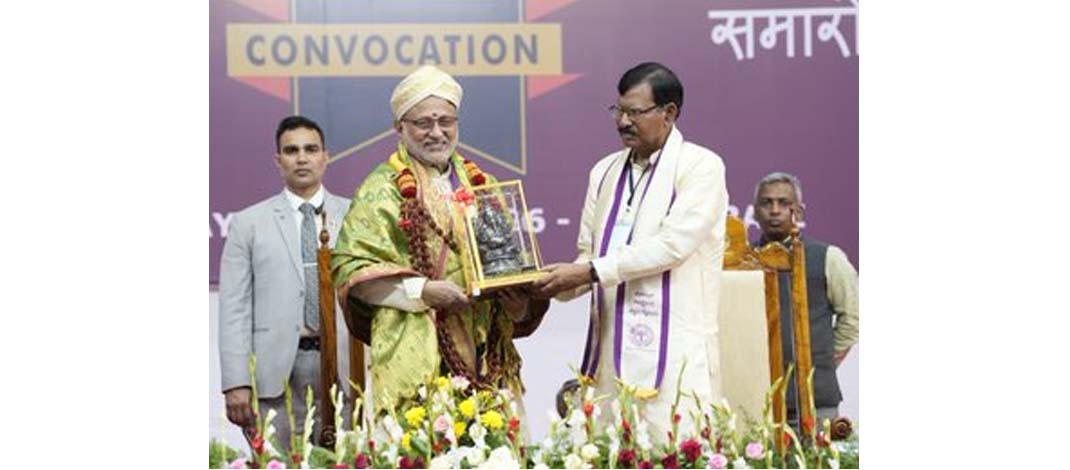
New Delhi/ Kalaburagi : The Vice President of India, C. P. Radhakrishnan, addressed the 10th convocation ceremony of Central University of Karnataka in Kalaburagi, Karnataka, where he congratulated graduating students and urged them to contribute meaningfully to society and the nation as they embark on a new journey.
Emphasizing India’s progress, he described the present moment as pivotal for the country’s future and referred to the vision of “Viksit Bharat” championed by Narendra Modi as a collective national mission. He encouraged young graduates to innovate, uphold integrity, and actively participate in nation-building efforts.
Highlighting the importance of self-reliance, he spoke about the “Aatma Nirbhar Bharat” initiative, stressing the need to strengthen domestic capabilities, promote innovation, and support local enterprises while remaining globally competitive. He also urged students to continuously upgrade their skills and adapt to evolving technologies in a rapidly changing world.
On women’s empowerment, the Vice President noted the increasing presence of women in academic excellence, pointing out that over 80 percent of gold medalists at the university this year are women. He described this as a reflection of the growing strength of “Nari Shakti” and a positive shift towards greater equality and leadership.
Addressing global challenges such as climate change, technological disruption, and social inequalities, he encouraged students to approach them with courage and creativity, and to measure success by their impact on society rather than personal achievements alone.
He also advised graduates to remain connected to India’s rich cultural heritage while embracing modern and global perspectives. Appreciating the contributions of parents, teachers, and the university administration, he urged students to stay resilient, learn from failures, and work with dedication towards building a developed and self-reliant India.
The ceremony was attended by Thaawarchand Gehlot, Vice-Chancellor Prof. Satya Narayana, along with faculty members, staff, parents, and students.
Related
Table of Contents
Toggle