
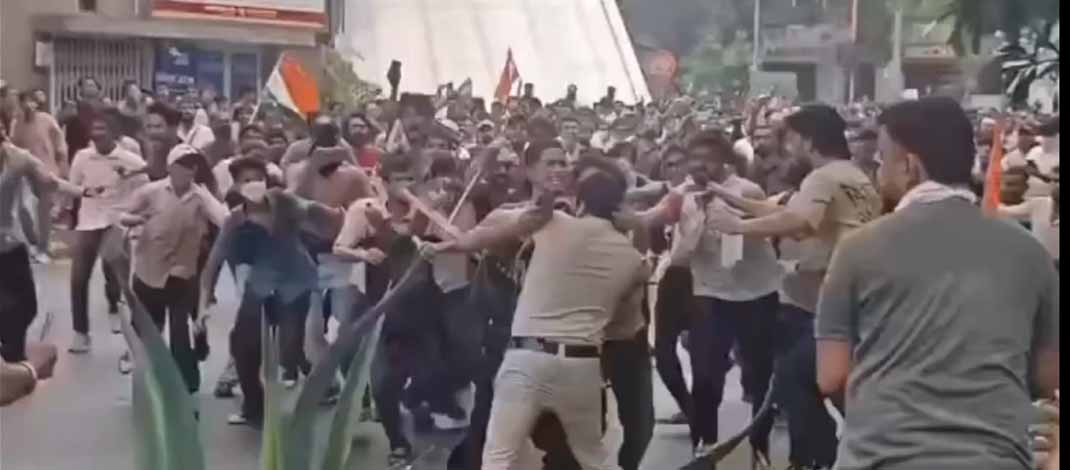
New Delhi : The first day of Parliament’s Monsoon Session witnessed intense disruptions both inside and outside the House, with the opposition raising strong objections over various issues, while large-scale protests over the NEET UG examination controversy led to clashes between demonstrators and security forces in the national capital.
The Lok Sabha and Rajya Sabha proceedings were repeatedly adjourned due to opposition protests. Meanwhile, outside Parliament, a large group of students and activists attempted to march towards the Parliament complex from Jantar Mantar, demanding action over alleged irregularities and paper leak claims linked to the NEET UG examination.
Security Tightened as Protesters March Towards Parliament
Ahead of the protest march, security agencies deployed heavy security arrangements and installed barricades at several locations to prevent protesters from entering restricted areas.
However, despite the restrictions, several protesters reached close to the outer area of Parliament, creating a tense situation. Some entry gates of Parliament were temporarily closed as a precautionary measure.
Clashes broke out at multiple locations between protesters and police personnel. To control the situation, security forces used baton charges and tear gas shells. By evening, authorities managed to bring the situation under control, and Jantar Mantar, which remained the centre of the protest throughout the day, was cleared with only security personnel remaining deployed.
Videos of Protests Circulate on Social Media
Several videos from the protest went viral on social media platforms, showing crowds raising slogans, moving towards Parliament, and security personnel attempting to stop them.
Reports also suggested heightened security deployment around areas such as Rajiv Chowk Metro Station and other sensitive locations to manage crowd movement.
The Rapid Action Force (RAF) was deployed near Le Meridien Hotel to assist in maintaining law and order. Around 4:40 PM, security forces carried out action to disperse the crowd.
SP MP Dimple Yadav Joins Protesters
Among the prominent political figures present during the demonstration was Samajwadi Party MP Dimple Yadav, who extended support to the protesting students.
One of the widely discussed visuals of the day showed Dimple Yadav meeting injured protesters at Jantar Mantar and inquiring about their condition.
During the afternoon, amid rainfall, police personnel were seen removing protesters and taking some into custody near Parliament. At Jantar Mantar, tear gas was used to disperse crowds after repeated attempts to convince protesters to move peacefully.
Government Holds Dialogue with Protesters
Amid the escalating situation, Union Health Minister J.P. Nadda held an important meeting with a delegation representing the protesters.
The meeting began at 11:50 AM and continued for nearly two-and-a-half to three hours. After discussions, the protesters submitted a written memorandum to the Union Minister at around 4 PM.
J.P. Nadda said that this was the first time the protesters had proposed talks with the government. He stated that the meeting took place in a cordial atmosphere, with detailed discussions held with the delegation.
The Union Minister appealed to all protesters to end their sit-in demonstration and cooperate with the administration in restoring normalcy.
NEET UG Controversy at the Centre of the Movement
The NEET UG examination controversy became the main trigger behind the protests.
The NEET UG exam held on May 3 witnessed participation from around 22 lakh students. Following allegations of paper leaks and irregularities, the examination was cancelled and a re-examination was conducted on June 21, 2026, in which nearly 20 lakh candidates appeared, while around two lakh students did not participate.
The controversy has raised serious questions over the transparency and credibility of India’s examination system.
Sonam Wangchuk Joins the Protest Movement
The protest movement began at Jantar Mantar on June 20 over demands related to NEET UG reforms.
Social activist and educationist Sonam Wangchuk joined the protest on June 28, beginning a hunger strike in support of the protesters’ demands. The movement gradually gained national attention, with several opposition leaders visiting the protest site.
Former Delhi Chief Minister Arvind Kejriwal and Congress leaders also extended support to the protesters by visiting Jantar Mantar.
Delhi Police Appeals for Peace
The Delhi Police repeatedly appealed to protesters to maintain peace and conduct demonstrations in a lawful manner.
The police also urged citizens not to believe or spread rumours, misinformation, or unverified information on social media and advised people to rely only on credible sources.
The NEET UG controversy has now emerged as one of the major political issues during the Monsoon Session of Parliament, with attention focused on further dialogue between the government and protesters.
Related
Table of Contents
Toggle