
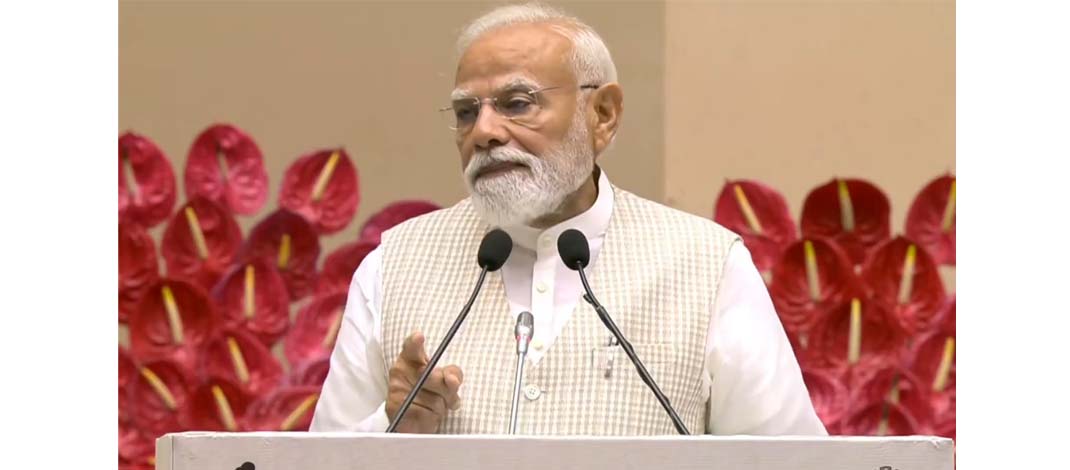
New Delhi : Prime Minister Narendra Modi addressed the Nari Shakti Vandan Programme at Vigyan Bhawan on April 13, 2026, underlining a transformative moment for women’s empowerment in India. The address coincided with the auspicious festival of Baisakhi and upcoming New Year celebrations in various regions, while also paying homage to the martyrs of the Jallianwala Bagh massacre.
Calling the occasion historic, the Prime Minister stated that India stands on the brink of taking one of the most significant decisions of the 21st century—dedicated to strengthening Nari Shakti. He emphasized that Parliament is poised to script a new chapter that reflects both the aspirations of the past and the vision for the future. Stressing the importance of social justice, he noted that the country aims to build an egalitarian society where justice becomes a lived reality rather than a mere slogan.
Recalling the unanimous passage of the Nari Shakti Vandan Act in 2023, the Prime Minister highlighted the collective political will behind the legislation, with all parties agreeing on its implementation by 2029. He informed that a special session of Parliament’s Budget Session will commence on April 16 to further advance this objective. He reiterated that the process would be guided by dialogue, cooperation, and participation, thereby enhancing the dignity and effectiveness of Parliament.
The Prime Minister acknowledged the growing enthusiasm among women across the country, noting that many are now aspiring to enter legislative bodies such as state assemblies and the Lok Sabha. He encouraged women to actively engage in the democratic process by interacting with their Members of Parliament and sharing their expectations and perspectives.
Reflecting on history, Shri Modi highlighted the pivotal role played by women during the freedom struggle and in the Constituent Assembly, stating that their contributions laid a strong foundation for modern India. He observed that women continue to hold key leadership positions in the country today, contributing significantly across sectors.
Citing grassroots governance as a powerful example, the Prime Minister pointed out that over 14 lakh women are actively participating in Panchayati Raj institutions, with nearly 50 percent representation in about 21 states. He remarked that this level of participation has drawn global attention and strengthened India’s democratic credentials.
The Prime Minister also noted that increased participation of women in decision-making has brought greater sensitivity to governance, particularly in areas such as water, education, health, and nutrition. He cited the success of initiatives like the Jal Jeevan Mission as evidence of the positive impact of women’s involvement at the grassroots level.
Highlighting the readiness of women for greater responsibilities, Shri Modi stated that those with experience in local governance are well-prepared to take on larger roles. The implementation of the Nari Shakti Vandan Act, he said, will facilitate a smoother transition from Panchayats to Parliament, opening new avenues for leadership.
Emphasizing the central role of women in the vision of a developed India (Viksit Bharat 2047), the Prime Minister outlined a range of government initiatives aimed at supporting women at every stage of life. These include the Beti Bachao Beti Padhao to address gender imbalance, the Pradhan Mantri Matru Vandana Yojana for maternal health, and the Sukanya Samriddhi Yojana to promote girls’ education and financial security.
He further elaborated on initiatives such as Mission Indradhanush for immunization, sanitation efforts under the Swachh Bharat Mission, and access to affordable healthcare through the Ayushman Bharat Yojana. Schemes like Pradhan Mantri Ujjwala Yojana and the Har Ghar Jal initiative have also significantly improved the quality of life for women across the country.
On economic empowerment, the Prime Minister highlighted that policies such as the Pradhan Mantri Awas Yojana have prioritized property ownership for women, benefiting over 3 crore women in the past decade. He also noted the success of the Pradhan Mantri Jan Dhan Yojana, which has brought millions of women into the formal banking system, and the Pradhan Mantri Mudra Yojana, where women account for a majority of beneficiaries.
Highlighting progress in entrepreneurship and innovation, Shri Modi shared that nearly 45 percent of startups in India have at least one woman director. He also pointed to initiatives like the Skill India Mission and the emergence of “Drone Didis” as examples of women leveraging technology for economic advancement.
The Prime Minister further noted that around 10 crore women have joined self-help groups, with over 3 crore achieving the status of “Lakhpati Didis,” contributing significantly to rural economic growth and promoting the Vocal for Local movement.
Celebrating achievements in education and new-age sectors, he highlighted that women now constitute nearly half of higher education enrollment, with a significant presence in STEM fields. He also noted that India has one of the highest proportions of women pilots globally, showcasing changing societal dynamics.
Addressing concerns around women’s safety, the Prime Minister outlined key legal reforms, including provisions under the Bharatiya Nyaya Sanhita. He emphasized measures such as fast-track courts, simplified FIR procedures including e-FIR and Zero-FIR, and the use of audio-video recording to ensure justice delivery is more efficient and sensitive.
Reaffirming the government’s commitment, Shri Modi assured that every effort is being made to support the aspirations of women across the country. He urged citizens to collectively strengthen women’s participation in decision-making processes and called upon women to spread awareness about the Nari Shakti Vandan initiative at the grassroots level.
Concluding his address, the Prime Minister emphasized that empowering women is essential for building a strong and prosperous India. He called for a collective resolve to ensure that women are not only given their rightful place but also become equal partners in shaping the nation’s future.