
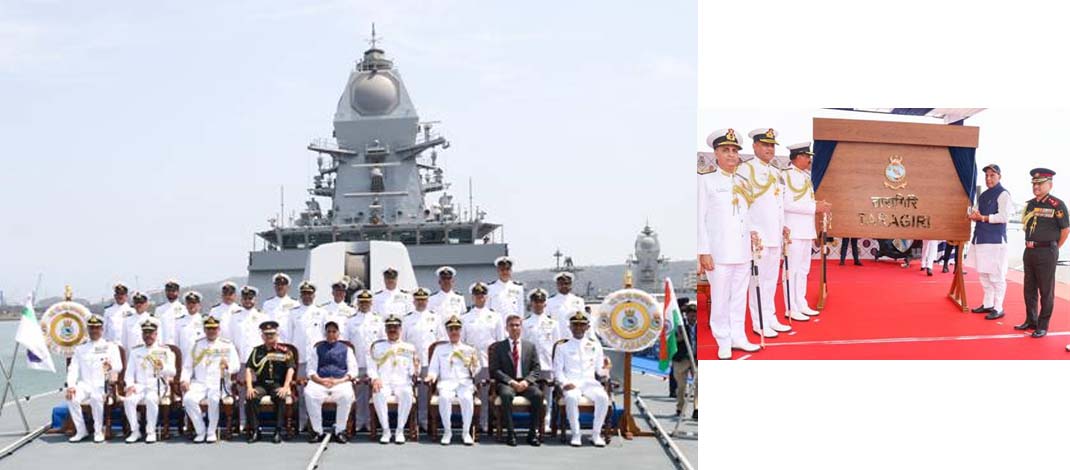
New Delhi / Visakhapatnam : In a major milestone for India’s maritime strength, the Indian Navy commissioned its latest stealth frigate, INS Taragiri, on April 3, 2026, at Visakhapatnam in the presence of Defence Minister Rajnath Singh.
Part of the advanced Project 17A class, the warship represents a new generation of indigenous naval platforms. Designed by the Warship Design Bureau and constructed by Mazagon Dock Shipbuilders Limited, the frigate has been built with over 75% indigenous components, reflecting India’s growing self-reliance in defence manufacturing.
Weighing around 6,670 tonnes, INS Taragiri is engineered for multi-role operations, combining stealth features with cutting-edge combat capabilities. Its reduced radar signature enhances survivability in hostile environments, while its arsenal—including supersonic cruise missiles and advanced air defence systems—makes it a formidable presence at sea.
A Symbol of Self-Reliance and Strategic Strength
Addressing the ceremony, Rajnath Singh described the warship as more than just a naval asset, calling it a reflection of India’s technological advancement and strategic confidence. He noted that the ship is capable of sustained high-speed deployment, equipped with modern surveillance and combat systems, and suited for a wide range of missions—from high-intensity warfare to anti-piracy and humanitarian operations.
He emphasized that with over 95% of India’s trade dependent on maritime routes and a coastline stretching beyond 11,000 km, a strong navy is essential for national security and economic stability.
Strengthening India’s Role in the Indo-Pacific
Highlighting the evolving security dynamics in the Indian Ocean Region, Singh said the Indian Navy maintains continuous vigilance to ensure safe passage of global trade and energy supplies. He also pointed to emerging threats, including risks to undersea data cables, stressing the need for a broader, future-ready maritime security approach.
The commissioning of INS Taragiri, he added, reinforces India’s capability to safeguard not only its own interests but also contribute to regional peace and stability.
Boost to Indigenous Defence Ecosystem
The warship showcases India’s expanding defence industrial base, with contributions from over 200 MSMEs. It is powered by a sophisticated Combined Diesel or Gas propulsion system and features an integrated platform management system, ensuring operational flexibility and efficiency.
India’s defence exports, which have surged to nearly ₹39,000 crore in FY 2025–26 from just ₹1,200 crore over a decade ago, further underline the country’s progress towards self-reliance under the leadership of Prime Minister Narendra Modi.
Legacy and Future Vision
Chief of Naval Staff Dinesh K Tripathi recalled the legacy of the earlier INS Taragiri, commissioned in 1980, and highlighted the Navy’s commitment to remaining a combat-ready and future-focused force.
With its induction into the Eastern Fleet, INS Taragiri not only carries forward a proud legacy but also signals India’s emergence as a leading builder of advanced warships—designed, developed, and deployed indigenously.