
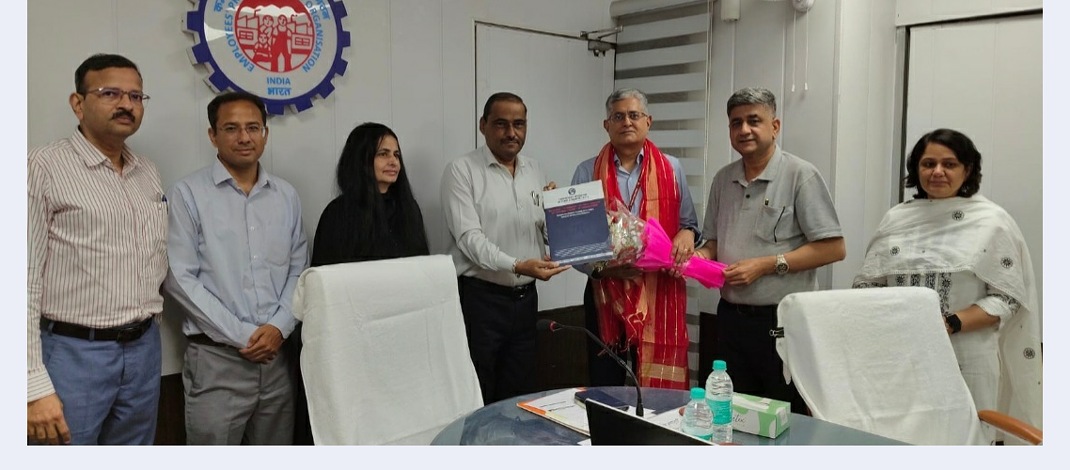
Gurugram: Central Provident Fund Commissioner (CPFC) Ramesh Krishnamurthy visited the Employees’ Provident Fund Organisation (EPFO) office in Sector-44, Gurugram, on Friday, where extensive discussions were held on the effective implementation of the Employees’ Provident Funds and Miscellaneous Provisions Act, 1952.
During the day-long visit, the CPFC conducted a series of meetings with departmental officials, representatives of industrial organizations, and trade unions to review pending matters related to Provident Fund implementation and social security coverage for workers.
In the morning session, Krishnamurthy chaired a review meeting with EPFO officials focusing on pending PF cases, inspection systems, online services, and employment generation initiatives. Later in the afternoon, a joint interaction was organized with trade unions and industrial representatives, with special emphasis on strengthening implementation of the PF Act across industries and extending social security benefits to more workers.
Representing industrial organizations, Progressive Federation of Trade and Industry (PFTI) Chairman Deepak Maini participated in the discussions, along with Advocate R.L. Sharma, President of the Labour Law Advisor Association, Gurugram, and workers’ union representative S.S. Thiriyan.
Senior officials from the EPFO present during the meeting included OSD to CPFC Shobhit, Additional Central PF Commissioner Mridula Ghai, Regional PF Commissioners Archana Jane, Ranveer Singh, Ravinder Babra, Nilendu Mishra, and Pramod Kumar, besides Enforcement Officers Vishal Satyam and Yaduveer Singh.
Addressing the gathering, CPFC Ramesh Krishnamurthy elaborated on the ‘Pradhan Mantri Viksit Bharat Rojgar Yojana,’ stating that the Central Government aims to bring the maximum number of workers under formal employment and social security schemes. He emphasized that the Employees’ Provident Fund is not merely a savings mechanism but an important social security legislation intended to secure the future of workers.
During the discussions, PFTI Chairman Deepak Maini highlighted several practical and technical challenges currently being faced by industries in complying with the new labour codes and procedural requirements. He stressed the need for stronger coordination between industries and the department to resolve these issues effectively.
Advocate R.L. Sharma underlined the importance of awareness among both employers and workers for successful implementation of the PF Act. He stated that extending PF benefits to eligible employees is a statutory obligation under the Employees’ Provident Funds and Miscellaneous Provisions Act, 1952. He further pointed out that the implementation of the new Wage Code has created technical concerns related to the definition of wages and PF contributions, which require timely clarification.
Sharma also explained that both employers and employees are legally required to contribute a prescribed percentage towards PF deposits, and the Act provides for interest and penal action in cases of delayed payments.
He noted that the PF framework offers not only financial security but also pension and insurance benefits to workers.
Workers’ union representative S.S. Thiriyan described the Employees’ Provident Fund as one of the most significant instruments for protecting the social and economic future of workers. He emphasized the urgent need to increase awareness regarding PF rights and benefits so that every eligible worker can access social security protections.
At the conclusion of the meeting, Central PF Commissioner Ramesh Krishnamurthy directed all Regional PF Commissioners to work in coordination with industrial organizations, particularly PFTI, to organize awareness campaigns across industrial sectors. The initiative aims to bring more establishments and workers under the ambit of the EPF Scheme.
He reiterated that the EPFO’s objective is not limited to enforcement action alone, but also to establish effective cooperation with industries and employees to ensure wider expansion of social security coverage. He appealed to all organizations to support full compliance with the PF Act while safeguarding workers’ interests.