
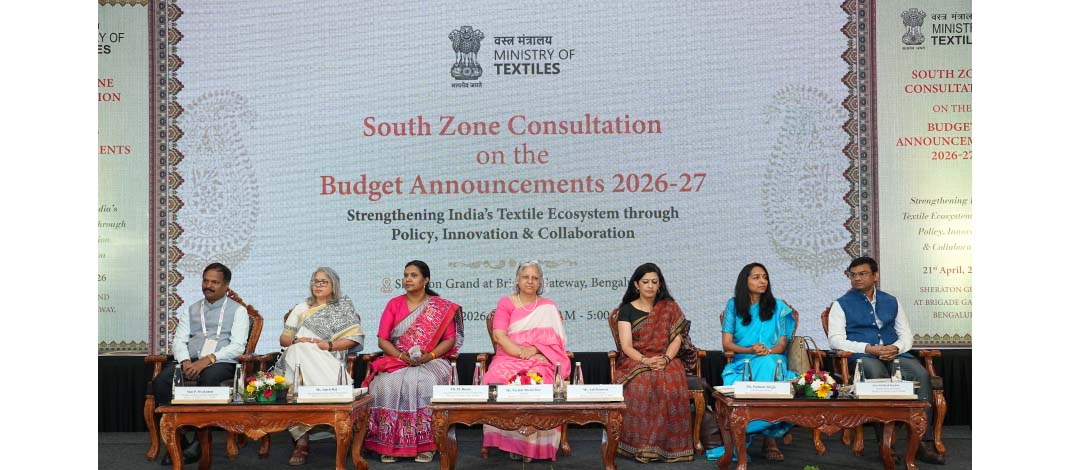
Bengaluru : The Ministry of Textiles India organized a Regional (South Zone) Consultation Workshop on new textile schemes announced in the Union Budget 2026–27, bringing together senior officials, state representatives, and industry stakeholders to deliberate on the future roadmap for the sector.
The workshop saw participation from ministry officials and its various verticals, along with delegates from southern states and Union Territories, as well as representatives from the textile industry. Discussions focused on aligning policy initiatives with ground-level implementation to strengthen the sector’s growth trajectory.
Addressing the gathering, Neelam Shami Rao, Secretary, Ministry of Textiles, emphasized that the textile sector will play a crucial role in achieving the vision of a developed India by 2047. She stressed the importance of strengthening both forward and backward linkages across the value chain, while maintaining a balance between quality and scale. She also highlighted the need for modernization, circular economy practices, and effective management of pre- and post-consumer textile waste in line with evolving global trends.
M. Beena, Development Commissioner (Handlooms), noted that the schemes introduced in the latest budget are designed to provide integrated support across the sector, particularly benefiting artisans, weavers, and grassroots stakeholders.
During the consultation, Padmini Singla addressed queries raised by state departments and offered clarifications on the implementation of new schemes. She also acknowledged the challenges faced by states and outlined practical strategies to address them effectively.
Providing an overview of policy support, Arti Kanwar highlighted key incentives such as subsidies for modernization and the promotion of indigenous machinery manufacturing. She elaborated on provisions including Employment Linked Incentives (ELI), top-up subsidies, wage support, and coverage under ESIC and EPF schemes. She further emphasized the development of cluster infrastructure, promotion of innovation and branding, establishment of plug-and-play textile parks, and the creation of Textile Seva Kendras to support industry needs.
Focusing on skill development, Akhilesh Kumar, Deputy Director General, spoke about Samarth 2.0, which aims to enhance workforce capabilities through industry-relevant courses, mobile-based learning, and dual certification systems to support both employment and academic progression.
Meanwhile, P. Sivakumar, Member Secretary of the Central Silk Board, emphasized that all initiatives should remain stakeholder-centric and aligned with the Prime Minister’s vision of “Farm to Foreign,” ensuring comprehensive sectoral development.
The workshop also featured in-depth discussions on major schemes such as the Integrated Programme for Textile Sector, National Fibre Scheme (NFS), Textile Expansion & Employment (TEEM) Scheme, National Handloom & Handicraft Programme (NHHP), Samarth 2.0, Tex-Eco Initiative, Mega Textile Parks, and the Mahatma Gandhi Gram Swaraj Initiative (MGGSI). These initiatives aim to strengthen the textile value chain, promote sustainability, and generate large-scale employment opportunities across the country.