
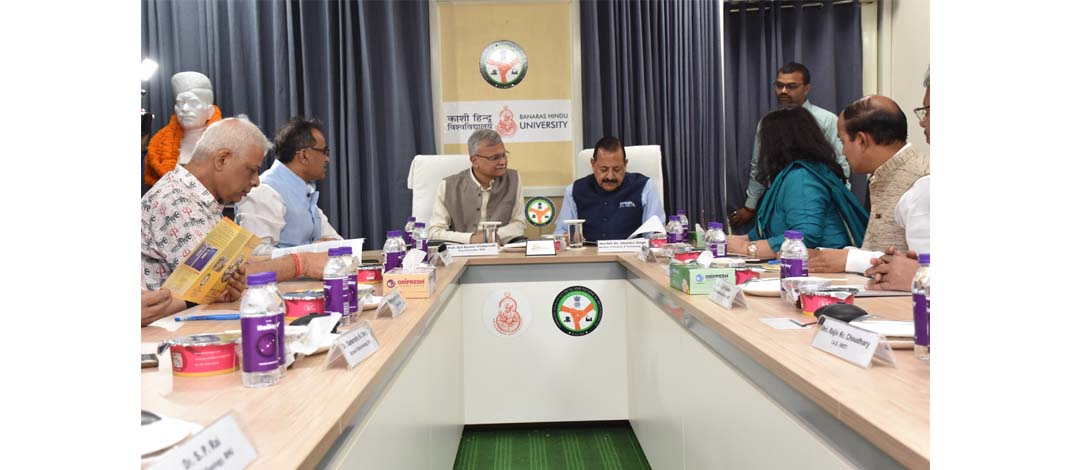
New Delhi : Union Minister of State (Independent Charge) for Science & Technology and Earth Sciences, Dr. Jitendra Singh, visited Banaras Hindu University to review the advanced interdisciplinary research facility “SATHI” established with the support of the Department of Science & Technology (DST), Government of India.
During the visit, Dr. Jitendra Singh inspected the infrastructure, analytical capabilities and major scientific equipment installed at the Sophisticated Analytical & Technical Help Institute (SATHI) and praised the university administration and faculty for developing the centre into a model scientific facility. He complimented Vice Chancellor Prof. A.K. Chaturvedi and the academic community for creating a success story that could inspire other institutions across the country.
The Minister said the Department of Science & Technology is actively expanding scientific infrastructure and research support systems in universities and higher educational institutions to democratise access to advanced technology, innovation and high-end research facilities.
Highlighting the government’s broader vision, Dr. Singh said initiatives such as SATHI, FIST and ARRF-linked research support mechanisms are helping create a robust ecosystem for research, innovation, startups and industry-academia collaboration, particularly benefiting young researchers, MSMEs and emerging enterprises.
He said DST’s outreach programmes are improving access to scientific infrastructure and technical education across the country by strengthening innovation ecosystems in universities and research institutions. The Minister also noted that several educational institutions are being connected through space-related laboratories and scientific research programmes to promote innovation-driven learning and emerging technology capabilities among students.
Senior officials from the Department of Science & Technology, scientists, faculty members and representatives of the SATHI Centre were present during the review meeting.
Established with financial support of nearly ₹72 crore from the Department of Science & Technology, SATHI-BHU functions as a national-level shared scientific infrastructure facility that provides advanced instrumentation, analytical services and technical expertise to academia, research institutions, industries, MSMEs and startups. The facility operates through a Section 8 company model within the university ecosystem and has emerged as a major multidisciplinary analytical and research support centre.
Dr. Jitendra Singh said strengthening scientific infrastructure in universities is essential to achieving the vision of Atmanirbhar Bharat and enhancing India’s global competitiveness in advanced technologies and research domains. He added that under the leadership of Prime Minister Shri Narendra Modi, the government has consistently promoted institutional research capacity, indigenous innovation and technology-led growth through targeted scientific interventions and collaborative research platforms.
The Minister was informed that SATHI-BHU houses several state-of-the-art facilities, including super-resolution confocal microscopy with live cell imaging, advanced NMR spectroscopy systems, high-resolution accurate mass spectrometry, clean room facilities, electrochemical workstations, chromatography platforms and isotope analysis systems. These facilities are supporting research in life sciences, pharmaceuticals, healthcare, semiconductors, food sciences, environmental sciences, biotechnology and advanced materials.
Officials informed the Minister that the centre has so far served nearly 1,100 users from academia, industries and research institutions, processed more than 30,000 samples and trained around 1,000 researchers and stakeholders since becoming operational. Around 60 short-term training programmes have also been conducted for skill development and capacity building.
Dr. Jitendra Singh appreciated the efforts of SATHI-BHU in achieving NABL accreditation and developing a sustainable analytical services model with strong industry participation. He noted that the facility has contributed significantly to research publications, patents and collaborative partnerships with national laboratories and industrial stakeholders, strengthening the link between science, innovation and economic growth.