
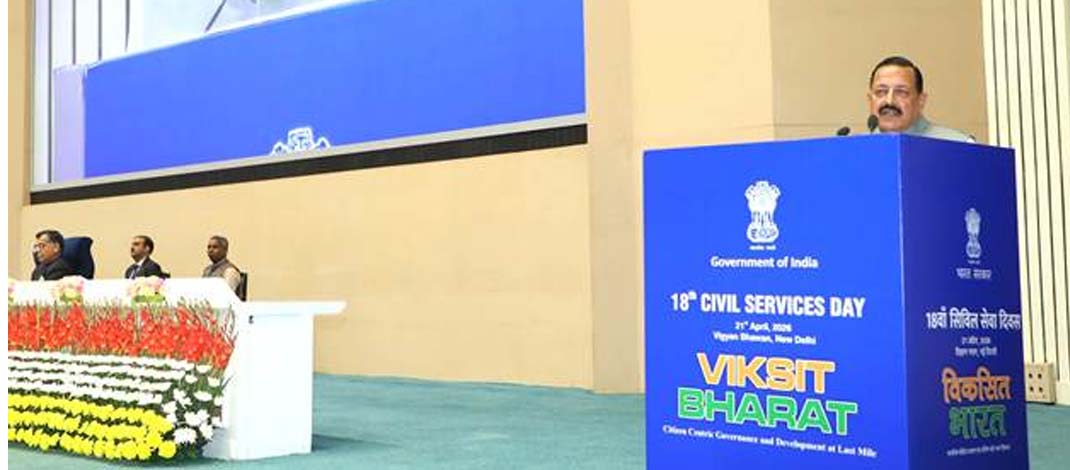
New Delhi: Highlighting a significant transformation in India’s governance framework, Union Minister of State for Personnel, Public Grievances and Pensions Jitendra Singh on Tuesday underscored the growing scale and impact of citizen-centric administrative reforms while addressing the 18th Civil Services Day समारोह.
Citing key indicators, the minister noted a sharp rise in participation for the Prime Minister’s Awards for Excellence, with applications increasing steadily from 1,216 in 2023 to over 2,000 in 2025, reflecting heightened competition across more than 750 districts. He also highlighted the rapid expansion of the iGOT Karmayogi platform, which has onboarded over 88 lakh officials and offers more than 2,000 training courses aimed at enhancing administrative capacity.
On grievance redressal, Singh pointed to the success of CPGRAMS, where annual complaints have surged from around 2 lakh in 2014 to nearly 25–30 lakh currently. Despite this increase, over 95 percent of cases are being resolved, with the average resolution time reduced significantly from 60 days to nearly 12 days—an indication, he said, of improved efficiency and growing public trust in the system.
In the area of pension reforms, he noted the widespread adoption of digital life certificates, with more than 40 lakh pensioners using face recognition-based verification in 2024 alone, marking a major step toward ease of living for retirees.
The minister emphasized a broader structural shift in governance—from individual-driven delivery to institutionalized systems, and from rule-based to role-based administration. He highlighted reforms such as the removal of nearly 2,000 obsolete rules, elimination of interviews for certain recruitment processes, and the redesign of Civil Services Day into a knowledge-oriented platform.
Singh also spoke about a revamped evaluation framework for excellence awards, now focused on outcomes of flagship government programmes rather than individual officer profiles. He pointed to institutional innovations like the Assistant Secretary programme and the expansion of digital governance systems, which now cover nearly 90 percent of government operations.
Looking ahead, he outlined plans to further strengthen initiatives such as Mission Karmayogi and “Karmayogi Prarambh,” aimed at preparing civil servants for emerging governance challenges. He added that India’s administrative models are drawing international attention, with countries like the Maldives, Mauritius, Bangladesh, and South Africa studying systems such as CPGRAMS.
Reinforcing the theme of “Viksit Bharat: Citizen-Centric Governance and Development at the Last Mile,” Singh stated that the reforms are focused on ensuring transparency, accountability, and timely service delivery. He remarked that the increase in grievance filings reflects rising public confidence rather than dissatisfaction.
The समारोह was presided over by Vice President C. P. Radhakrishnan, with senior officials including P. K. Mishra, Shaktikanta Das, T. V. Somanathan, and Nivedita Shukla Verma in attendance, reflecting the high-level institutional participation at the annual gathering.
Related
Table of Contents
Toggle