
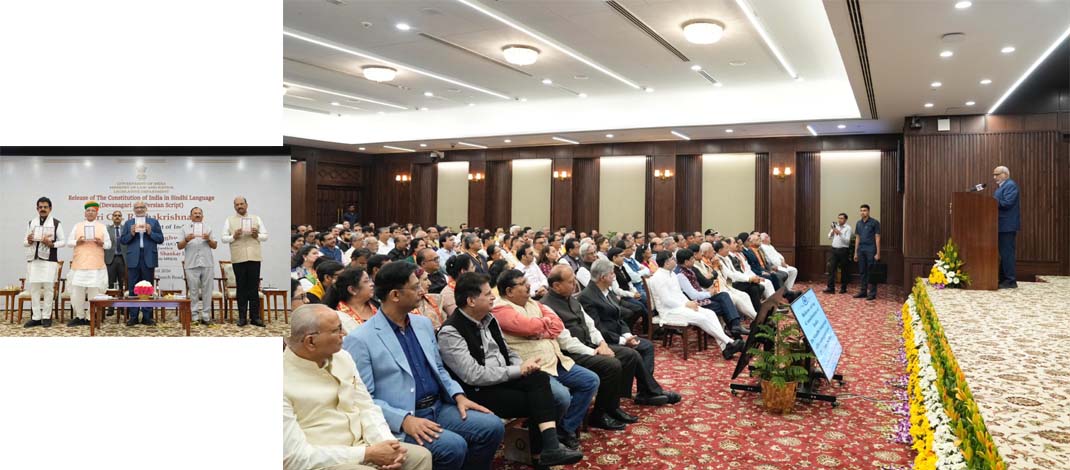
New Delhi :The Vice-President of India, C. P. Radhakrishnan, today released the latest edition of the Constitution of India in the Sindhi language, presented in both Devanagari and Persian scripts, at a समारोह held at Uprashtrapati Bhawan.
Addressing the gathering, the Vice-President extended his greetings to the Sindhi-speaking community on the occasion of Sindhi Bhasha Diwas. He described Sindhi as one of the oldest and most melodious languages, highlighting its rich literary heritage shaped by a unique blend of Vedantic philosophy and Sufi thought that promotes values of unity, love, and brotherhood.
Underscoring the importance of the occasion, he noted that the release of the Constitution in Sindhi—particularly in the Devanagari script for the first time since Independence—marks a significant step towards linguistic inclusivity. He emphasized that the Constitution is not merely a legal text, but a living document that embodies the nation’s aspirations, safeguards citizens’ rights, and guides democratic governance.
The Vice-President appreciated the efforts of the government under the leadership of Prime Minister Narendra Modi in making the Constitution accessible in multiple Indian languages. He observed that such initiatives help bridge the gap between citizens and governance by enabling people to understand the Constitution in their mother tongue, thereby strengthening democratic participation and trust.
He further noted that India stands out for making its Constitution available in a wide range of languages, recalling similar initiatives in Bodo, Dogri, Santhali, Tamil, Gujarati, and Nepali. These efforts, he said, celebrate the country’s linguistic diversity while reinforcing democratic values.
Reflecting on history, he highlighted the resilience of the Sindhi community, noting that the language served as a unifying force in the aftermath of the Partition of India. He also recalled that Sindhi was included in the Eighth Schedule of the Constitution through the 21st Constitutional Amendment in 1967, recognizing its cultural importance and ensuring its preservation.
Emphasizing respect for all languages, he stated that while individuals cherish their mother tongues, equal respect must be accorded to every language. He underlined that India’s strength lies in its diversity, with languages serving as vital carriers of culture, tradition, and identity.
The Vice-President also commended the Ministry of Law and Justice and its Regional Language Officers for their efforts in making the Constitution accessible in regional languages. He expressed confidence that such initiatives would empower citizens and contribute to the vision of a developed India by 2047.
Concluding his address, he urged citizens to celebrate both their mother tongues and the nation’s collective linguistic heritage, reiterating the spirit of unity in diversity and the guiding principle of “Nation First – Rashtra Pratham.”
The event was attended by Union Minister of State for Law and Justice & Parliamentary Affairs Arjun Ram Meghwal; Speaker of the Rajasthan Legislative Assembly Vasudev Devnani; Member of Parliament Shankar Lalwani; and Secretary, Legislative Department Rajiv Mani, along with other dignitaries.
Related
Table of Contents
Toggle