
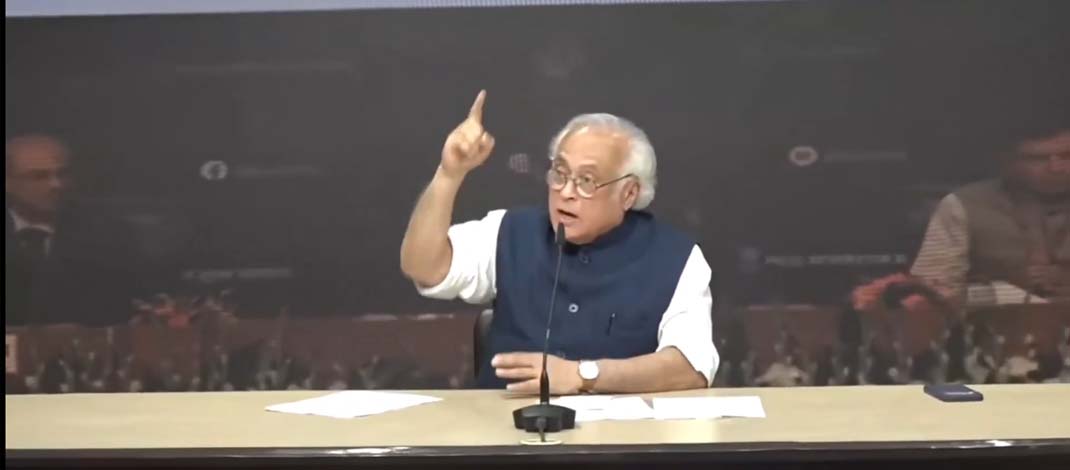
-Union Govt Wants to Engage Congress Party in Discussions Regarding Proposed Women’s Reservation Bill : Jairam Ramesh
New Delhi : The Central government has announced a special session of Parliament, with sittings of both the Lok Sabha and Rajya Sabha scheduled for April 16, 17, and 18, a development highlighted by Congress General Secretary (Communications) Jairam Ramesh. According to the Congress, the move follows earlier communication from Union Minister Kiren Rijiju, who on March 16 wrote to Leader of Opposition in the Rajya Sabha Mallikarjun Kharge, expressing the government’s willingness to engage in discussions with the Congress regarding proposed amendments to the ‘Nari Shakti Vandan Adhiniyam’ (Women’s Reservation Bill).
Responding the same day, Kharge suggested that the government should convene an all-party meeting and circulate a formal written proposal to enable collective deliberation. Subsequently, on March 24, opposition parties jointly reiterated this demand, urging the government to schedule such a meeting after April 29, when the Election Commission’s Model Code of Conduct would no longer be in effect.
The Congress also emphasized the historical roots of women’s reservation, recalling that former Prime Minister Rajiv Gandhi was the first to introduce the idea. In 1989, the 64th and 65th Constitutional Amendment Bills, proposing one-third reservation for women in Panchayats and Municipalities, were passed in the Lok Sabha but failed in the Rajya Sabha amid opposition, including from BJP members.
It was later, in 1993, under a Congress-led government, that the landmark 73rd and 74th Constitutional Amendments were successfully enacted, institutionalizing reservation for women in local governance. Today, women account for nearly half of the approximately 3 million elected representatives in Panchayats and Municipal bodies—surpassing the mandated one-third quota.
Raising further concerns, the opposition pointed to statements from the Registrar General and Census Commissioner indicating that Census results will begin to be released only by 2027. The population enumeration itself is expected to start in February 2027, as part of the ongoing first phase of the Census process.
In this context, the Congress has accused the government of presenting misleading timelines in Parliament by suggesting that the process would take 3–4 years, thereby justifying the urgency to pass amendments ahead of the 2029 general elections.
The opposition alleges that the timing of the special session is politically motivated, aimed at securing electoral advantage and enabling Prime Minister Narendra Modi to claim credit for the implementation of women’s reservation.