
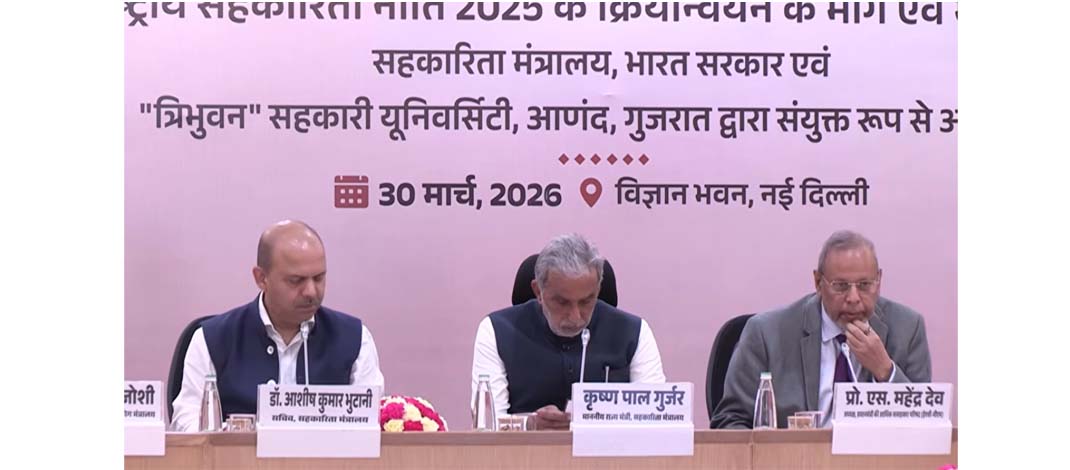
New Delhi : A national-level conclave focusing on the implementation of the National Cooperation Policy 2025 was held at Vigyan Bhawan, bringing together policymakers, experts, and stakeholders to deliberate on strengthening India’s cooperative sector.
The event, organised by the Ministry of Cooperation in collaboration with Tribhuvan Sahkari University, aimed to translate Prime Minister Narendra Modi’s vision of “Sahkar Se Samriddhi” into actionable outcomes, under the broader leadership of Union Minister Amit Shah.
Addressing the gathering, Minister of State for Cooperation Krishan Pal Gurjar highlighted the historic role of cooperatives in empowering rural India and described the new policy as a forward-looking blueprint to position the sector as a key driver of national growth. He emphasised that the policy focuses on inclusive development, strengthening rural economies, and contributing to the vision of a developed India by 2047.
He noted that the policy was shaped through an extensive consultation process involving nationwide inputs, and outlined its core priorities—strengthening institutional foundations, expanding cooperative networks, promoting transparency and professionalism, encouraging youth participation, and diversifying into new sectors.
The Minister also underlined several ongoing initiatives aligned with the policy, including the transformation of Primary Agricultural Credit Societies (PACS) into multi-functional units, the establishment of Tribhuvan Sahkari University, and the rollout of digital and data-driven frameworks such as the National Cooperative Database and ranking systems.
Secretary, Ministry of Cooperation, Ashish Kumar Bhutani, highlighted that over 80,000 PACS are being digitised nationwide to enhance efficiency and service delivery. He stressed the importance of decentralised storage, fair pricing for farmers, and reduction in post-harvest losses.
In his special address, S. Mahendra Dev, Chairman of the Economic Advisory Council to the Prime Minister, called for strategies to significantly boost the cooperative sector’s contribution to the economy, while Satish Marathe emphasised the sector’s role in expanding affordable credit access to underserved populations.
The conclave featured multiple thematic and breakout sessions on digital infrastructure, cooperative credit systems, youth and women participation, and emerging opportunities in organic markets. The discussions concluded with key recommendations aimed at ensuring effective and timely implementation of the policy.
The event is expected to play a crucial role in shaping a transparent, technology-driven, and people-centric cooperative ecosystem, accelerating progress towards the vision of “Sahkar Se Samriddhi”.