
Suvash C Choudhary/ The Public World
Gurugram : The 8th International Symposium on Automotive Lighting (ISOL) 2025, hosted at the International Centre for Automotive Technology (ICAT), Manesar, successfully brought together global experts, researchers, designers, policymakers, and industry leaders to deliberate on the future of lighting and illumination technologies. Organised in a state-of-the-art convention facility, the symposium focused on emerging trends shaping the lighting ecosystem, including smart and connected lighting, sustainable materials, human-centric design, and intelligent safety solutions.
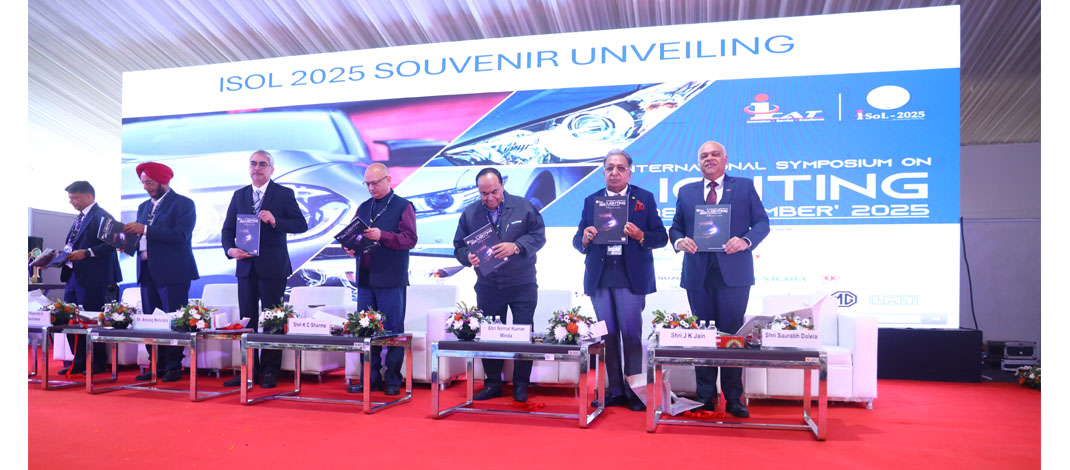
ISOL 2025 was formally inaugurated in the presence of eminent dignitaries from the automotive and regulatory ecosystem. The Inaugural Session featured distinguished speakers: Rajinder S. Sachdeva, Deputy Chief Executive Officer and Chief Transformation Officer, Volvo Eicher Commercial Vehicles Ltd.; Anurag Mehrotra, Managing Director, JSW MG Motor India Pvt. Ltd.; K. C. Sharma, Advisor, Ministry of Road Transport and Highways (MoRTH) and former Chief Engineer; Nirmal Kumar Minda, Executive Chairman, Uno Minda Limited and President, ASSOCHAM; J. K. Jain, Chairman and Managing Director, Fiem Industries Ltd.; and Saurabh Dalela, Director, ICAT. The inaugural proceedings were anchored by Dr. Madhusudan Joshi, Head – Technology, ICAT.
 During the three-day symposium, six technical sessions were conducted, addressing key aspects such as regulatory frameworks, safety enhancements, innovation, photometry, intelligent lighting systems, and advancements in automotive lighting technologies. Additionally, two high-level panel discussions facilitated in-depth deliberations among industry leaders on current challenges and future opportunities in automotive and mobility lighting.
The event also featured hands-on workshops and a dedicated exhibition zone, where international manufacturers, technology providers, and startups showcased next-generation lighting solutions, including high-efficiency LEDs, adaptive lighting systems, advanced sensors, and AI-driven lighting controls. These interactions provided participants with valuable insights into emerging technologies and market-ready innovations.
Sustainability emerged as a central theme throughout ISOL 2025. Speakers highlighted circular-economy approaches, low-impact manufacturing processes, and strategies to reduce global energy consumption through intelligent and adaptive lighting solutions. Special sessions explored the impact of lighting on human health, safety, and productivity, emphasizing the growing relevance of circadian-friendly and human-centric lighting designs.
The symposium concluded with an Awards and Valedictory Ceremony, recognising outstanding contributions and excellence in the field of automotive lighting. This was followed by structured business interactions at ICAT, aimed at strengthening collaboration between original equipment manufacturers (OEs), component suppliers, testing agencies, technology providers, and regulatory authorities.
ISOL 2025 reaffirmed ICAT’s commitment to promoting innovation, safety, and technological excellence in the Indian automotive sector through knowledge sharing, industry engagement, and global collaboration. The event further reinforced Manesar’s emergence as a key hub for technology-driven conferences, leaving participants with renewed insights, inspiration, and a shared vision for shaping a safer, smarter, and more sustainable future through advancements in lighting technologies.
 Objectives of the ISOL 2025 :
The International Symposium on Automotive Lighting (ISOL) 2025 was organised with the objective of promoting meaningful knowledge exchange on global advancements in lighting technologies. The event provided a comprehensive platform to discuss emerging trends, innovative solutions, and best practices in automotive and intelligent lighting, enabling stakeholders to gain insights into the evolving global lighting ecosystem.
Another key objective of ISOL 2025 was to create a collaborative ecosystem that supports innovation, safety enhancement, and technological growth within the automotive sector. By bringing together original equipment manufacturers, component suppliers, technology providers, testing agencies, and policymakers, the symposium encouraged cross-sector dialogue and collective problem-solving aimed at addressing current and future mobility challenges.
Aligned with India’s vision for future-ready, energy-efficient, and intelligent mobility, the symposium focused on advancing sustainable and smart lighting solutions. Discussions and technical sessions emphasized regulatory harmonisation, energy efficiency, and the integration of advanced technologies that contribute to safer roads, reduced environmental impact, and improved vehicle performance.
ISOL 2025 also aimed to serve as a common platform for collaboration among industry leaders, innovators, startups, and research organisations. The event facilitated structured interactions, exhibitions, and networking opportunities that helped strengthen partnerships, accelerate technology adoption, and support the development of market-ready lighting solutions.
Strengthening the interface between industry, academia, and regulatory authorities was another important objective of the symposium. By fostering closer engagement among these stakeholders, ISOL 2025 supported the alignment of research, standards, and policy frameworks with industry needs and global benchmarks.
ISOL 2025 Featured Six Technical Sessions :
Additionally, the symposium placed strong emphasis on encouraging young talent by providing opportunities for paper presentations, technical competitions, and interactive sessions with industry experts. These initiatives were designed to inspire innovation, build technical capabilities, and nurture the next generation of professionals in the field of automotive and lighting technologies.
ISOL 2025 featured six technical sessions, during which 31 technical papers were presented by a diverse group of industry experts, government representatives, lamp manufacturers, suppliers, eminent personalities, and academicians. The wide participation reflected the growing importance of lighting as a critical element in vehicle safety, efficiency, aesthetics, and user experience.
The symposium covered a broad spectrum of contemporary and emerging subjects. Key themes included Advanced Lighting Technologies, Automotive Lighting Industry: India on the Move, Modular Light Source Solutions for Faster Adoption and Engineering Efficiency, and Optics, Simulation Testing, and Regulatory Compliance. Discussions also explored the increasing relevance of ambient lighting, examining whether it is a functional necessity or a consumer-driven desire.
Several sessions focused on innovation-led design and engineering, such as Design Driven by Data: Role of CAE in Modern Lighting, Advancements in Projector Lens Engineering, and Advanced LED Drivers Powering the Next Generation of Automotive Lighting. Emerging trends in two-wheeler lighting technologies were also highlighted, reflecting the sector’s rapid growth in the Indian market.
Two Panel Discussions :
ISOL 2025 featured insightful panel discussions bringing together experts from OEMs and component manufacturers in the automotive lighting domain. The first panel discussion, “From Brightness to Balance: Innovations for Safer Night Driving,” on 17th November 2025 focused on the evolving role of lighting in enhancing night-time driving safety. The second panel discussion, held on 18th November 2025, deliberated on “Smart, Adaptive, and Safe: The Future of Automotive Lighting,” highlighting the integration of intelligence and adaptability in next-generation lighting systems.
The dialogues and deliberations across both panels were structured around four substantive sections, each addressing a critical facet of automotive lighting.
13 Distinct Award Dategories :
This year, over 75 recipients were nominated across 13 distinct award categories, reflecting the depth and diversity of innovation within the sector. The nominations and performances were meticulously evaluated through a structured assessment process by a distinguished panel of expert jury members, constituted by eminent industry leaders and domain experts from the automotive and lighting ecosystem.
