
Defence Budget Rises to Record ₹7.85 Lakh Crore for FY 2026–27; Government Targets ₹3 Lakh Crore Defence Production and ₹50,000 Crore Exports by 2029
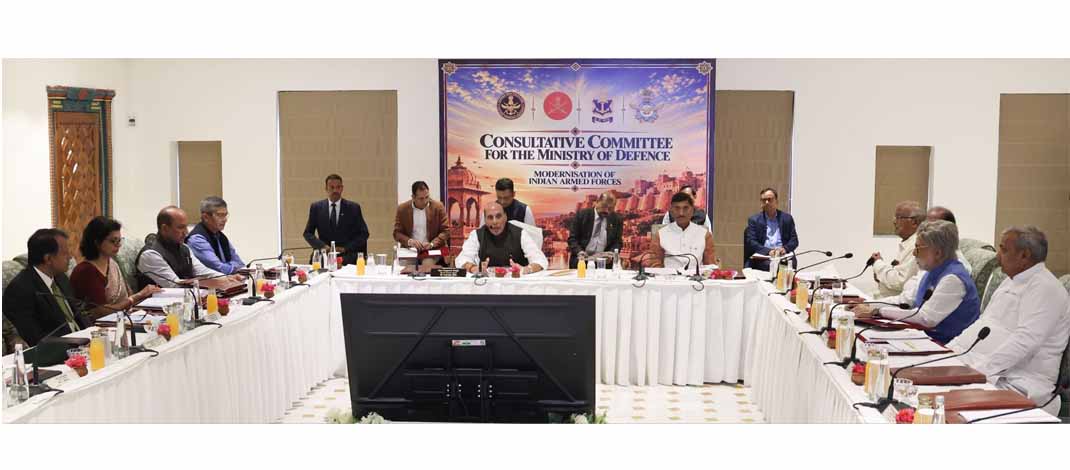
Jaisalmer : Defence Minister Rajnath Singh chaired a meeting of the Consultative Committee of the Ministry of Defence on ‘Modernisation of Indian Defence Forces’ in Jaisalmer, Rajasthan, on November 3, 2026. The meeting witnessed comprehensive deliberations on emerging security challenges, changing warfare paradigms, technological advancements and the need to build a future-ready, technologically empowered and operationally agile military.
The discussions focused on strengthening India’s defence preparedness through next-generation military capabilities, greater integration among the three Services, indigenous defence manufacturing, advanced technological applications and improved human resource capabilities. The deliberations also emphasised the need to translate modernisation plans into measurable operational outcomes through clear priorities, effective institutional mechanisms and time-bound implementation.
Six key pillars of India’s defence modernisation strategy
The meeting identified six major areas requiring sustained attention to strengthen the operational capabilities of the Indian Armed Forces:
1. Capability Development and Force Modernisation: Accelerating the induction of next-generation platforms, advanced weapon systems and modern technologies to improve combat effectiveness and operational preparedness.
2. Jointness and Integration: Strengthening coordination among the Army, Navy and Air Force through integrated operational planning and the synergised application of capabilities across multiple domains.
3. Indigenous Defence Manufacturing: Providing further momentum to Make in India and Aatmanirbhar Bharat through domestic research, design, development and manufacturing, while encouraging greater participation from Indian industries, start-ups and academic institutions.
4. Emerging and Disruptive Technologies: Expanding the application of Artificial Intelligence (AI), autonomous systems, unmanned platforms, cyber capabilities, space technologies, electronic warfare and advanced communication systems to prepare for future conflicts.
5. Defence Research and Innovation: Strengthening collaboration among the Armed Forces, Defence Research and Development Organisation (DRDO), Defence Public Sector Undertakings (DPSUs), private industries and academic institutions to convert technological innovations into operational capabilities.
6. Resource Optimisation and Implementation: Establishing clear priorities, institutional mechanisms and measurable milestones to ensure that modernisation programmes deliver tangible improvements in military preparedness.
Three key dimensions: Budget, technology and human capital
Emphasising the need for the Defence Forces to remain prepared for both existing and emerging security challenges, Rajnath Singh outlined the initiatives undertaken by the Government under the leadership of Prime Minister Narendra Modi across three critical dimensions: Budget and Capital Acquisition & Self-reliance, Technology, and Human Capital.
He highlighted the Government’s sustained commitment to providing adequate budgetary support and accelerating capital acquisition to meet the modernisation requirements of the Armed Forces. He stressed that sufficient financial resources, combined with effective utilisation and prioritisation of critical requirements of the three Services, are essential to strengthening India’s military capabilities.
Record ₹7.85 lakh crore defence budget for FY 2026–27
The Defence Minister stated that India’s defence budget for Financial Year 2026–27 had been increased to a record ₹7.85 lakh crore, including a capital outlay of ₹2.19 lakh crore earmarked for modernisation and capital procurement.
He said the increased allocation reflects the Government’s commitment to meeting the operational requirements of the Armed Forces while simultaneously strengthening domestic defence industries and manufacturing capabilities.
The capital expenditure allocation is expected to support the acquisition of advanced military platforms, modern weapon systems and essential equipment, alongside efforts to expand indigenous defence production.
Defence production reaches ₹1.78 lakh crore; exports touch approximately ₹40,000 crore
Highlighting the progress made towards Aatmanirbharta in defence manufacturing, Rajnath Singh stated that India’s defence production had increased substantially from ₹46,429 crore in FY 2014–15 to a record ₹1.78 lakh crore in FY 2025–26.
He also pointed out that India’s defence exports, which stood at less than ₹2,000 crore in 2014, had grown to approximately ₹40,000 crore.
Setting out the Government’s future ambitions, the Defence Minister said:
“We aim to achieve defence production worth ₹3 lakh crore and defence exports worth ₹50,000 crore by 2029.”
The Minister emphasised that these achievements reflect the growing strength of India’s indigenous defence manufacturing ecosystem and the increasing contribution of domestic industries towards meeting national security requirements.
Technology and innovation to shape the future of warfare
Underscoring the transformative role of technology in modern warfare, Rajnath Singh observed that technological advancements are fundamentally changing the nature and character of military conflicts.
He highlighted the initiatives undertaken by DRDO in developing advanced weapons, missiles and military systems. He also noted that the Government was providing a level playing field to the private sector, enabling organisations ranging from Micro, Small and Medium Enterprises (MSMEs) to large corporations to participate more actively in the defence ecosystem.
Describing this approach as a ‘whole-of-the-nation’ effort, he expressed satisfaction over the growing contribution of private industry towards strengthening India’s defence capabilities.
The discussions also highlighted the importance of integrating emerging technologies such as artificial intelligence, autonomous systems, unmanned platforms, cyber warfare, space-based capabilities and electronic warfare into the Armed Forces.
The emphasis was on ensuring that technological innovations are effectively translated into operational advantages and enhance India’s preparedness for increasingly complex multi-domain security challenges.
Human capital remains central to military preparedness
Highlighting the importance of human resources, the Defence Minister stated that the strength of a military is determined not merely by its technological capabilities and financial resources but also by the competence, preparedness and operational effectiveness of its personnel.
He observed that the rapidly changing nature of warfare requires the Armed Forces to continuously adapt their organisational structures, formations and operational strategies.
In this context, he referred to the organisational initiatives undertaken by all three Services and highlighted the effectiveness of the Indian Army’s new formations, including the ‘Asani’, ‘Bhairav’ and ‘Shaktiban’ platoons, in addressing contemporary operational requirements and adapting to evolving battlefield dynamics.
He said these initiatives demonstrate the importance of developing agile military formations capable of responding effectively to changing operational environments.
Aatmanirbhar Bharat: Building strategic autonomy in defence
Rajnath Singh emphasised that military modernisation is not limited to procuring new weapons and equipment. It also involves strengthening operational preparedness, adopting advanced technologies and developing indigenous capabilities for long-term national security.
Highlighting the importance of Aatmanirbhar Bharat, he said India’s objective is to establish a robust domestic defence ecosystem that aligns technological development with military requirements, encourages greater participation of Indian industries and reduces strategic dependence on foreign sources.
He underlined that strategic autonomy and indigenous technological capabilities are essential pillars of national security, particularly in an increasingly complex global security environment.
The Defence Minister further stressed that modernisation is a continuous process requiring sustained investment in research and development, indigenous technologies, industrial participation and innovation.
He called for long-term capability development to ensure that the Armed Forces remain operationally effective, technologically advanced and self-reliant in responding to evolving security challenges.
MPs offer suggestions for strengthening defence modernisation
The meeting also witnessed valuable suggestions and contributions from Members of Parliament representing both the Rajya Sabha and the Lok Sabha.
Their diverse perspectives enriched the consultative process by bringing important legislative, strategic and national considerations into discussions on the modernisation of the Armed Forces.
The deliberations helped outline a roadmap for further action, focusing on prioritising critical military capabilities, strengthening coordination among stakeholders, streamlining acquisition and development procedures, and periodically evaluating progress against clearly defined objectives.
Emphasising the importance of translating policy intent into tangible results, the meeting called for a structured and phased approach to military modernisation.
The overarching objective is to build a future-ready Indian military capable of responding effectively to conventional, sub-conventional and multi-domain security challenges.
Senior defence officials attend the meeting
Raksha Rajya Mantri Shri Sanjay Seth attended the meeting along with Defence Secretary Shri Rajesh Kumar Singh, Secretary (Defence Production) Shri Sanjeev Kumar, Secretary (Ex-servicemen Welfare) Smt. Sukriti Likhi and Secretary (Defence Finance) Shri Vishvajit Sahay.
Several other senior civil and military officials of the Ministry of Defence and the Armed Forces were also present.