
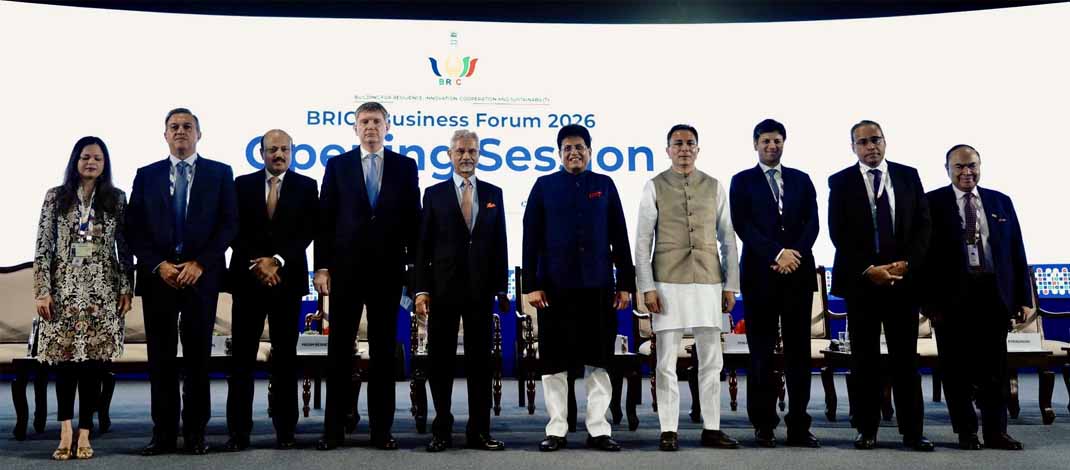
Commerce Minister stresses greater market access, diversified supply chains and simpler regulations as BRICS Business Forum opens in New Delhi
New Delhi : With BRICS accounting for nearly one-fourth of global trade, Union Minister of Commerce and Industry Piyush Goyal on Friday called for deeper, more resilient and balanced trade partnerships among member and partner countries.
Addressing the opening session of the BRICS Business Forum in New Delhi, Shri Goyal stressed the need for greater market access, diversified supply chains and simpler regulatory procedures to unlock the full potential of economic cooperation. He expressed confidence that the Forum would generate meaningful outcomes and elevate economic dialogue and business partnerships among BRICS countries.
The opening session was also addressed by H.E. Maxim Reshetnikov, Minister of Economic Development of the Russian Federation; Union Minister of External Affairs Dr. S. Jaishankar; Minister of State for Commerce and Industry and Electronics and Information Technology Shri Jitin Prasada; and Commerce Secretary Shri Rajesh Agrawal.
Highlighting India’s role in intra-BRICS commerce, Shri Goyal said the country remains an important pillar of trade within the grouping. He pointed to India’s strengths in engineering goods and electronics, which constitute the largest share of its manufactured exports, and also highlighted the country’s position as the “pharmacy of the world.” India sees BRICS as an important market for these products and for other sectors in which it seeks to expand its global presence as a trusted partner, he said.
Calling for deeper and more resilient trade ties, the Commerce Minister said supply chains must be diversified and should support growth and the well-being of people across all member countries. He urged BRICS nations to open their markets further to one another’s products, including raw materials and critical minerals.
Shri Goyal said truly resilient supply chains must function in both directions. Referring to the impact of non-tariff measures, which he said impose export costs higher than tariffs for 88 per cent of countries, he called for smoother and easier market access. BRICS members and partner countries, he said, should work towards opening markets, simplifying regulatory procedures and ensuring faster clearance of consignments.
The Minister also sought stronger cooperation in agriculture and called for agri-tech startups across BRICS countries to jointly develop solutions for farmers, particularly in support of food security. He further urged member countries to open their services markets in a meaningful way, facilitate the cross-border movement of professionals and make mutual recognition of professional qualifications easier.
Highlighting the growing role of women in India’s entrepreneurial ecosystem, Shri Goyal said more than 45 per cent of the country’s 250,000 recognised startups have at least one woman partner or director. He added that two-thirds of the small loans extended over the past decade had gone to women entrepreneurs, helping them become financially independent and self-reliant.
Referring to the BRICS Women’s Business Alliance meeting held in New Delhi earlier this week, Shri Goyal said he had urged the Alliance to ensure greater participation of women-led enterprises in every BRICS exhibition, trade fair and other business opportunities that could be promoted and supported.
On digital cooperation, Shri Goyal highlighted India’s progress in building digital public infrastructure. He said the Unified Payments Interface (UPI) now records more than 250 billion transactions annually and accounts for over half of global digital transactions by volume. UPI is currently accepted in 11 countries, he said, urging BRICS members and partners to link their payment systems, promote trade in local currencies, expand digital trade and collaborate on emerging technologies.
India brings strong capabilities in agriculture, pharmaceuticals, engineering, electronics, automobiles, auto components and services, Shri Goyal said, while also calling for closer integration of startup ecosystems. Such cooperation, he added, could create major opportunities for joint innovation, technology partnerships and the development of resilient global value chains.
As India advances towards the vision of Viksit Bharat 2047, Shri Goyal said the country’s 1.4 billion people have set the collective goal of making India a developed nation by the centenary of its independence. He said there was immense scope to deepen cooperation with BRICS members and partner countries and expressed hope that the Forum’s thematic sessions would produce constructive and actionable recommendations to strengthen intra-BRICS trade and economic cooperation.
In his address, Union Minister of External Affairs Dr. S. Jaishankar noted that 2026 marks 20 years of institutionalised BRICS cooperation. Over this period, he said, the grouping has evolved significantly in terms of its membership, agenda and mechanisms of cooperation.
India’s Chairship, he said, has sought to take this evolution forward under the theme of resilience, innovation, cooperation and sustainability. These priorities have become particularly important at a time when volatility, uncertainty and complexity are reshaping the global political and economic order, with geopolitical conflicts, pandemics, climate disruptions, digitisation and technological advances transforming the economic landscape.
Dr. Jaishankar said resilience had emerged as a defining component of the BRICS community. He highlighted the important role of the BRICS Business Council and the BRICS Women’s Business Alliance in bringing industry, entrepreneurs and business leaders into the wider BRICS process.
He said supply-chain connectivity and trade facilitation had become increasingly important, alongside cooperation in services, agriculture and agri-technology, digital delivery, MSMEs, startups and women-led enterprises. He stressed the importance of greater self-reliance while remaining connected and competitive through genuine market practices, dependable logistics, a predictable business environment, diversified commercial relationships and transparent trade and investment systems.
The External Affairs Minister also identified digital public infrastructure, artificial intelligence, fintech and advanced manufacturing as major areas of opportunity, while underlining the need to address issues relating to access, standards, security and trust.
Dr. Jaishankar said India’s Chairship had worked to strengthen the innovation and entrepreneurship ecosystem through initiatives such as the BRICS incubator network and the BRICS Startup Innovation Fund. He stressed that the benefits of these initiatives should reach businesses across the entire spectrum.
India’s large and growing market, expanding manufacturing base, deepening talent pool, digital experience and dynamic innovation ecosystem make it a natural partner, he said. As BRICS leaders prepare to meet, Dr. Jaishankar added, the most valuable contribution of the Business Forum would be to provide a clear business perspective on the next phase of BRICS cooperation, including opportunities, challenges faced by businesses and steps governments can take to address them.
Minister of State for Commerce and Industry and Electronics and Information Technology Shri Jitin Prasada said the BRICS Business Forum offers an opportunity to translate the collective strength of BRICS economies into concrete commercial outcomes.
He highlighted digital services, particularly artificial intelligence, as an important area for cooperation. AI, he said, has the potential to improve productivity, living standards, incomes and outcomes for individuals and MSMEs, while access to computing resources—especially for countries of the Global South—remains an important consideration.
Shri Prasada called for greater technology exchange and cooperation in AI while keeping the United Nations at the centre of global governance. On semiconductors, he highlighted India’s Semiconductor Mission 2.0, backed by incentives worth about USD 13 billion, and called for collaboration to develop the complete semiconductor ecosystem.
He also identified Digital Public Infrastructure and data centres as promising areas for BRICS cooperation. Calling for the sharing of India’s best practices, he urged member countries to co-develop, co-invest and co-innovate. Greater resources for research and development and startups, he said, could help young people gain access to markets across international borders.
Commerce Secretary Shri Rajesh Agrawal said BRICS represents a significant and expanding market, with trade among BRICS countries increasing from USD 84 billion in 2003 to nearly USD 1.2 trillion in 2024.
He emphasised the importance of preserving and revitalising the multilateral trading system with the World Trade Organization at its core. He also called for greater support to MSMEs through affordable working capital, noting that the Jaipur Consensus provides a basis for exploring a common BRICS mechanism.
Shri Agrawal highlighted the need to strengthen global value chains through initiatives such as BRICS Connect, deeper B2B partnerships, an annual BRICS Trade and Investment Expo, digital trade documentation and enhanced sectoral cooperation, including in healthcare.
Calling for stronger economic integration under the BRICS Economic Partnership Strategy 2030, he said the way forward should be guided by cooperation, trust, innovation and shared prosperity. He concluded by wishing the BRICS Business Forum every success.