
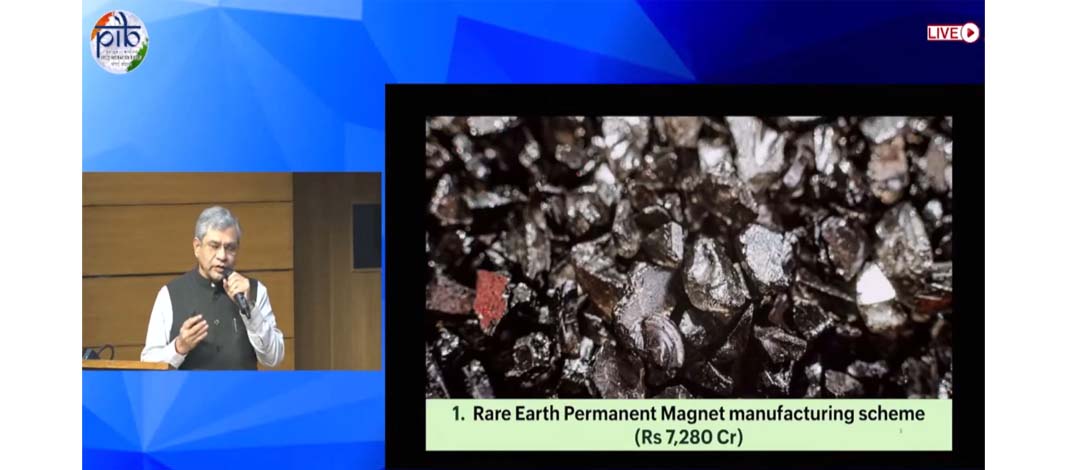
New Delhi : The Union Cabinet, chaired by Prime Minister Narendra Modi, today approved the ‘Scheme to Promote Manufacturing of Sintered Rare Earth Permanent Magnets (REPM)’ with a total outlay of ₹7,280 crore. This first-of-its-kind initiative aims to set up 6,000 Metric Tons per Annum (MTPA) of integrated REPM manufacturing in India, boosting self-reliance and positioning the country as a major player in the global REPM market.
REPMs are some of the strongest types of permanent magnets and are essential for electric vehicles, renewable energy, electronics, aerospace, and defence applications. The scheme will support the creation of integrated facilities that convert rare earth oxides into metals, metals into alloys, and alloys into finished REPMs.
Driven by growing demand from electric vehicles, renewable energy, industrial uses, and consumer electronics, India’s REPM consumption is expected to double by 2030 compared to 2025. Currently, most of India’s REPM requirements are met through imports. This initiative will establish the country’s first integrated REPM manufacturing facilities, generate employment, strengthen self-reliance, and contribute to India’s Net Zero 2070 goals.
The scheme has a total financial outlay of ₹7,280 crore, including ₹6,450 crore as sales-linked incentives over five years and ₹750 crore as capital subsidy to set up the 6,000 MTPA facilities.
The capacity will be allocated to five beneficiaries through global competitive bidding, with each allotted up to 1,200 MTPA. The total duration of the scheme is seven years, including a two-year gestation period to set up the facilities and five years for incentives based on REPM sales.
This initiative marks a major step in strengthening India’s domestic REPM manufacturing ecosystem. By building indigenous capabilities, the scheme will secure supply chains for domestic industries, improve global competitiveness, and support the nation’s commitment to a Net Zero 2070. It reflects the government’s focus on creating a self-reliant, technologically advanced, and sustainable industrial base, in line with the vision of Viksit Bharat @2047.