
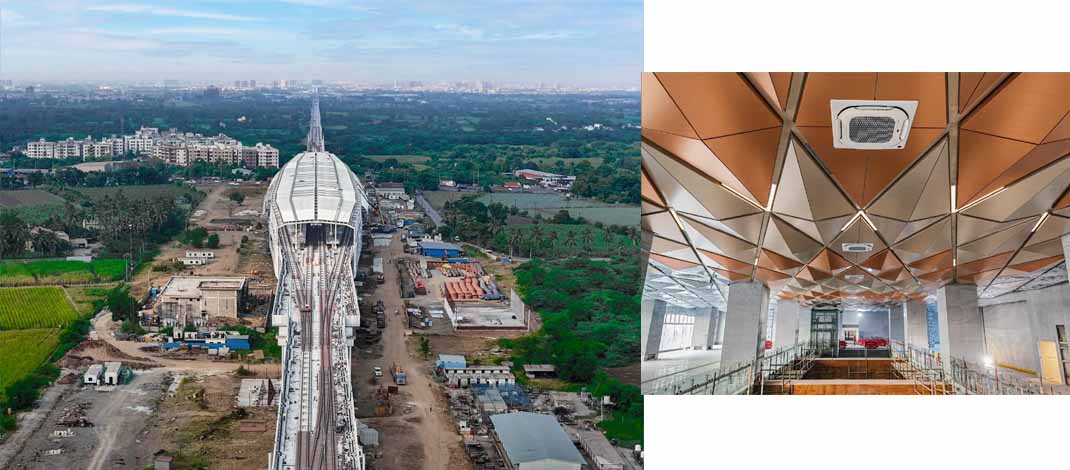
Under-construction station to offer world-class passenger amenities; Surat is an important stop on the Mumbai–Ahmedabad High-Speed Rail Corridor
New Delhi : The Surat Bullet Train Station is taking shape as a modern transportation hub, blending contemporary architecture, smart technology and advanced passenger amenities. The Ministry of Railways has shared photographs offering a glimpse of the station’s ongoing construction, highlighting the progress of India’s ambitious high-speed rail project.
Designed to provide passengers with a modern and comfortable travel experience, the station is being developed as an important stop on the Mumbai–Ahmedabad High-Speed Rail Corridor, India’s first bullet train project.
Mumbai–Ahmedabad Bullet Train Corridor: Key Highlights
The 508-km Mumbai–Ahmedabad High-Speed Rail Corridor is India’s first dedicated bullet train project. Being implemented by the National High Speed Rail Corporation Limited (NHSRCL) with technical and financial assistance from Japan, the project will connect Maharashtra, Gujarat and the Union Territory of Dadra and Nagar Haveli.
Key features of the corridor include:
-
12 stations: Mumbai, Thane, Virar, Boisar, Vapi, Bilimora, Surat, Bharuch, Vadodara, Anand, Ahmedabad and Sabarmati.
-
320 kmph operational speed: The corridor is designed for high-speed train operations.
-
Faster connectivity: The Mumbai–Ahmedabad journey is expected to take around two hours, depending on the stopping pattern.
-
Advanced infrastructure: The project includes elevated tracks, underground sections, advanced signalling and Japanese high-speed rail technology.
- Passenger convenience: Stations are planned with modern ticketing facilities, waiting areas, business-class lounges, retail spaces and connectivity with other modes of transport.
Surat is particularly significant as it is one of the eight stations planned in Gujarat and an important stop on the corridor connecting major commercial and industrial centres of western India.
The project is expected to transform inter-city mobility, improve connectivity between major business hubs and provide a major boost to economic activity along the route.