
Two low-cost sensors to be installed in every Municipal Council and Municipality area across NCR; special mobile monitoring in Sohna and Pataudi
Drones to monitor biomass burning incidents; civic bodies directed to strengthen dust control, improve waste management and increase roadside greenery
Gurugram : The Commission for Air Quality Management (CAQM) has decided to expand its air pollution monitoring and control strategy beyond major urban centres to cover entire districts, including smaller towns and rural areas across the National Capital Region (NCR).
CAQM Chairman Rajesh Verma said that district administrations have so far focused primarily on improving air quality in urban areas. However, considering emerging environmental challenges, it is now essential to monitor and address air pollution across entire districts.
To strengthen the monitoring network, he directed the installation of two low-cost air quality sensors in every Municipal Council and Municipality area across the NCR, ensuring regular monitoring of air quality in smaller towns and settlements as well.
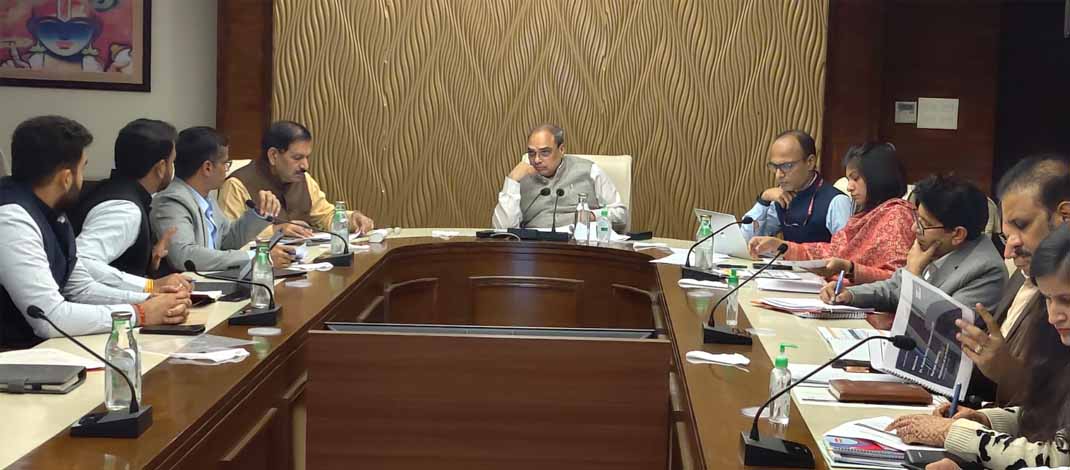
Verma was chairing a review meeting with municipal officials from Gurugram and Jhajjar districts at the PWD Rest House in Gurugram on Thursday. CAQM Member (Technical) S.D. Atri and Member Secretary Tarun Kumar Pithode were also present.
Gurugram Deputy Commissioner Uttam Singh and Jhajjar Deputy Commissioner Varsha Khangwal briefed the commission on the measures being undertaken in their respective districts to improve air quality and control pollution.
Focus on Dust Control, Waste Management and Roadside Greenery
Reviewing the prevailing dust pollution situation, the CAQM Chairman directed all concerned agencies to strictly comply with the statutory directions issued by the Commission from time to time and ensure their effective implementation.
He asked Municipal Corporations, Municipal Councils and Municipalities to strengthen dust-control measures on roads and open spaces falling within their respective jurisdictions.
He also called for continuous monitoring of pollution-control initiatives in both districts and prompt action on complaints received from citizens through social media platforms.
Emphasising the need for better civic management, Verma directed the authorities to curb the practice of open garbage dumping, prioritise road repairs and develop secondary waste collection points in smaller towns.
He further called for special campaigns to increase green cover along roadsides in municipal areas, with maximum public participation to make these initiatives more effective.
Review of Parivartan Scheme, C&D Waste and Door-to-Door Garbage Collection
The Commission also reviewed the implementation of the Parivartan Scheme, management of Construction and Demolition (C&D) waste and door-to-door garbage collection services.
Verma directed the concerned officials to ensure proper collection and disposal of waste and prevent construction and demolition debris from being scattered in open areas.
To prevent biomass burning, he instructed the authorities to identify pollution hotspots and appoint nodal officers to monitor these locations.
He also stressed the need to make adequate arrangements for night shelters during the winter season to prevent people from lighting bonfires in open spaces. Sufficient shelter facilities should be made available so that people in need can protect themselves from the cold.
Mobile Sensors for Special Monitoring in Sohna and Pataudi; Drones to Track Biomass Burning
Highlighting the need for stronger surveillance during the winter months, particularly in December and January, the CAQM Chairman said that incidents of biomass burning must be effectively controlled.
He directed the authorities to strengthen the monitoring mechanism and explore the use of drones for surveillance.
The Gurugram district administration was specifically asked to deploy low-cost mobile air quality sensors in Sohna and Pataudi. Officials were also instructed to identify locations where air quality is more likely to deteriorate and ensure special monitoring at these points.
Verma said that if sensor readings at a particular location are found to be lower than expected, the mobile sensor can be shifted to another location where pollution levels are likely to be higher.
He emphasised that efforts to control air pollution must not remain confined to metropolitan cities and major urban centres. Smaller towns and rural areas must also be brought within the ambit of the air quality improvement campaign.
Ensure Timely LPG Cylinder Refills for Ujjwala Scheme Beneficiaries
CAQM Member Secretary Tarun Kumar Pithode underlined the importance of ensuring uninterrupted access to clean cooking fuel under the Pradhan Mantri Ujjwala Yojana.
He said the Central Government’s flagship scheme has played an important role in improving air quality across the NCR.
Citing a survey, Pithode stated that the implementation of the scheme over the past 10 years had contributed to an improvement of up to 40 per cent in air quality in the NCR region.
He directed district administrations to ensure timely refilling of LPG cylinders provided to beneficiaries under the Ujjwala scheme so that families are not compelled, due to financial or other constraints, to return to traditional cooking fuels such as firewood.
He stressed that ensuring the continuous availability of clean cooking fuel is an important step towards controlling air pollution.
Gurugram Municipal Corporation Commissioner Dr. Pankaj, Manesar Municipal Corporation Commissioner Pradeep Singh, Jhajjar Additional Deputy Commissioner Jagnivas, Gurugram Municipal Corporation Additional Commissioner Ravinder Kumar, officials of the Pollution Control Boards of Gurugram and Jhajjar, and representatives of other concerned departments attended the meeting.