
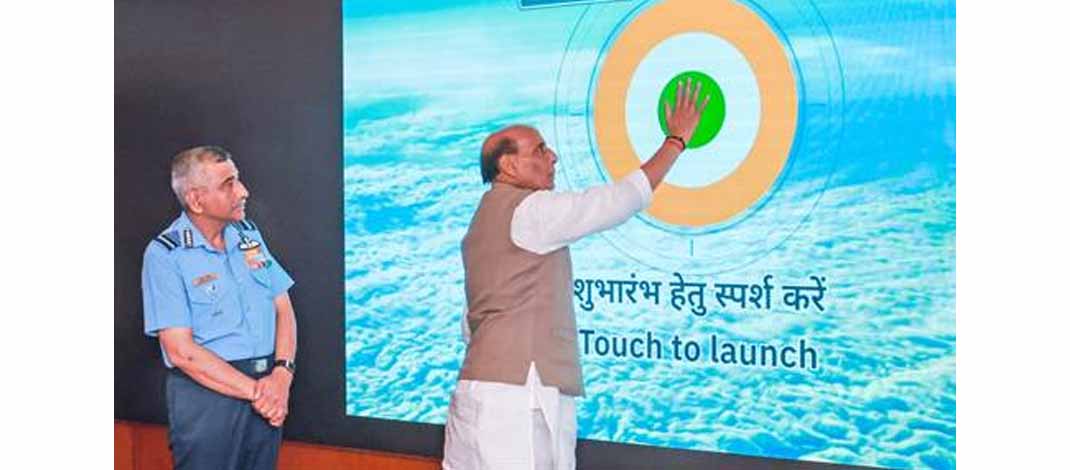
New Delhi : Defence Minister Rajnath Singh asked the armed forces to strengthen both the offensive and defensive sides of the “element of surprise,” so that they stay ready for conventional and emerging threats. He said such threats are growing out of rapid technological change and the shifting nature of modern warfare. He was speaking at the Air Force Commanders’ Conference in New Delhi.
He stressed the need to keep improving intelligence and surveillance, better integrate systems and spot potential threats before they develop. The forces, he said, must build capabilities and methods that leave an adversary no time to react or recover, while making sure India is never caught off guard by an enemy move. Surprise can take conventional or electronic forms, he noted, and personnel must remain alert, agile and ready to respond to any emerging challenge.
Changing character of warfare
Rajnath Singh said modern conflicts are moving beyond traditional battlefields into non-contact domains, where missiles, drones and advanced weapon systems play a major role. Citing the Russia-Ukraine and Israel-Hamas conflicts, he said drones and air defence systems have become critical to modern warfare. He asked commanders to prepare for challenges such as kamikaze drones, surveillance and counter-drone operations.
 New doctrines for emerging domains
The Defence Minister asked the Indian Air Force (IAF) to develop dedicated doctrines and architectures for electronic, cyber and space warfare. He said victory in future conflicts will depend not only on the number of aircraft, but also on technological sophistication, speed of response and precision in preparation. He urged commanders to make these challenges a core priority and build them into institutional thinking, planning and operational processes.
He added that the armed forces are going through a transformative phase, with reforms in organisational structures, jointness and integration, and operational concepts. The changing security environment, he said, demands continuous adaptation and a forward-looking approach.
Operation Sindoor and jointness
Rajnath Singh praised the IAF for applying its doctrines and operational methods effectively during and after Operation Sindoor, and commended the professionalism, restraint and judgement of its air warriors. He said lessons from the operation are visible in the IAF’s evolving procedures, especially its greater emphasis on drones and air defence, and are shaping the pace and direction of change across the forces.
He also congratulated all three Services for the coordination and integration they showed during the operation, and said jointness must continue to guide military planning and execution.
Training and Agniveers
Appreciating the IAF’s efforts to upgrade the skills of its personnel, he urged commanders to keep training air warriors in emerging technologies. He also said the technological knowledge of young recruits should be used, as it can strengthen decision-making and organisational development.
On the Second Tour of Duty for Agniveers, he said the decision followed feedback from the armed forces, reflecting the government’s commitment to taking the Services’ suggestions into policy. He expressed confidence that the initiative will further strengthen the three Services.
AI applications launched
At the conference, the Defence Minister launched a suite of artificial intelligence (AI) applications developed in-house by the IAF’s AI Centre of Excellence, part of the Unit for Digitisation, Automation, Artificial Intelligence and Application Networking (UDAAN). The applications will automate and speed up tasks in operations, administration and aerospace safety, and run on the IAF’s secure network. The launch marks a significant step in the IAF’s technology-driven transformation.
Attendees and theme
The inaugural session was attended by Raksha Rajya Mantri Sanjay Seth, Chief of the Air Staff Air Chief Marshal Ashutosh Dixit, Defence Secretary Rajesh Kumar Singh, Secretary (Defence Production) Sanjeev Kumar and Secretary (Defence Finance) Vishvajit Sahay. Air Officers Commanding-in-Chief of all IAF Commands, principal staff officers and director generals also attended.
The two-day conference is themed “The Year of Empowerment: Maximising Efficiency Through Decentralisation.” It gives the IAF’s senior leadership a forum to discuss operations, maintenance and administration.