
Rekha Gupta Government Introduces Comprehensive Measures Covering Vehicle Emissions, Construction Activities, 50% Work-from-Home, Higher Parking Charges and Strict Pollution Monitoring
New Delhi : With air pollution emerging as a major environmental and public health challenge during the winter months, the Delhi Government has brought its comprehensive Winter Pollution Action Plan into force from November 1. The initiative aims to reduce vehicular emissions, control construction-related dust, minimise traffic congestion and strengthen enforcement of pollution-control regulations across the national capital.
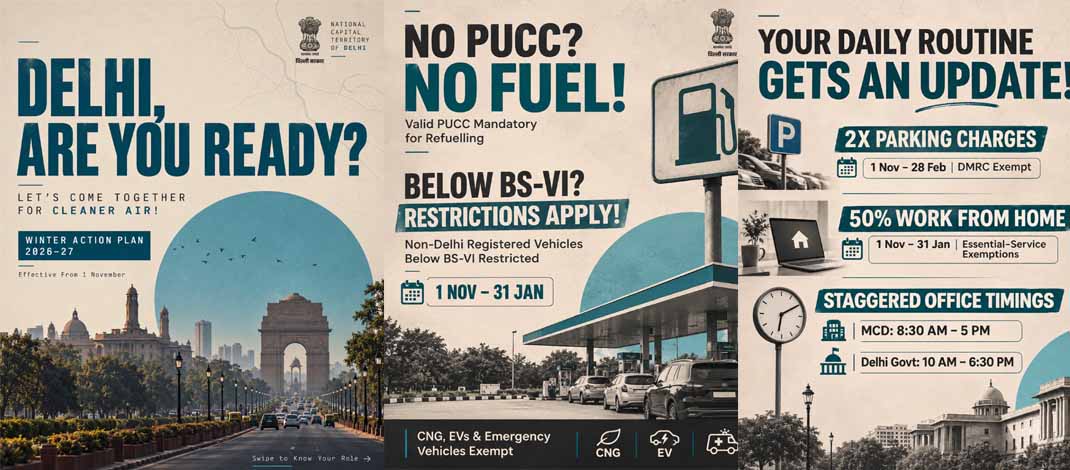
Under the new framework, vehicles registered outside Delhi that do not comply with Bharat Stage-VI (BS-VI) emission standards will not be permitted to enter the national capital from November 1 to January 31, 2027. However, CNG and electric vehicles, along with specified exempted and essential-service vehicles, will be allowed entry subject to applicable regulations.
The Winter Action Plan, notified as a permanent annual framework, will remain operational from November 1 to February 28 every year. It consolidates multiple pollution-control interventions into a coordinated mechanism involving the Delhi Government, the Centre, the Commission for Air Quality Management (CAQM), the Central Pollution Control Board (CPCB), municipal bodies, Delhi Police and other concerned agencies.
The government has emphasised that effective implementation will require coordinated administrative action as well as active participation from residents, businesses, industries and public institutions.
Delhi Chief Minister Smt. Rekha Gupta has announced the implementation of the Delhi Winter Action Plan 2026–27 from November 1, introducing stricter pollution-control measures, enhanced enforcement mechanisms and round-the-clock monitoring to tackle the national capital’s recurring air pollution challenges during the winter season.
Emphasising the importance of collective efforts in addressing deteriorating air quality, the Chief Minister appealed to all Delhi residents to follow the prescribed pollution-control guidelines and actively participate in the government’s initiatives to make the capital’s environment cleaner and healthier.
Under the leadership of Chief Minister Rekha Gupta, the Delhi Government is seeking to strengthen its multi-pronged strategy to address major sources of pollution, including vehicular emissions, construction dust, road dust, industrial activities and waste burning.
The Winter Action Plan places particular emphasis on stricter regulatory compliance, continuous surveillance and coordinated action by the concerned government departments and enforcement agencies.
The Chief Minister stressed that government interventions alone cannot deliver the desired results without active public cooperation. She urged citizens to adopt environmentally responsible practices, minimise unnecessary use of private vehicles, ensure compliance with vehicle emission standards and avoid activities that contribute to air pollution.
Calling for a united effort, she appealed to Delhiites to take responsibility for protecting the environment and supporting measures aimed at improving public health and air quality.
1. Restrictions on Non-BS-VI Vehicles
One of the major components of the Winter Action Plan is the restriction on the entry of older, more polluting vehicles registered outside Delhi.
From November 1, vehicles registered outside the national capital that do not meet BS-VI emission standards will be prohibited from entering Delhi until January 31, 2027. CNG and electric vehicles are exempt from this particular restriction, along with other specified exempted categories.
The measure is intended to reduce vehicular emissions entering the capital from neighbouring states, particularly during winter when unfavourable meteorological conditions can contribute to the accumulation of pollutants.
The Delhi Traffic Police will enforce the restrictions at entry points and advise motorists to verify their vehicle eligibility before travelling to the capital.
2. ‘No PUC, No Fuel’ Policy to Be Enforced
The government is also implementing the ‘No Pollution Under Control Certificate (PUCC), No Fuel’ policy to ensure that vehicles comply with prescribed emission standards.
Under this provision, vehicles without a valid Pollution Under Control (PUC) certificate will not be supplied petrol, diesel, CNG or LPG at fuel stations across Delhi.
The enforcement drive will cover approximately 500 fuel stations equipped with Automatic Number Plate Recognition (ANPR) systems. These facilities will help authorities identify non-compliant vehicles and strengthen monitoring.
The policy is intended to encourage vehicle owners to obtain timely emission tests and maintain valid pollution certificates rather than allowing vehicles with excessive emissions to continue operating without checks.
3. Restrictions on Construction and Demolition Activities
Construction dust is another major contributor to air pollution in Delhi. To address this challenge, the government has introduced restrictions on dust-generating activities during the winter season.
The key provisions include:
-
Dust-generating demolition activities and outdoor civil construction work will remain prohibited from November 1 to January 31, except for specified essential public infrastructure projects.
-
A more comprehensive ban on construction and demolition activities will be imposed from December 10 to January 20.
-
Large commercial buildings and major construction sites will be required to install anti-smog guns or mist-based systems for dust suppression.
-
Construction sites will be monitored through AI-enabled cameras connected to the government’s Command and Control Centre.
-
CCTV surveillance and digital monitoring will be strengthened to identify violations and ensure compliance with environmental guidelines.
The government is also strengthening the use of the ‘Malba App’ for monitoring construction and demolition waste management.
These measures are aimed at preventing dust from construction sites, unregulated demolition and the improper disposal of building materials from contributing to the city’s pollution burden.
4. Work-from-Home and Staggered Office Timings
To reduce the number of private vehicles on Delhi’s roads and minimise traffic-related emissions, the government has introduced a 50% work-from-home arrangement.
Under the announced framework, government and private establishments will be required to implement arrangements under which 50% of employees work from home, with the remaining workforce attending offices physically. The arrangement is intended to operate from November 1 to January 31, 2027.
Staggered office timings have also been introduced to reduce congestion during peak commuting hours.
The revised timings include:
-
Municipal Corporation of Delhi (MCD) offices: 8:30 AM to 5:00 PM.
-
Delhi Government offices: 10:00 AM to 6:30 PM.
By distributing office traffic across different time slots and reducing daily commuting requirements, the government aims to ease congestion and lower vehicular emissions.
5. Parking Charges Doubled to Discourage Private Vehicles
In another step to encourage public transport and reduce dependence on private vehicles, parking charges at authorised parking facilities across Delhi will be doubled from November 1, 2026, to February 28, 2027.
Parking facilities owned and operated by the Delhi Metro Rail Corporation (DMRC) are exempt from this increase.
The higher parking charges are intended to encourage commuters to use public transport, including the Delhi Metro and city bus services, wherever feasible.
6. Greater Focus on Public Transport and Electric Mobility
The Winter Action Plan places considerable emphasis on strengthening public transportation as a long-term solution to vehicular pollution.
Delhi’s public transport network currently includes 6,840 buses, of which 5,088 are electric buses. The government is seeking to increase daily ridership to approximately 72 lakh passengers on the Delhi Metro and 42 lakh passengers on Delhi Transport Corporation (DTC) buses.
A special campaign to encourage the use of the Delhi Metro’s Sarthi App has also been undertaken to improve last-mile connectivity.
The objective is to make public transport a more convenient alternative to private vehicles, particularly for daily commuters.
The government is also promoting its EV Policy 2026 and the Parivartan Yojana, including incentives for scrapping older vehicles and encouraging the adoption of cleaner mobility alternatives.
7. Mechanised Road Cleaning and Dust Suppression
The government has intensified efforts to control road dust, which contributes significantly to particulate pollution, particularly PM10.
The measures include:
-
Deployment of 98 mechanised road-sweeping machines operating in two shifts.
-
Regular water sprinkling and deep cleaning of major roads.
-
Paving of road shoulders and footpaths to prevent dust accumulation.
-
Removal of garbage, construction debris and accumulated waste from roadsides.
-
Accelerated redevelopment of approximately 3,000 kilometres of roads.
According to the government, road redevelopment work covering 1,193 kilometres had already been completed, with further work targeted for completion in November 2026.
The authorities have also directed concerned agencies to address public complaints relating to road dust and sanitation within 72 hours, in accordance with the prescribed standard operating procedure.
8. Special Monitoring of Pollution Hotspots
The government has identified 37 major air-quality and traffic hotspots requiring focused intervention.
Weekly inspections will be conducted by public representatives, including Members of Parliament, MLAs and councillors, along with designated nodal officers and enforcement agencies.
The monitoring will focus on:
-
Traffic congestion and vehicle emissions.
-
Road dust and construction-related pollution.
-
Illegal parking and road encroachments.
-
Open dumping and waste accumulation.
-
Biomass and garbage burning.
Of the identified 15 major road stretches targeted for traffic decongestion and signal-free movement, eight have reportedly already been addressed, with work on the remaining stretches being expedited.
9. Action Against Industrial Pollution and Open Waste Burning
Industrial emissions and the open burning of waste and biomass are also being targeted under the action plan.
The government has decided to strengthen industrial inspections, improve compliance monitoring and take strict action against units violating pollution-control standards.
An AI-enabled Command and Control Centre will support monitoring and enforcement. The number of monitoring stations is also planned to increase from 47 to 60.
Additionally, 334 enforcement teams are being deployed to ensure compliance, inspect industrial establishments and prevent activities contributing to air pollution.
A special ‘Zero Burning’ campaign will target the open burning of garbage, leaves and other waste materials. Resident Welfare Associations (RWAs), market associations and institutions will also be encouraged to participate in preventing such practices.
10. Graded Response Action Plan (GRAP) to Operate Alongside Winter Measures
The Winter Pollution Action Plan will function alongside the Commission for Air Quality Management’s Graded Response Action Plan (GRAP).
GRAP prescribes additional emergency restrictions depending on the severity of air pollution and the Air Quality Index (AQI).
As pollution levels deteriorate, progressively stricter measures can be introduced, including restrictions on construction activities, vehicle movement, industrial operations and other pollution-generating activities.
The objective is to ensure that preventive measures are implemented in advance and additional interventions are activated whenever air quality reaches prescribed thresholds.
Government Appeals for Public Participation
The Delhi Government has emphasised that controlling winter pollution cannot be achieved through administrative restrictions alone. Citizens, industries, RWAs, market associations and public institutions have been urged to contribute actively.
People have been encouraged to:
-
Prefer public transport, Metro services and carpooling.
-
Keep vehicle PUC certificates valid.
-
Avoid unnecessary use of private vehicles.
-
Refrain from burning garbage, leaves and other waste.
-
Follow construction dust-control regulations.
-
Report illegal dumping and pollution-related violations.
-
Support electric mobility and environmentally responsible practices.