
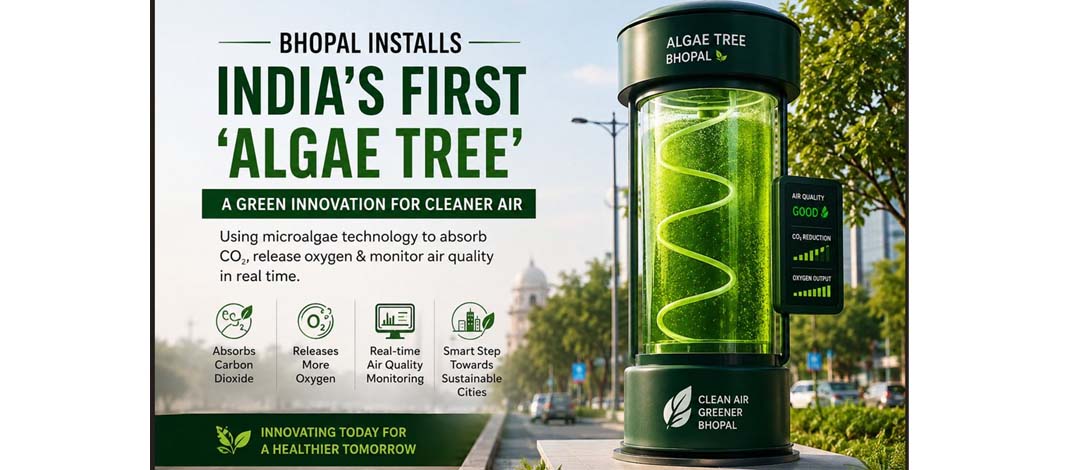
New Delhi : In a significant step towards promoting innovative green technologies and sustainable urban development, India’s first “Algae Tree” has been installed at. The project represents an experimental approach to improving urban air quality through advanced environmental engineering and biotechnology.
The “Algae Tree” is a solar-powered vertical photobioreactor system designed to absorb carbon dioxide (CO₂) and release oxygen through the process of photosynthesis carried out by microalgae suspended in water. Although termed a “tree,” the installation is not a natural tree but a specially engineered device developed to replicate some environmental benefits provided by conventional trees.
According to project developers, a single unit has the potential to absorb nearly 1.5 tonnes of carbon dioxide annually, which is considered equivalent to the carbon absorption capacity of approximately 20 to 25 mature trees. In addition to carbon capture, the system is also expected to help reduce PM2.5 particles and other airborne pollutants in nearby surroundings, contributing to localized air quality improvement.
The structure operates using solar energy through panels mounted on top of the installation, making it an energy-efficient and environmentally sustainable system with minimal external power requirements.
The project has been developed by after nearly two years of research and technical development involving scientists, engineers, and environmental experts. Officials associated with the initiative stated that such systems are particularly useful in densely populated urban areas where space limitations restrict large-scale plantation activities.
Experts have clarified that the technology is intended to complement natural plantation efforts rather than replace conventional trees. The installation is currently being evaluated as a smart pollution-control solution capable of integrating biological processes with engineering innovation for cleaner urban environments.
The initiative has attracted considerable attention as part of India’s broader focus on sustainable technologies, smart cities, and innovative environmental management systems aimed at addressing rising urban pollution challenges.