
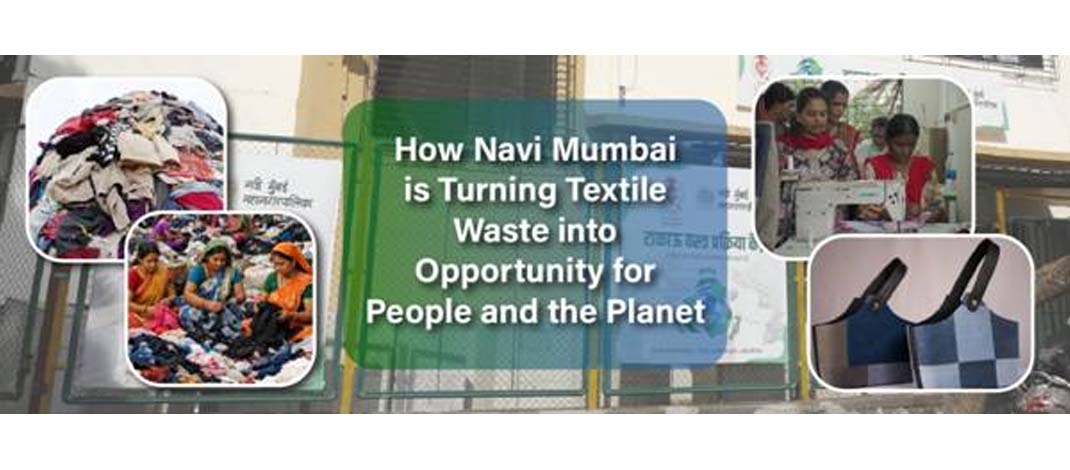
New Delhi : Navi Mumbai is emerging as a national leader in sustainable waste management with its pioneering Textile Recovery Facility (TRF), transforming post-consumer textile waste into economic opportunity through circular systems and community participation. Implemented under the Swachh Bharat Mission-Urban 2.0, the initiative is reducing landfill burden, generating livelihoods, and offering a scalable model for urban India.
India produces nearly 7.8 million metric tonnes of textile waste annually, much of which ends up in landfills. Addressing this challenge, the Navi Mumbai Municipal Corporation established the country’s first municipal-level TRF in Belapur, positioning textile waste as a valuable resource within a circular economy framework.
A Circular Ecosystem for Textile Waste
The TRF operates as a comprehensive ecosystem integrating collection, sorting, technology, and livelihood generation. Textile collection is decentralised, with 140 dedicated bins already installed across housing societies in all eight municipal wards, with plans to scale up to 250.
At the Belapur facility, set up in a repurposed urban health centre, collected textiles are scientifically sorted into reusable, recyclable, upcyclable, downcyclable, and reject categories. Advanced tools such as the KOSHA handheld scanner enable real-time fibre identification—including cotton, polyester, wool, and silk—enhancing accuracy and efficiency.
A digital tracking system is also being developed to map the journey of each item from donation to final use, ensuring transparency and data-driven operations. Post-sorting, materials are sanitised and prepared for reuse or transformation.
From Waste to Livelihoods
Recovered textiles are creatively upcycled into bags, garments, accessories, and home décor products by women from self-help groups. These products are showcased and sold at exhibitions, giving discarded materials a second life.
More than 300 women have been trained through structured programmes, with over 150 currently earning between ₹9,000 and ₹15,000 per month. The initiative has enabled many homemakers to transition into skilled workers within the circular economy, creating green jobs and strengthening local entrepreneurship.
Strong Impact and Community Participation
The TRF has collected around 30 metric tonnes of textile waste, of which 25.5 metric tonnes have been scientifically processed. Over 41,000 items have been handled, averaging nearly 500 items daily.
The initiative has engaged over 1.14 lakh households, conducted more than 75 awareness workshops, and onboarded 350+ housing societies—highlighting strong citizen participation. It has also developed over 400 upcycled product samples and successfully piloted paper production from rejected textile waste.
Scaling Up a Sustainable Model
Despite initial challenges such as resistance to bin placement and complexities in sorting mixed fibres, the project has overcome these through sustained awareness campaigns, phased implementation, and technological integration.
Building on its success, plans are underway to establish a permanent, higher-capacity TRF in Koparkhairane near Nisarg Udyan.
A Model for Urban India
The Navi Mumbai TRF demonstrates how urban waste streams can be transformed into drivers of economic and environmental value. It aligns with national missions like Swachh Bharat 2.0 and the Smart Cities Mission, as well as global sustainability goals such as Sustainable Development Goal 12.
By combining innovation, community engagement, and sustainability, the initiative sets a benchmark for cities across India to adopt circular solutions for textile waste management.