
- Notice Within Three Days, 45 Days to Decide on Challan; Grievances to be Resolved Within 30 Days
- 27 Scrapping Centres to Promote Scrapping of Old Vehicles and Pollution Control
Panchkula, October 6. Haryana Police has taken a significant step towards strengthening compliance with traffic rules, road safety and traffic management by implementing the Next Gen E-Challan system across the state. Under this technology-driven system, action against traffic violations will not only be more transparent and digital, but the entire process—from issuance of challan to its disposal—will be time-bound and accountable.
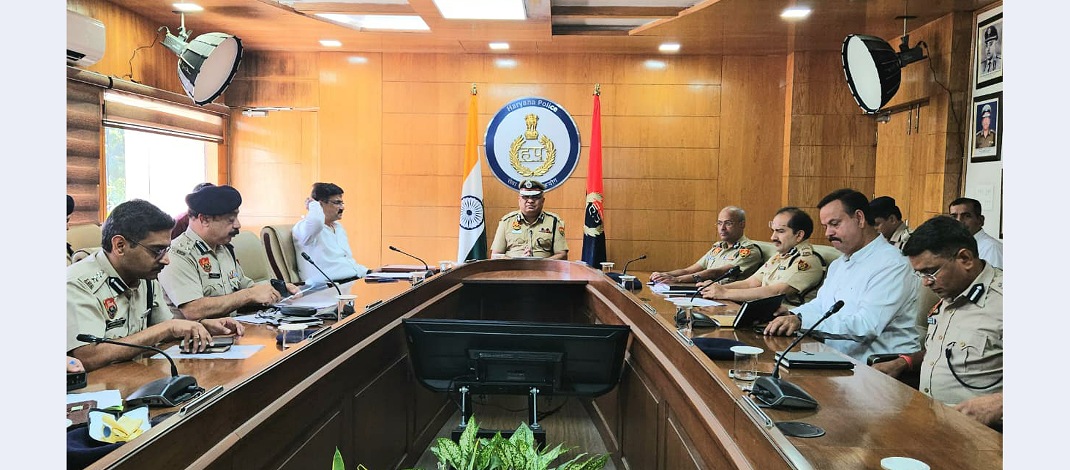
Director General of Police, Haryana, Shri Ajay Singhal, reviewed various issues related to traffic management, road safety and pollution control during a review meeting held at Police Headquarters, Panchkula, with Additional Directors General of Police, Inspectors General of Police, Superintendents of Police and other senior police officers of the state. The DGP directed the officers to ensure that technology-driven policing is translated into effective results at the ground level, with the safety of citizens remaining the highest priority.
- Next Gen E-Challan: Entire Process to be Digital, Time-Bound and Accountable
During the meeting, ADGP Shri Vikas Arora apprised the participants of the initiatives being undertaken for traffic management and enforcement in the state. He informed that in accordance with the notification issued by the Ministry of Road Transport and Highways (MoRTH) on January 20, 2026, the Next Gen E-Challan system has been implemented in Haryana with effect from June 16, 2026. Under the new system, a notice will be sent within three days of the traffic violation, and the vehicle owner/driver will have 45 days to accept or contest the challan. If no action is taken within the stipulated period, the challan will be deemed to have been accepted automatically. If the vehicle owner/driver files a grievance against the challan, it will be mandatory to dispose of the grievance within 30 days. If the grievance is not disposed of within the stipulated period, it will be deemed to have been accepted automatically. One Nodal Officer and two Grievance Redressal Officers have been appointed in each district.
In case a grievance is rejected, the vehicle owner/driver can challenge the challan before the court after depositing 50 percent of the challan amount, while an accepted challan must be paid within 90 days. Further, under Rule 167(12) of the Central Motor Vehicles Rules, 1989, registration-related or driving licence-related transactions of the concerned vehicle/driver may be restricted until disposal of the pending challan, and the vehicle can be marked as “Not to be Transacted” on the portal. Under Rule 167(13), police officers are also empowered to detain the motor vehicle as per the prescribed provisions. This system marks an important step towards transforming traffic enforcement from a paperwork-based process into a digital, transparent and accountable mechanism.
- Large-Scale Enforcement Against Traffic Violations
During the meeting, Superintendent of Police Pushpa Khatri informed that Haryana Police has undertaken extensive enforcement against traffic violations during 2026. During this period, action was taken in 1,40,851 cases of vehicles without number plates, 3,03,435 cases of lane driving violations, 37,332 cases of drunken driving, 2,68,360 cases of driving on the wrong side, 9,75,160 cases of riding/driving without helmets, 77,413 cases of vehicles without valid PUC and 3,67,118 cases of over-speeding. These figures reflect that Haryana Police views road safety not merely as a matter of enforcement, but as an effort to build a disciplined and safe traffic system. Special emphasis is being laid on strict action against serious violations such as driving without helmets, over-speeding, driving on the wrong side and drunken driving.
- Promoting ‘Preventive Policing’ to Tackle Traffic Congestion
DGP Ajay Singhal directed the officers to adopt preventive and data-driven traffic management strategies to address the problem of traffic congestion. He directed that congestion-prone areas be continuously monitored through available technological tools such as control rooms, digital mapping and Google Maps. At locations where traffic congestion occurs regularly, advance deployment of police personnel, traffic diversions and other necessary arrangements should be ensured according to local conditions, so that instead of responding after congestion occurs, a strategy is adopted to prevent traffic jams in the first place.
- Focus on Pollution Control through Scrapping of Old Vehicles
The meeting also discussed in detail the restrictions related to the operation of BS-III and below-standard vehicles in the NCR region and the government’s vehicle scrapping policy. ADGP Traffic informed that 27 scrapping centres have been established in the state for scrapping old vehicles. Eligible vehicle owners can scrap their old vehicles and avail themselves of the prescribed scrap value, concessions in commercial tax and other benefits available as per rules on the purchase of a new vehicle. The DGP directed the officers to create widespread public awareness about the vehicle scrapping policy and ensure its effective implementation in coordination with the concerned departments. He said that clean air, safe roads and well-regulated traffic are all important components of a modern and citizen-centric policing system.
- DGP Ajay Singhal Directs: Technology, Data and Preventive Policing to Build a Safe and Smart Traffic System
DGP Ajay Singhal said that the objective of Haryana Police is not to limit traffic management merely to compliance with rules, but to ensure a safe, smooth and well-organised traffic system through technology, data and preventive policing. He directed the officers to ensure effective and impartial enforcement against traffic violations, while also ensuring scientific and time-bound solutions at the local level to issues related to traffic congestion, road safety, pollution control and traffic management. He said that the Next Gen E-Challan system will enhance transparency and accountability in the enforcement process, while technology-driven monitoring will enable the police to identify potential traffic congestion and other issues in advance and take necessary action. The DGP directed the officers to develop a policing system through the integration of modern technology and human sensitivity, wherein road safety, citizen convenience and effective compliance with the law remain the highest priorities.
- Those Present
Additional Directors General of Police Sanjay Kumar, Saurabh Singh, Vikas Arora and several other senior police officers were present in the meeting. Other senior officers and police personnel from across the state participated in the meeting through video conferencing.