
Initiative to drive KPI-based sanitation, technology-enabled monitoring, scientific waste management and citizen participation under SBM-U 2.0
New Delhi: In line with the directions of Prime Minister Narendra Modi during the 51st PRAGATI meeting, the Ministry of Housing and Urban Affairs (MoHUA) has identified 50 cities across 24 states under the PRAGATI-50 initiative to establish higher benchmarks of urban cleanliness.
The initiative, launched under the framework of Swachh Bharat Mission–Urban 2.0 (SBM-U 2.0), seeks to demonstrate sustained, visible improvements in sanitation through targeted, Key Performance Indicator (KPI)-based action, intensive monitoring and technology-enabled governance.
Click here to see the list of 50 cities
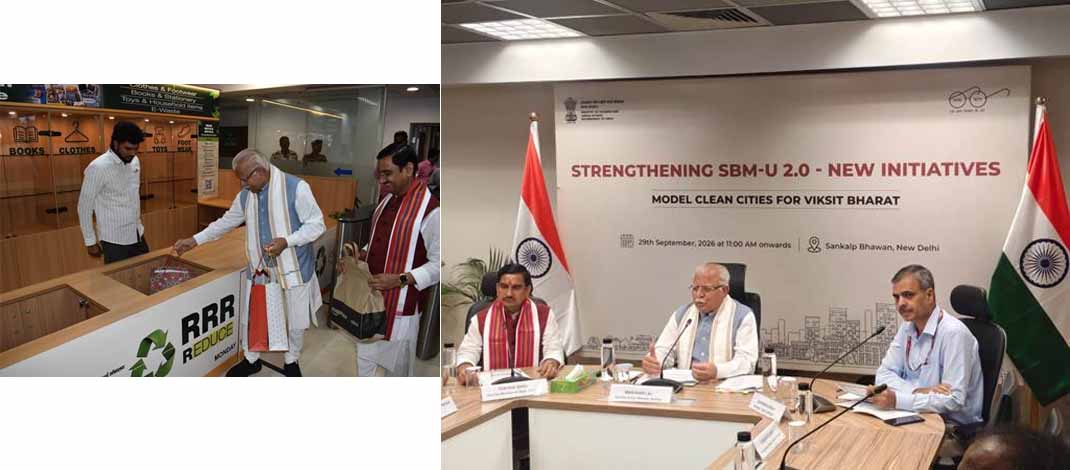
Speaking at the launch, Union Minister for Housing and Urban Affairs Manohar Lal said the 50 cities would serve as clean-city role models by moving beyond routine sanitation activities and demonstrating sustained high-performance standards in visible cleanliness.
He said the selection covers major cities, culturally significant cities, leading tourism destinations and important economic centres. The initiative will focus on visible improvements in urban cleanliness, solid waste management, used water management, sanitation and citizen participation through a structured monitoring and review mechanism.
Manohar Lal said the progress of the selected cities would be assessed continuously through outcome-based evaluations and technology-enabled monitoring. He added that he would personally chair review meetings every two months to monitor the advancement of the initiative.
Focus on Garbage Free Cities
Minister of State for Housing and Urban Affairs Tokhan Sahu said that over the past decade, Swachhata has evolved from a people’s movement into a way of life.
Referring to the PRAGATI-50 initiative, Sahu said the programme would support cities in achieving the objective of becoming Garbage Free Cities within a defined timeframe and enable them to emerge as models for other urban centres.
He called upon States and Urban Local Bodies (ULBs) to prepare micro-level action plans and ensure their timely and effective implementation.
Highlighting the convergence of youth power and technology, Sahu noted that India has emerged as the world’s third-largest startup ecosystem. He also said that the launch of the third cohort of startups in collaboration with IIT Kanpur marks the achievement of the national target of onboarding and incubating 75 startups under the Mission.
‘City as a Whole’ approach
Secretary, Department of Urban Development (DoUD), MoHUA, Satendra Singh said the initiative would focus on improving citizen experience and ensuring holistic service delivery.
He highlighted the “City as a Whole” approach, under which all stakeholders, partners and Urban Local Bodies will be brought together in the planning and implementation process.
For effective supervision, MoHUA has established a PRAGATI-like Pro-Active Governance and Timely Implementation digital review mechanism on the Swachhatam Portal. Ministry officers will be assigned specific cities for regular monitoring, supervision and handholding.
New guidelines for waste management
Recognising that sustainable urban transformation requires continuous capacity building and knowledge sharing, SBM-U has provided stakeholders with technical guidelines, model designs and targeted advisories.
During the programme, two important documents were released to support implementation on the ground:
- Standard Operating Procedure for Establishment of Secondary Collection Centre for Construction & Demolition Waste (C&D)
- Guidelines for Source Segregation of Municipal Solid Waste, mandated under the Solid Waste Management Rules, 2026
Swachh Bharat Test Bed & Innovation Centre launched
MoHUA, in collaboration with CSIR-CMERI, launched the Swachh Bharat Test Bed & Innovation Centre at Durgapur.
The national facility will support research, product development, testing, validation, certification and capacity building in sanitation technologies, strengthening the innovation ecosystem for urban sanitation.
Third cohort of sanitation startups launched
SBM-Urban has increasingly moved towards technology-driven solutions across the waste-management value chain. Under the Mission, 75 startups have been engaged to accelerate innovation.
MoHUA, in partnership with the Startup Incubation and Innovation Centre (SIIC), IIT Kanpur, launched the third cohort of startups focused on sanitation and waste-management solutions.
A total of 13 startups have joined Cohort 3, with the programme aimed at accelerating the deployment of technology-based solutions for cleaner and more sustainable cities.
Dedicated WhatsApp channel for Swachhata complaints
To strengthen citizen participation, MoHUA also launched a dedicated WhatsApp channel linked to the Swachhata ecosystem.
The initiative builds upon the Swachhata App, which enables citizens to register complaints and seek grievance redressal. The WhatsApp channel is intended to provide citizens with a more accessible platform to report sanitation-related issues and participate in keeping their cities clean.
Swachhata Behaviour Change Digital Kosh
Union Minister Manohar Lal also launched the Swachhata Behaviour Change Digital Kosh, a digital repository bringing together ideas, creatives, campaigns and communication resources aimed at strengthening behavioural change for a cleaner and more sustainable India.
The platform will provide States, ULBs and other stakeholders with ready-to-use communication material, innovative campaign ideas and advocacy resources. It is designed to facilitate knowledge sharing, replication of successful campaigns and citizen-centric communication, with the broader objective of making Swachhata a habit and a way of life.
RRR Centre inaugurated under Swachhata Hi Seva 2026
As part of Swachhata Hi Seva 2026, Manohar Lal inaugurated a Reduce, Reuse and Recycle (RRR) Centre at Sankalp Bhawan in New Delhi.
The centre is envisaged as the first such facility in a Union Ministry office and will promote sustainable consumption, reuse, resource recovery and circular-economy practices within government workplaces.
The PRAGATI-50 initiative, along with these innovation, technology and citizen-engagement measures, marks another step in MoHUA’s efforts to strengthen urban sanitation through scientific waste management, circularity, innovation, peer learning and capacity building.
The broader objective is to support the development of garbage-free, resilient and future-ready cities as India advances towards the vision of Viksit Bharat 2047.