
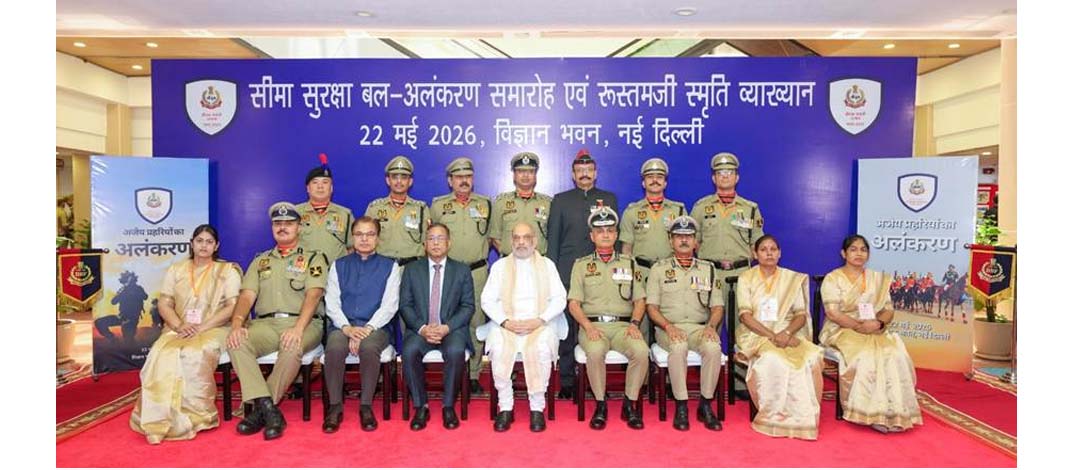
New Delhi : Union Home Minister and Minister of Cooperation Amit Shah attended the Border Security Force (BSF) Investiture Ceremony and Rustamji Memorial Lecture as the Chief Guest in New Delhi, where he emphasized the need for technologically advanced and coordinated border security to tackle emerging threats facing the country.
The event was attended by several senior officials, including the Director of the Intelligence Bureau, Secretary (Border Management), and the Director General of the BSF.
Addressing the gathering, Amit Shah said the investiture ceremony reflects the BSF’s unwavering dedication, discipline, and commitment towards national security. He recalled that following the 1965 war, the need for a dedicated border guarding force during peacetime led to the establishment of the Border Security Force under the leadership of Padma Vibhushan K.F. Rustamji. He said the strong foundation laid by Rustamji helped transform the BSF into one of the world’s most respected border guarding forces.
The Home Minister said the nature of border security challenges has changed significantly over time, with threats such as illegal infiltration, narcotics smuggling, cattle smuggling, counterfeit currency, organized crime, cyber threats, hybrid warfare, and drone-based smuggling emerging as major concerns. He praised the BSF for effectively confronting these challenges despite difficult circumstances.
Amit Shah stressed that border security can no longer rely solely on traditional methods and called for greater coordination among State Police, Central Armed Police Forces (CAPFs), intelligence agencies, the Narcotics Control Bureau, armed forces, and state administrations. He said border security should be viewed as a broader territorial responsibility requiring integrated efforts.
Highlighting the difficult conditions in which BSF personnel serve, he said the force remains deployed across some of the country’s toughest terrains, including Siachen, Kashmir, Rajasthan deserts, the Rann of Kutch, Sundarbans, and the eastern borders in Tripura, Meghalaya, and Mizoram. He noted that the BSF, which began in 1965 with just 25 battalions, has now grown into the world’s largest border guarding force with around 2.70 lakh personnel.
Referring to India’s evolving security doctrine under the leadership of Prime Minister Narendra Modi, the Home Minister said the country has adopted a firm approach against terrorism. Mentioning incidents such as Uri, Pulwama, and Pahalgam, he said India responded through surgical strikes, air strikes, and Operation Sindoor by targeting terror infrastructure across the border.
Amit Shah announced that the Government of India will soon launch a Smart Border Project equipped with advanced technologies including drones, radars, and modern surveillance systems to strengthen border security. He said the initiative aims to create an impregnable security grid along the India-Bangladesh and India-Pakistan borders within the next year.
The Home Minister also stated that the government is committed to preventing illegal infiltration and identifying and deporting infiltrators. He urged the BSF to work closely with local administrations, police stations, and village-level officials to identify infiltration routes and dismantle smuggling networks operating along border areas.
He further said that the government’s efforts have significantly reduced Naxalism in the country and emphasized that security policies should focus not merely on controlling threats but on eliminating them completely.
Highlighting welfare initiatives, Amit Shah said that along with strengthening border infrastructure through Vibrant Villages programmes and Smart Border initiatives, the government will soon introduce a major welfare programme for BSF personnel and all CAPF jawans within the next two months.
The Home Minister also announced that the government will launch a nationwide campaign against narcotics trafficking, in which the BSF will play a crucial role. He urged BSF personnel to adopt modern technologies, strengthen coordination with local communities and administrations, and work towards the goal of making India infiltration-free.
Related
Table of Contents
Toggle