
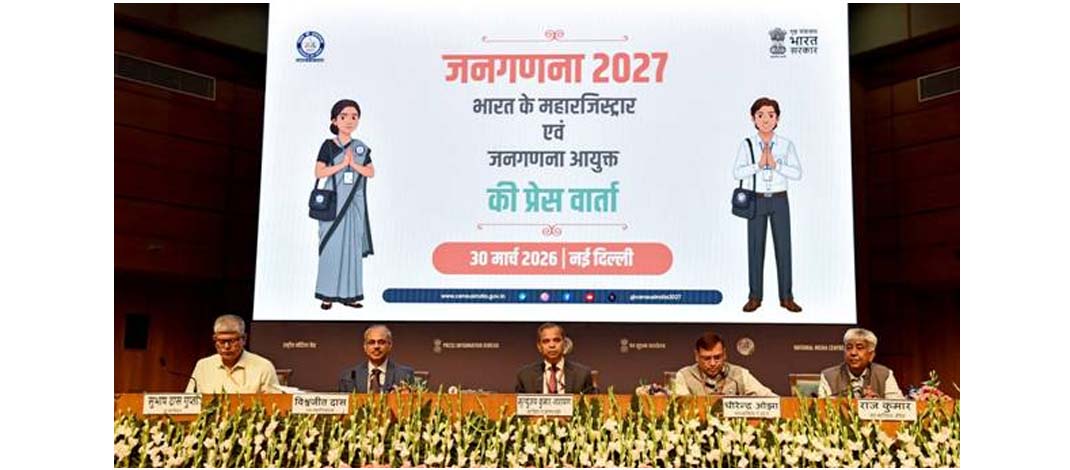
New Delhi : The Office of the Registrar General and Census Commissioner of India on Monday outlined the roadmap for conducting Census 2027, marking a historic shift as the country prepares for its first fully digital population count. Addressing a press conference, Registrar General and Census Commissioner Mritunjay Kumar Narayan detailed the scale, timeline, and innovations planned for what will be the world’s largest census exercise.
The Census will be conducted in two phases, with the first phase set to commence on April 1, 2026. For the first time, citizens will also have the option of self-enumeration, allowing them to submit their details online before the enumerator’s visit.
Phased Approach and Timeline
The exercise will be carried out under the provisions of the Census Act, 1948 and the Census Rules, 1990. Census 2027 will be the 16th Census overall and the 8th since Independence, with the previous census conducted in 2011.
Phase I—House Listing and Housing Census (HLO)—will be undertaken between April and September 2026, with each State/UT completing the process within a 30-day window as per administrative convenience. A 15-day self-enumeration window will precede this phase.
In select regions, including Goa, Karnataka, Odisha, Mizoram and Sikkim, the houselisting exercise will take place from April 16 to May 15, 2026, following a self-enumeration period from April 1 to 15.
Phase II—Population Enumeration—will be conducted in February 2027, with earlier timelines for snow-bound regions such as Ladakh and parts of Jammu and Kashmir, Uttarakhand, and Himachal Pradesh. The reference date for the census will be March 1, 2027 (October 1, 2026 for these special areas).
Importantly, caste enumeration will also be undertaken during the second phase.
Digital Transformation and Self-Enumeration
A key highlight of Census 2027 is its complete digital execution. Enumerators will use mobile applications to collect and upload data in real time, while a dedicated online portal will allow households to self-enumerate using mobile numbers and basic details.
The digital platform will be available in 16 languages, ensuring wider accessibility. Once submitted, respondents will receive a unique Self-Enumeration ID, which must be shared with enumerators during verification.
The system also includes advanced digital tools for monitoring field operations, generating ID cards, allocating work, and tracking progress through real-time dashboards. Houselisting blocks will be mapped using web-based geographic applications, with robust data security measures in place.
Coverage, Training and Infrastructure
Census 2027 will cover 36 States and Union Territories, including over 7,000 sub-districts, more than 5,000 statutory towns, 4,500 census towns, and nearly 6.4 lakh villages. Administrative boundaries have been frozen from January 1, 2026 to March 31, 2027 to ensure consistency.
To manage the scale of operations, extensive training arrangements have been made. Around 100 national trainers have already trained 2,000 master trainers, who are further training approximately 45,000 field trainers. These trainers will, in turn, prepare nearly 31 lakh enumerators and supervisors across the country.
Financial Outlay and Preparations
The Union Government has approved a total outlay of ₹11,718.24 crore for the exercise, covering training, honorariums, IT infrastructure, and logistics.
A nationwide pre-test of the houselisting phase was conducted in November 2025 across all States and UTs, covering around 5,000 blocks to validate the methodology, digital tools, and operational readiness.
Objective and Significance
The upcoming census aims to gather comprehensive data on housing conditions, amenities, and household assets in Phase I, and detailed demographic, socio-economic, education, migration, and fertility data in Phase II.
With its digital-first approach, self-enumeration option, and large-scale logistical preparedness, Census 2027 is expected to set new benchmarks in data collection, transparency, and efficiency, playing a crucial role in policy planning and governance for the coming decade.
State & UT-wise Houselisting and Housing Census and SE Period
| State/UT | Self-Enumeration Period | Houselisting and Housing Census Period | |||
|
Andaman and Nicobar Islands, Delhi (New Delhi Municipal Council and Delhi Cantonment Board), Goa, Karnataka, Lakshadweep, Mizoram, Odisha, and Sikkim. |
1 April to 15 April | 16th April to 15th May | |||
| Gujarat*, Dadra and Nagar Haveli and Daman and Diu | 5 April to 19 April | 20 April to 19 May | |||
| Uttarakhand | 10 April to 24 April | 25 April to 24 May | |||
| Madhya Pradesh, Andhra Pradesh, Arunachal Pradesh, Chandigarh, Chhattisgarh, and Haryana | 16 April to 30 April | 1 May to 30 May | |||
| Bihar | 17 April to 1 May | 2 May to 31 May | |||
| Telangana | 26 April to 10 May | 11 May to 9 June | |||
|
30 April to 14 May | 15 May to 13 June | |||
| Delhi (Municipal Corporation of Delhi), Maharashtra, Meghalaya, Rajasthan and Jharkhand ** | 1 May to 15 May | 16 May to 14 June | |||
|
7 May to 21 May | 22 May to 20 June | |||
| Jammu and Kashmir, Ladakh, and Puducherry | 17 May to 31 May | 1 June to 30 June | |||
| Himachal Pradesh | 1 June to 15 June | 16 June to 15 July | |||
| Kerala and Nagaland | 16 June to 30 June | 1 July to 30 July | |||
| Tamil Nadu and Tripura | 17 July to 31 July | 1 Aug to 30 Aug | |||
| Assam | 2 Aug to 16 Aug | 17 Aug to 15 Sep | |||
| Manipur | 17 Aug to 31 Aug | 1 Sep to 30 Sep | |||
| West Bengal | To be decided | ||||
*Gujarat- Subject to change
**Jharkhand- Notification of intention to conduct census published. For HLO period notification to be issued.