
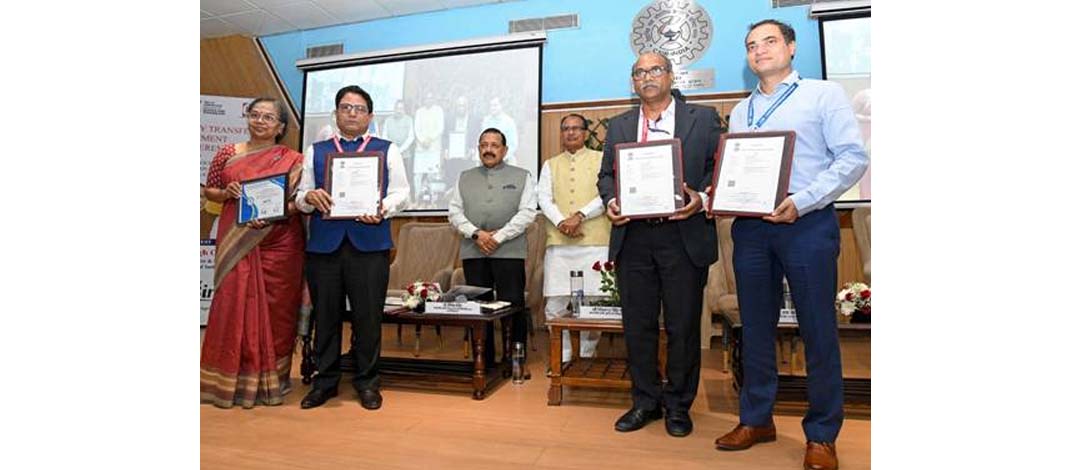
New Delhi : In a major push towards sustainable infrastructure and circular economy practices, the Council of Scientific and Industrial Research (CSIR) organised a technology transfer event in the national capital to promote large-scale adoption of its innovative solution—bio-bitumen derived from agricultural biomass.
The event witnessed the presence of Union Minister Shivraj Singh Chouhan, Minister of State (Independent Charge) for Science & Technology Jitendra Singh, and CSIR Director General N. Kalaiselvi, along with senior officials, scientists, industry representatives, and policymakers.
Addressing the gathering, Chouhan described the innovation as a game-changing development linking agriculture with infrastructure growth. He highlighted that converting farm residue into road-building material not only supports India’s climate goals and Net Zero ambitions but also creates new income streams for farmers while tackling the issue of stubble burning.
Dr. Jitendra Singh emphasised that the initiative reflects the government’s “Waste to Wealth” vision and strengthens India’s journey towards self-reliance and clean energy transition. He noted that the technology has shown strong performance in durability and compatibility with conventional materials, making it viable for widespread use in infrastructure projects.
Dr. Kalaiselvi termed the development a significant shift from petroleum-based to bio-based construction materials, reaffirming CSIR’s commitment to delivering scalable, impactful technologies for national development.
The technology, developed by CSIR-Central Road Research Institute and CSIR-Indian Institute of Petroleum, uses a thermochemical process to convert agricultural residues into eco-friendly bio-bitumen. It offers a renewable alternative to traditional bitumen, with comparable performance and reduced environmental impact.
Designed for adoption in road construction by the Ministry of Road Transport and Highways, the innovation addresses key national challenges, including crop residue management and dependence on imported petroleum products.
The initiative marks an important step in taking laboratory research to real-world application, paving the way for greener, more sustainable road infrastructure across the country.