
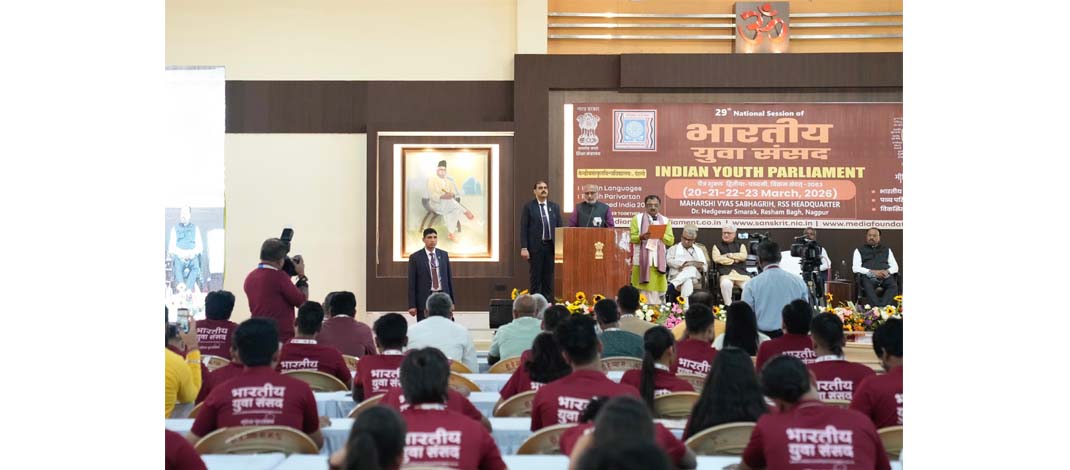
Nagpur, Maharashtra : The Vice-President of India, C. P. Radhakrishnan, today addressed the 29th National Session of the Indian Youth Parliament National Trust at Maharshi Vyas Sabhagrah in Nagpur. The session was organised around the theme “Indian Languages & Developed India–2047.”
Highlighting the significance of Nagpur, the Vice-President noted its important place in India’s national consciousness as the birthplace of the Rashtriya Swayamsevak Sangh, founded by Keshav Baliram Hedgewar in 1925. He remarked that the organisation’s growth from a modest beginning into a nationwide movement reflects a deep commitment to national service and the spirit of “Rashtra Pratham.”
Commending the efforts of the organising body, he said the Youth Parliament initiative has, over the past two decades, played a vital role in connecting young minds across regions and strengthening the vision of Ek Bharat Shreshtha Bharat.
Speaking on the central theme, the Vice-President emphasised that India’s linguistic diversity is a powerful strength. He remarked that speaking in one’s mother tongue is not being “regional” but “original,” underscoring that each language carries a unique heritage contributing to the nation’s cultural harmony. He also noted ongoing efforts to make the Constitution available in multiple Indian languages, stressing that preservation and promotion of linguistic diversity are crucial for national progress.
C. P. Radhakrishnan further stated that the vision of Viksit Bharat @2047 cannot be achieved through borrowed ideas alone. He called for innovation rooted in India’s civilizational ethos, encouraging youth to think and create in their native languages and scripts with confidence.
Appreciating the role of Central Sanskrit University, he highlighted the importance of Sanskrit in connecting various Indian languages and preserving the country’s rich knowledge tradition.
Emphasising the importance of dialogue in a democracy, the Vice-President—drawing from his experience as Chairman of the Rajya Sabha—said that differences of opinion should lead to constructive discussions and solutions rather than conflict. He noted that platforms like Youth Parliament foster respectful debate, active listening, and consensus-building.
Describing Youth Parliament as a training ground for leadership, he stressed that character-building is the foundation of true leadership. He urged students to utilise such platforms to cultivate discipline, leadership skills, and a spirit of national service.
Addressing the youth, he remarked that the world is closely watching India and described today’s youth as the “Amrit Generation” that will witness India’s transformation into a developed nation by 2047. He expressed confidence that initiatives like the Youth Parliament would significantly contribute to this national aspiration.
Earlier in the day, the Vice-President paid floral tributes at the memorial of Keshav Baliram Hedgewar at Dr. Hedgewar Smruti Bhavan in Nagpur.
The event was attended by the Governor of Maharashtra, Jishnu Dev Varma; State Minister Chandrashekhar Bawankule; social worker Krishna Gopal; Vice-Chancellor of Central Sanskrit University, Shrinivasa Varakhedi; National Convenor of the Youth Parliament, Ashutosh Joshi; and several other dignitaries, along with a large number of youth participants from across the country.