
Exports of Made-in-India electric cars reach US$369 million in Q1 FY2026-27; Spain and the UK emerge as leading destinations as Indian automakers expand their international footprint
New Delhi : India’s electric vehicle (EV) manufacturing industry is making significant progress in international markets, with exports of electric passenger cars registering a remarkable increase, particularly across Europe. The growing overseas demand reflects the strengthening capabilities of India’s automobile manufacturing sector and its emergence as an important production base for the global electric mobility industry.
The latest export figures indicate that India exported electric motor cars worth approximately US$369 million during April–June 2026, compared with around US$22.2 million during the corresponding period of the previous financial year. In volume terms, exports increased to 10,802 vehicles from 1,309 units, marking more than an eightfold rise in shipments and a substantial increase in export earnings.
Europe emerges as the biggest market for Indian electric cars
European countries have become major destinations for India’s electric passenger vehicles, with Spain and the United Kingdom leading the import figures.
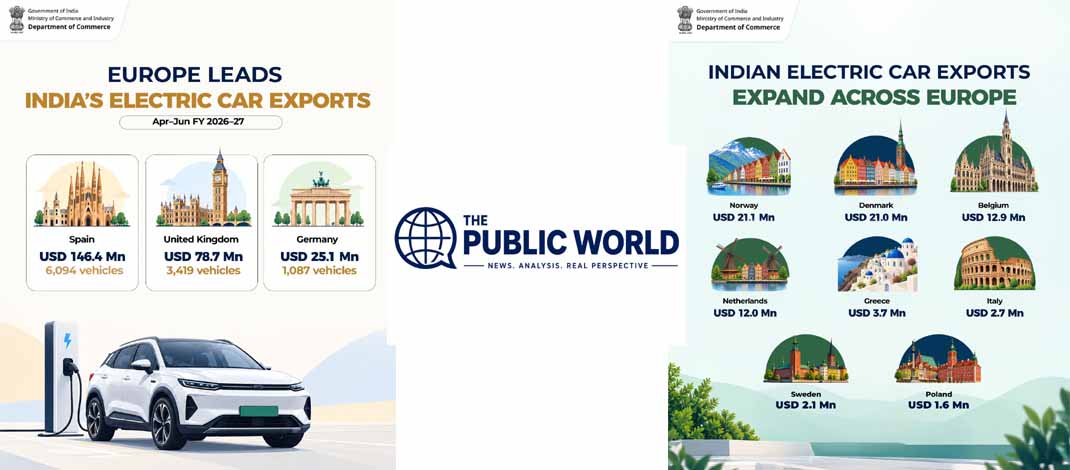
During the first quarter of FY2026-27, Spain emerged as the largest destination, importing Indian electric cars worth approximately US$146.4 million, followed by the United Kingdom at US$78.7 million.
Other important European destinations included:
| Country | Export value |
|---|---|
| Spain | US$146.4 million |
| United Kingdom | US$78.7 million |
| Germany | US$25.1 million |
| Norway | US$21.1 million |
| Denmark | US$21 million |
| Belgium | US$12.9 million |
| Netherlands | US$12 million |
The growing presence of Indian electric vehicles in these markets indicates increasing international acceptance of vehicles manufactured in India and their expanding integration into global automotive distribution networks.
Annual exports register substantial growth
The strong quarterly performance follows a significant increase in India’s electric passenger car exports during FY2025-26.
Export earnings rose to approximately US$701 million in FY2025-26, compared with US$77.9 million in FY2024-25. This growth reflects the expanding production capacity of Indian automobile manufacturers and their increasing focus on international markets.
The trend also demonstrates how India’s automotive industry is gradually moving beyond its traditional role as a supplier of conventional passenger vehicles and strengthening its position in the rapidly developing electric mobility segment.
Maruti Suzuki emerges as a major contributor
A significant contribution to India’s electric car export expansion has come from Maruti Suzuki India Limited, particularly through its electric SUV, the e VITARA.
Manufactured at the company’s Hansalpur facility in Gujarat, the e VITARA entered international export markets in August 2025, with shipments initially covering 12 European countries.
The company’s export operations have subsequently expanded, with the vehicle reaching approximately 50 international markets. By October 2026, cumulative exports of the e VITARA had crossed 50,000 units.
Maruti Suzuki has emerged as a major contributor to India’s electric passenger vehicle exports, reflecting the growing importance of domestic manufacturing facilities in serving international demand.
New opportunities for India’s automotive manufacturing ecosystem
The expansion of electric car exports is creating opportunities across India’s wider automotive ecosystem. Increased overseas demand can encourage manufacturers to expand production facilities, strengthen research and development, invest in advanced battery technologies and improve manufacturing standards.
The development also has implications for domestic component manufacturers, battery suppliers, electric powertrain developers and automotive testing agencies, which are becoming increasingly important to the electric mobility value chain.
At the same time, access to international markets requires Indian manufacturers to meet diverse regulatory requirements relating to vehicle safety, battery performance, energy efficiency, emissions and product quality.
Continued investment in technological innovation, charging compatibility, battery reliability and cost competitiveness will therefore remain essential for sustaining export growth.
India strengthens its ambition as a global EV manufacturing hub
India’s expanding electric vehicle exports are taking place alongside the country’s broader efforts to accelerate domestic EV adoption and develop a competitive manufacturing ecosystem.
Government initiatives such as the Production Linked Incentive (PLI) Scheme for Automobile and Auto Components, the PLI Scheme for Advanced Chemistry Cell (ACC) Battery Storage and the PM E-DRIVE Scheme are contributing to the development of the country’s electric mobility and advanced automotive manufacturing ecosystem.
With Indian-made electric cars gaining access to more international markets, the country is gradually strengthening its position in the global transition towards cleaner transportation.
The rise in electric car exports represents an important milestone for India’s automobile industry. The growing international footprint of Made-in-India EVs not only opens new business opportunities for domestic manufacturers but also reinforces India’s ambition to become a globally competitive automotive manufacturing and export destination under the vision of ‘Make in India, Make for the World’.