
Restrictions on protests, reported transport disruptions, heightened security deployment and competing political campaigns mark a tense build-up to the October 10 demonstration
NEW DELHI: The national capital is witnessing a rapidly evolving situation ahead of a proposed protest on October 10 demanding the resignation of Chief Election Commissioner (CEC) Gyanesh Kumar. A series of reported security measures, restrictions on public movement, appeals against participation and counter-campaigns in support of the CEC have raised concerns about the atmosphere surrounding the planned demonstration.
The developments outlined below, based on reports and claims circulating in connection with the proposed protest, point to an increasingly tense situation in Delhi. The details of the reported restrictions and deployment arrangements require independent verification.
16 Key Developments in the Run-up to the October 10 Protest
1. Permission for a Protest at Jantar Mantar Denied
Delhi Police, according to the information circulating on the issue, has stated that permission has not been granted for a protest at Jantar Mantar on October 10. Consequently, any demonstration held at the designated location without the necessary authorisation could be treated as unauthorised and dealt with in accordance with the law.
2. Reported Closure of 57 Metro Stations
Reports suggest that 57 Delhi Metro stations are to remain closed from 9 pm on October 9 until the early hours of October 11. If implemented on this scale, the measure could significantly disrupt public transport and restrict access to several parts of central Delhi. The list of affected stations and the official rationale for the closures require confirmation.
3. Restrictions on Train Arrivals at Major Railway Stations
According to the claims, mail and superfast express trains scheduled to arrive at New Delhi and Hazrat Nizamuddin railway stations would be prevented from halting at these stations from 2 pm on October 9 until the early hours of October 11. Such a measure would have significant implications for passengers travelling to the capital. An official railway advisory would be necessary to establish the precise scope of any restrictions.
4. Suspension of Bus Services to Central Delhi
Bus services operating towards central Delhi are reportedly expected to be curtailed from late evening on October 9 until the early hours of October 11. If confirmed, the restrictions could inconvenience commuters, workers, students and visitors who depend on public transport.
5. Reported Sealing of Delhi’s Borders
The claims further suggest that Delhi’s borders would be sealed from late October 9 until the early hours of October 11, with buses, trucks, tractors and other large transport vehicles reportedly facing restrictions on entry. The precise nature and extent of any border restrictions remain to be established.
6. Detentions and Restrictions on Activists and Student Leaders
Concerns have also been raised over reports that student union representatives and activists associated with the CJP movement are being detained, placed under house arrest at residences outside Delhi, or intercepted while travelling to the capital by road and rail.
The identities of those allegedly detained, the legal grounds for any such action and the number of people affected require further verification.
7. Reported Closure of Government-Run Liquor Outlets
According to the information provided, liquor outlets operated by the Delhi government are to remain closed on October 9 and 10. An official order would be needed to confirm the closures, their duration and the stated reasons behind the decision.
8. Large-Scale Security Deployment
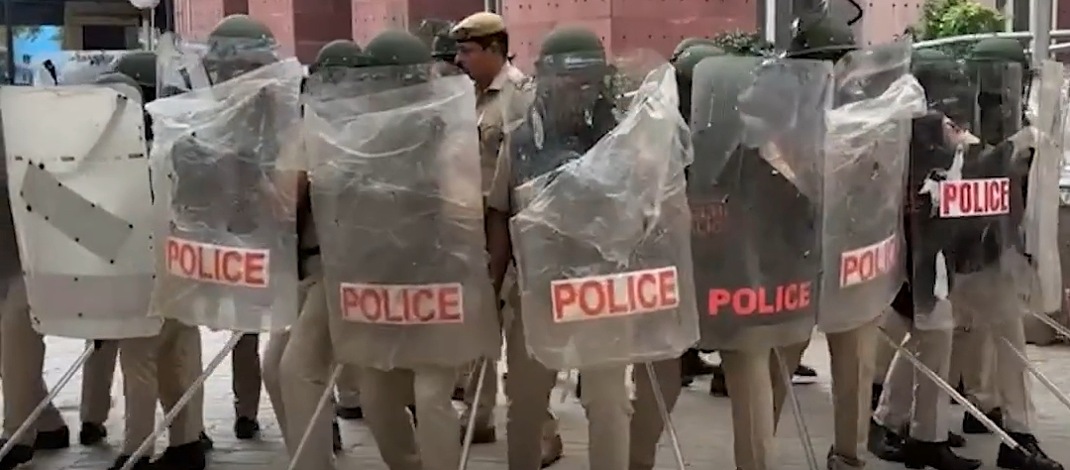
The account claims that approximately 22,000 armed personnel from different parts of the country have been brought to Delhi for deployment on October 10, alongside more than 10,000 Delhi Police personnel expected to be deployed across the capital.
If these figures are accurate, the scale of the deployment would underscore the security establishment’s preparations for the proposed demonstration. The number of personnel, the forces involved and their designated areas of deployment need official confirmation.
9. Facial Recognition and CCTV Surveillance
Reports also refer to the installation of additional CCTV cameras equipped with facial-recognition technology across New Delhi. If confirmed, the deployment would raise questions about the scope of surveillance, the safeguards governing the use of facial-recognition systems and the protection of citizens’ privacy during public demonstrations.
10. Appeals to Families in Local Communities
According to the account, police personnel have visited mosques and appealed to parents and community elders to counsel young people to remain at home and avoid areas where protest marches might take place.
The circumstances of these visits, their geographical coverage and the precise nature of the messages conveyed have not been independently established.
11. Appeals Urging Citizens Not to Join the Protest
A substantial campaign of public appeals by security personnel is also alleged to be under way, urging ordinary citizens to refrain from participating in the October 10 demonstration. The extent of this campaign and the official or organisational bodies responsible for it require confirmation.
12. Online Threats Against Prospective Protesters
Videos circulating on social media are reportedly threatening punitive action against people described as “anti-national” if they participate in or support the demonstration. Some individuals appearing in these videos allegedly display rods, lathis and other weapons.
The authenticity, origin and reach of these videos need to be established. If verified, such threats would raise serious concerns about intimidation, public safety and the freedom of citizens to participate peacefully in demonstrations.
13. Farmers’ Organisations Appeal for Participation
Several farmers’ unions are reportedly appealing to farmers to join the proposed protest on October 10. Their participation could broaden the demonstration’s social and organisational base, although the scale of mobilisation and the positions of the unions involved remain to be confirmed.
14. Khap Panchayat Representatives Express Divergent Positions
Representatives associated with khap panchayats are reportedly making appeals both encouraging participation and urging people to stay away from the demonstration. These differing positions suggest that opinion within community and regional organisations is not necessarily uniform.
15. Campaign in Support of the Chief Election Commissioner
A substantial social media campaign is reportedly being conducted in support of CEC Gyanesh Kumar. Some messages allegedly portray him as a defender of Hindu culture and traditions, giving the controversy a broader ideological dimension beyond the immediate demand for his resignation.
The scale of the campaign, the identities of its organisers and the extent of its reach remain to be independently assessed.
16. Enhanced Security for the Chief Election Commissioner
The security arrangements for CEC Gyanesh Kumar are also reportedly being strengthened. If confirmed, the enhanced protection would reflect heightened security concerns surrounding the controversy and the proposed demonstration.
The precise level of protection and any changes to his security classification have not been officially established.
A Protest Becomes a Wider Test of Democratic Space
Taken together, these reports depict a tense and polarised atmosphere in the run-up to the proposed October 10 protest. Allegations of restrictions on movement, possible preventive detentions, extensive security deployment and online intimidation have placed questions of public order and democratic freedoms at the centre of the unfolding controversy.
At the same time, the reported mobilisation by farmers’ organisations, the differing positions of khap panchayat representatives and the campaign supporting the Chief Election Commissioner indicate that the issue is generating competing political and social responses.
The central questions now concern the accuracy and legal basis of the reported restrictions, the extent to which citizens will be able to travel freely, and whether those wishing to express dissent peacefully will be able to do so within the applicable legal framework.
Official orders, police advisories, railway notifications, Metro announcements and independently verified accounts of alleged detentions will be essential to establish the full picture.
A Rarely Seen Level of Polarisation
Reflecting on the developments, the author of the original account writes:
“I cannot recall such a divisive atmosphere surrounding the Election Commission in the past three decades of my professional journalistic career.
“Nor can I recall security arrangements and restrictions on movement on this reported scale being imposed in response to a student-led protest in India. Not even during the anti-reservation agitations at their peak in 1990 do I remember witnessing a comparable situation.”
These observations reflect the author’s professional assessment and recollection. Whether the present circumstances are unprecedented in scale would require a systematic comparison with official records and historical accounts of previous protests.
As October 10 approaches, the situation in Delhi warrants close scrutiny. The manner in which the authorities manage the proposed demonstration will be significant not only for public order but also for the wider debate over freedom of assembly, the right to dissent and public confidence in democratic institutions.
