
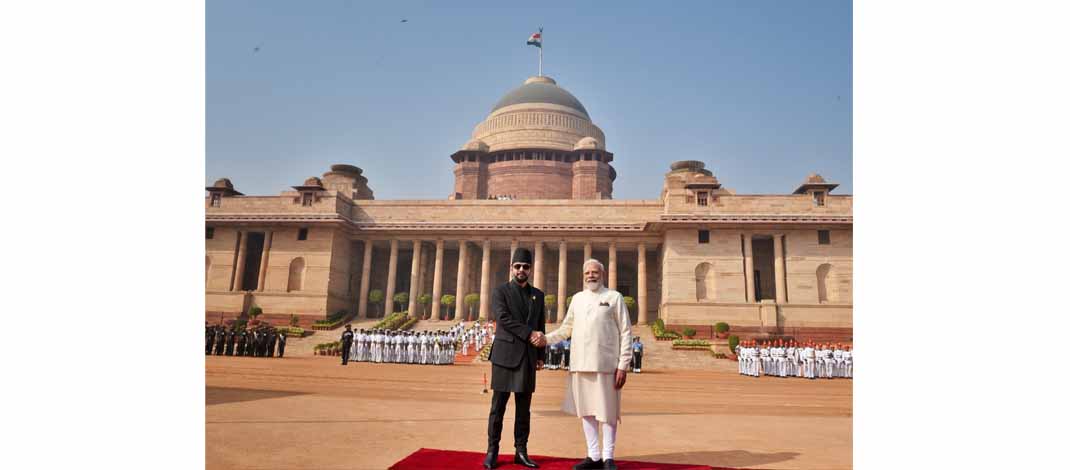
PM Modi and Balendra Shah to discuss connectivity, energy, trade, investment and wider economic cooperation
New Delhi : Nepal Prime Minister Balendra Shah received a ceremonial welcome at Rashtrapati Bhavan in New Delhi on Monday, marking a special beginning to his state visit to India. The ceremonial reception reflected the warmth and enduring friendship between India and Nepal, two close neighbours with deep historical, cultural and people-to-people ties. Prime Minister Narendra Modi was present during ceremonial welcomeat forcourt of the Rashtrapati Bhawan .
Prime Minister Shah is on a two-day state visit to India, during which he is holding a series of high-level engagements aimed at further strengthening bilateral relations and expanding cooperation across economic, developmental and strategic areas.
Following the ceremonial welcome, Prime Minister Shah paid tribute to Mahatma Gandhi at Raj Ghat.
A key engagement of the visit is his meeting with Prime Minister Narendra Modi, with the two leaders holding discussions on the entire spectrum of India-Nepal relations. The talks are expected to focus particularly on trade and commerce, investment, energy cooperation, hydropower, infrastructure development and cross-border connectivity.
Focus on connectivity and infrastructure
Connectivity is expected to remain one of the important pillars of the discussions. India and Nepal are working to expand rail, road and air connectivity, improve cross-border infrastructure and facilitate smoother movement of people and goods.
The two sides are also looking at strengthening transportation and transit arrangements, which have a direct bearing on bilateral trade and Nepal’s access to regional markets.
The proposed Ayodhya–Janakpur passenger train service is also significant in the context of strengthening cultural, religious and people-to-people linkages between the two countries. The initiative is expected to contribute to religious tourism and deepen the civilisational connection between India and Nepal.
Energy and hydropower cooperation
Hydropower and energy cooperation are another major area of the bilateral partnership. Nepal has substantial hydropower potential, while India is an important market for electricity generated in Nepal.
The two countries have been expanding cooperation in power generation, transmission and cross-border electricity trade, with the objective of creating greater economic opportunities and strengthening regional energy connectivity.
Business and investment on the agenda
The visit also carries an important business and investment dimension. A Nepal-India Business Forum is bringing together business leaders, investors, entrepreneurs and representatives of the private sector from both countries.
The forum provides an opportunity to explore new avenues for investment, trade, infrastructure, energy, technology, tourism and other emerging sectors.
Nepal’s economic team and business representatives are expected to engage with their Indian counterparts on ways to increase private-sector participation and create a more favourable environment for cross-border investment.
The discussions are also expected to encourage Indian investment in Nepal and identify opportunities for Nepalese businesses to expand their presence in the Indian market.
Cooperation in technology, education and social sectors
The bilateral agenda extends beyond traditional areas of cooperation. India and Nepal are also looking at greater collaboration in technology, start-ups, education, healthcare, agriculture and human-resource development.
The two sides are exploring ways to strengthen the start-up ecosystem through greater opportunities for training, mentorship, innovation and knowledge exchange.
Education and skill development are also expected to receive attention, including possibilities for strengthening institutional partnerships and expanding access to advanced technical education and training.
Sports and people-to-people ties
Sports cooperation, particularly cricket, is another emerging area of India-Nepal engagement. Greater collaboration in sports can provide additional opportunities for young people and further strengthen people-to-people relations.
The two countries also share strong cultural, religious and social connections, with millions of people travelling across the open border for business, education, employment, tourism and family ties.
Disaster management and development cooperation
The discussions are also expected to cover disaster management, reconstruction and climate-resilient infrastructure, particularly in view of the challenges faced by Nepal from floods, landslides and other natural disasters.
India’s development partnership with Nepal includes assistance for infrastructure, community-level projects, capacity building and reconstruction, and both sides are looking at ways to make such cooperation more effective and responsive to emerging needs.
Prime Minister Shah is also scheduled to meet President Droupadi Murmu during his visit.
The state visit comes at an important moment for India-Nepal relations, with both countries seeking to give fresh momentum to their longstanding partnership through greater economic engagement, stronger connectivity, expanded energy cooperation, increased investment and deeper people-to-people ties.
The broader message emerging from Prime Minister Balendra Shah’s visit is that India-Nepal relations are increasingly moving beyond traditional ties towards a more comprehensive partnership centred on connectivity, commerce, energy, technology, development and shared economic opportunities.