
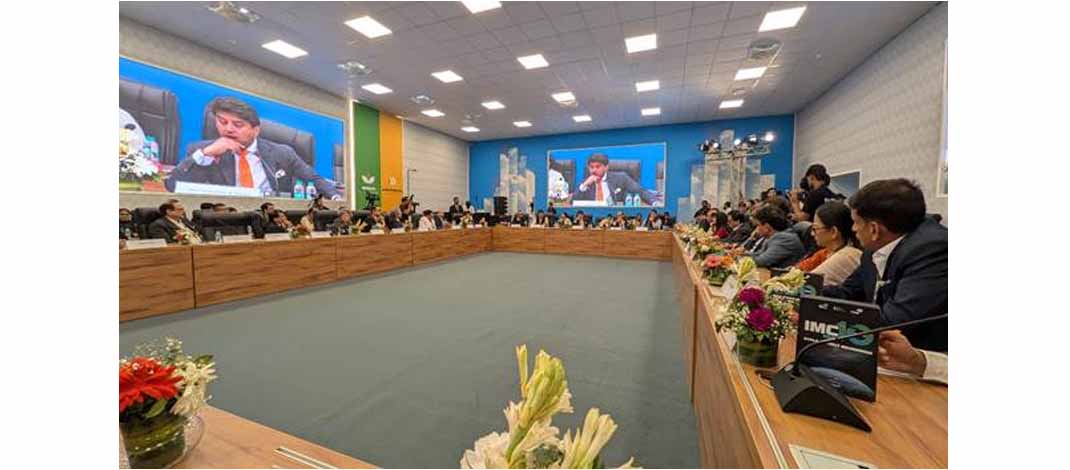
New Delhi : Union Minister for Communications and Development of the North Eastern Region, Shri Jyotiraditya M. Scindia, participated in a high-level CEO Round Table titled “The Sovereign Inflection & The Future of Telecom” during the 10th edition of the India Mobile Congress (IMC) 2026 at Yashobhoomi, New Delhi.
Held under the theme “Scale Without Boundaries,” IMC 2026 brought together senior representatives from the telecommunications, digital infrastructure, network equipment, technology and consulting sectors to discuss emerging opportunities and strategic priorities shaping the future of India’s telecom industry. The leadership dialogue focused on translating innovation into scalable, resilient and globally competitive digital capabilities.
The Round Table witnessed participation from senior industry leaders representing leading telecom service providers, network equipment manufacturers, technology companies, digital infrastructure firms and industry advisory organisations. The discussions centred on advancing telecom infrastructure, promoting innovation, strengthening indigenous capabilities and supporting the next phase of India’s digital growth. Shri Amit Agrawal, Secretary, Department of Telecommunications, also participated in the deliberations alongside senior officials from the Department.
AI, Cloud Computing and Next-Generation Networks in Focus
The discussions examined the rapidly evolving telecom value chain and the convergence of Artificial Intelligence (AI), cloud and computing infrastructure, advanced connectivity, intelligent networks and next-generation communication technologies.
Participants also deliberated on strengthening domestic technological capabilities, encouraging innovation, building resilient digital infrastructure and creating an enabling policy environment to sustain investment and technological advancement.
Addressing the industry leaders, Shri Scindia highlighted the significant progress India had made in the telecom sector over the past decade in terms of network coverage, penetration, affordability, inclusivity and innovation. He also underlined the sector’s contribution to creating a strong foundation for the development of application platforms and digital services across the country.
The Minister said, “I think we have been meeting quite regularly and therefore this is not an annual meeting for any of us. But having said that, what has come out very clearly in this year’s IMC is that we have achieved a lot in the last decade. Both in terms of coverage, penetration, affordability, inclusivity, innovation and really providing the foundational layer for a lot of application platforms to be innovated in our country.”
Emphasising India’s growing global standing, Shri Scindia noted that the country is the world’s second-largest telecom market and the second-largest producer of mobile phones. He pointed to the expansion of India’s semiconductor manufacturing ecosystem, with eight to nine semiconductor fabrication facilities coming up in the country, as an important step towards developing an end-to-end domestic value chain.
Highlighting the strategic significance of technological self-reliance, the Minister said, “And therefore the fundamental inflection point today is going to be based on who writes the rules, who makes the equipment, who designs innovation, who builds the technology.”
Government–Industry Partnership to Drive Telecom Growth
Shri Scindia emphasised the need for a partnership-based approach between the Government and industry to shape the next phase of India’s telecom development. He underlined the role of the Department of Telecommunications as an enabler and facilitator, supporting an ecosystem in which all stakeholders could contribute to the sector’s growth.
The Minister observed that India’s telecom ecosystem extended well beyond connectivity infrastructure. It encompassed network equipment and optical fibre manufacturers, telecom service providers, internet service providers, applications, digital platforms and emerging technologies such as Artificial Intelligence.
He stressed that the collective strength of these interconnected segments would be critical to enhancing the competitiveness and resilience of India’s digital economy. He also highlighted the importance of moving beyond basic connectivity towards advanced technologies and digital infrastructure capable of generating wider economic and social value.
India’s expanding digital ecosystem, he noted, increasingly relies on telecommunications as a foundational enabler of digital public infrastructure, technological innovation, emerging applications and economic growth.
Industry Dialogue to Shape a Future-Ready Telecom Ecosystem
The CEO Round Table provided a platform for industry leaders to share perspectives on sectoral developments, technology adoption, investment opportunities, and policy and regulatory priorities needed to support the next phase of telecom expansion.
The interaction reflected the Government’s continued commitment to maintaining an open and constructive dialogue with industry stakeholders and ensuring that policy frameworks remain responsive to evolving technologies and market requirements.
The deliberations reinforced the vision of “Scale Without Boundaries” by bringing the Government and industry together to advance a future-ready telecom ecosystem built on innovation, resilient and trusted infrastructure, indigenous technological capabilities and global competitiveness.
The Department of Telecommunications reiterated its commitment to sustained engagement with industry stakeholders, innovators, technology companies and other partners to develop a robust and inclusive digital communications ecosystem and strengthen India’s position as a global hub for telecom innovation and technology.