
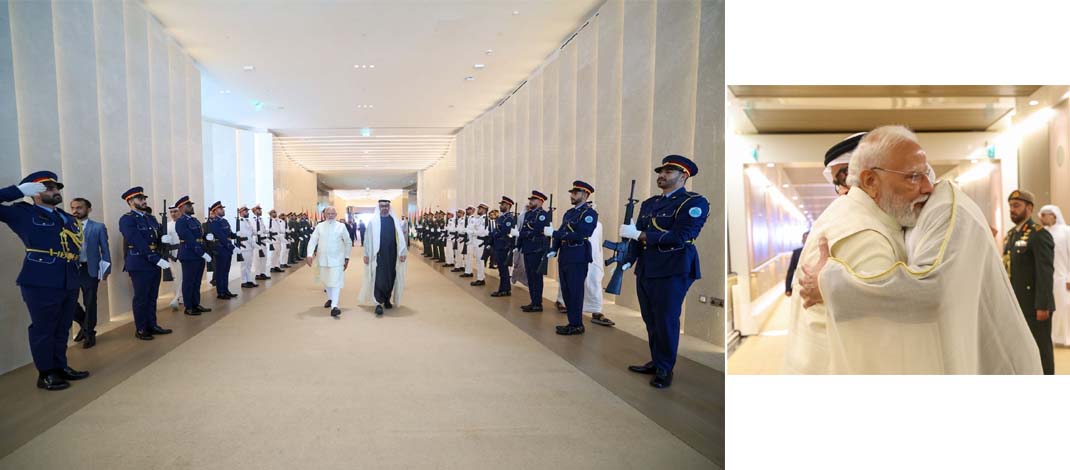
New Delhi : Prime Minister Narendra Modi paid an official visit to the United Arab Emirates on Thursday, where he was received at the airport by UAE President Mohamed bin Zayed Al Nahyan and accorded a ceremonial welcome.
During the visit, the two leaders held extensive discussions covering regional developments and the expanding India-UAE Comprehensive Strategic Partnership. Prime Minister Modi reiterated India’s strong condemnation of the recent attacks on the UAE and expressed solidarity with the UAE leadership and its people.
The Prime Minister also underlined India’s support for ensuring safe and uninterrupted navigation through the Strait of Hormuz, describing it as critical for regional peace, stability, and global energy and food security.
Both leaders reviewed the full spectrum of bilateral ties and welcomed the growing cooperation between India and the UAE in sectors including energy, trade, investment, defence, security, fintech, infrastructure, education, culture and people-to-people exchanges.
The two sides acknowledged the success of the India-UAE Comprehensive Economic Partnership Agreement (CEPA), which has significantly boosted bilateral trade and economic engagement.
Energy cooperation featured prominently in the discussions, with the leaders appreciating the UAE’s continued role as a key partner in India’s energy security through supplies of crude oil, LNG and LPG. They agreed to pursue new initiatives to deepen the comprehensive energy partnership between the two countries.
In this context, the leaders welcomed a Strategic Collaboration Agreement signed between Indian Strategic Petroleum Reserves Limited and Abu Dhabi National Oil Company (ADNOC) to expand the UAE’s participation in India’s strategic petroleum reserves to 30 million barrels. The two sides will also work together on establishing strategic gas reserves in India.
The leaders also welcomed a long-term LPG supply arrangement between Indian Oil Corporation Limited and ADNOC aimed at strengthening India’s energy supply chain.
During the visit, UAE entities announced investments worth USD 5 billion in India. This includes a USD 3 billion investment by Emirates NBD in RBL Bank, USD 1 billion investment by Abu Dhabi Investment Authority in partnership with the National Infrastructure and Investment Fund for priority infrastructure projects, and USD 1 billion investment by International Holding Company in Sammaan Capital.
The two leaders said these investments reflect the UAE’s long-term confidence in India’s growth potential and further strengthen the strategic investment partnership between the two countries.
Defence cooperation also figured prominently in the talks, with both sides recognising it as a key pillar of the Comprehensive Strategic Partnership. The two countries welcomed the signing of a Framework for Strategic Defence Partnership aimed at deepening collaboration in defence manufacturing, innovation, advanced technologies, maritime security, cyber defence, training, military exercises, secure communications and information sharing.
The two Leaders also witnessed the conclusion of the following additional documents during the visit, which will further strengthen bilateral cooperation:
· MoU between Cochin Shipyard Limited and Drydocks World, Dubai on setting up Ship Repair Cluster at Vadinar, including offshore fabrication, under the Maritime Development Fund Scheme launched by the Government of India.
· Tripartite MoU between Cochin Shipyard Limited, the Drydocks World Dubai and Centre of Excellence in Maritime & Shipbuilding (CEMS) on Skill Development in Ship Repair. This establishes a framework to mobilize, train and employ a skilled maritime workforce, enhances the capabilities of the Indian maritime workforce and position India as a hub for skilled shipbuilding and ship repair professionals.
· Term Sheet for setting up 8 Exaflop Super Compute Cluster in partnership between CDAC, India and G-42, UAE.
The two leaders also welcomed the operationalisation of the Virtual Trade Corridor using MAITRI (Master Application for International Trade and Regulatory Interface interface). This digital framework, connecting customs and port authorities on both sides, will streamline cargo movement and reduce both costs and transit time, thereby enabling more efficient trade flows.
Prime Minister thanked President His Highness Sheikh Mohamed bin Zayed Al Nahyan for the warm welcome and gracious hospitality extended to him and invited him to visit India at an early date.