
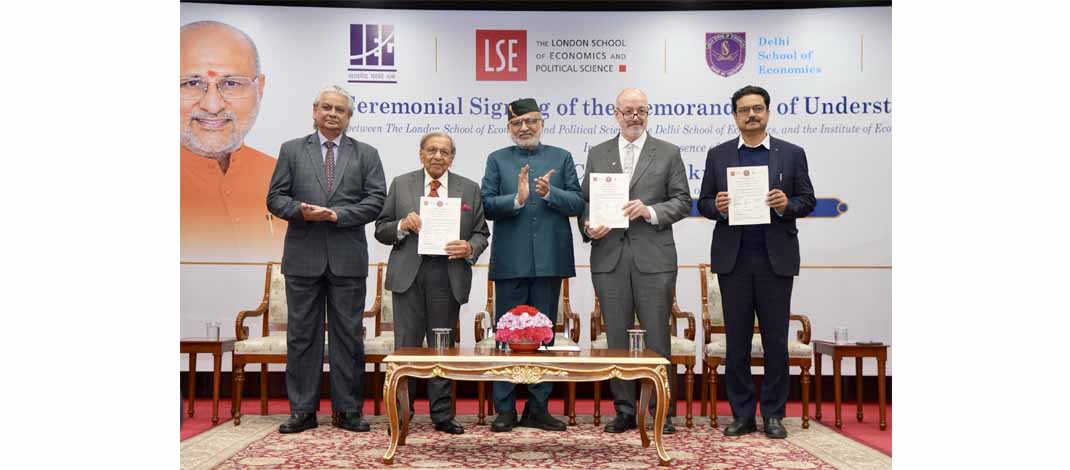
Academic partnership aims to strengthen research collaboration, bring together institutional expertise and address contemporary economic and social challenges.
New Delhi : University of Delhi’s Delhi School of Economics and the Institute of Economic Growth signed an MoU with the London School of Economics and Political Science today in the presence of the Chancellor, Vice President of India. This partnership will strengthen academic and research collaboration between the institutions. We express our sincere gratitude to our Chancellor for this initiative.
Vice-President of India and Chancellor of the University of Delhi, C. P. Radhakrishnan, graced the MoU exchange ceremony between the London School of Economics and Political Science (LSE), the Delhi School of Economics and the Institute of Economic Growth (IEG) at Uprashtrapati Bhavan in New Delhi. Describing the collaboration as an important milestone, the Vice-President highlighted its potential to bring together academic excellence, research capabilities and policy expertise to address contemporary economic and social challenges.
The partnership is expected to provide a platform for greater academic engagement and institutional cooperation among the three prestigious institutions. It also reflects the importance of strengthening research-driven approaches and encouraging knowledge-sharing to address emerging economic and societal issues.
The ceremony was attended by several distinguished academic and institutional leaders, including Shri N. K. Singh, President of the Institute of Economic Growth; Professor Larry Kramer, President and Vice-Chancellor of the London School of Economics and Political Science; Dr. Michael Debabrata Patra, Chairman of the Institute of Economic Growth; and Professor Yogesh Singh, Vice-Chancellor of the University of Delhi.
Faculty members, students and other dignitaries were also present on the occasion.
The collaboration marks an important step towards strengthening international academic partnerships and connecting research institutions with policy-oriented expertise. It is expected to create opportunities for deeper intellectual engagement and contribute to informed discussions on India’s economic and social development challenges.