
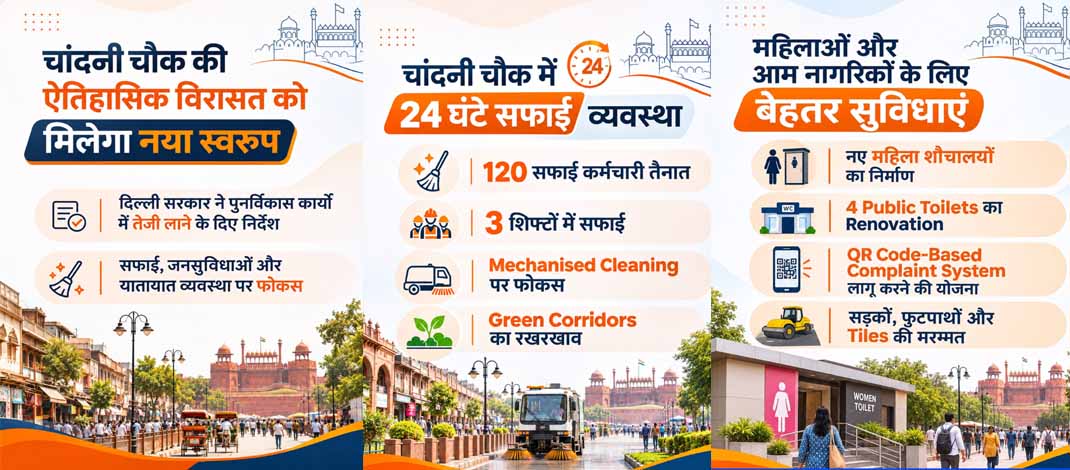
Chief Minister Rekha Gupta directs faster execution of redevelopment works, including round-the-clock cleanliness, better public facilities, improved roads and strict action against encroachments to preserve the historic character of Old Delhi.
NEW DELHI: The Delhi government has stepped up efforts to preserve the historic heritage of Chandni Chowk while transforming the iconic marketplace into a cleaner, safer and better-organised urban destination. Chief Minister Rekha Gupta has directed officials to expedite redevelopment works and ensure that residents, traders and tourists benefit from improved civic infrastructure without compromising the area’s historical identity.
The directions are part of the government’s broader initiative to restore the historic grandeur of Shahjahanabad (Old Delhi), while upgrading essential public facilities and strengthening the management of one of the capital’s busiest commercial and cultural centres.
The redevelopment plan includes round-the-clock cleaning, expansion of women’s toilets and public conveniences, repair of roads, footpaths and damaged flooring, improved drainage and maintenance of public spaces. The government has also called for strict action against encroachments, illegal parking and unauthorised occupation of roads and footpaths.
Delhi Police, the Municipal Corporation of Delhi (MCD) and the Public Works Department (PWD) have been directed to coordinate their efforts to improve traffic management, remove obstructions and ensure better pedestrian movement.
According to officials, 120 sanitation workers have been deployed in three shifts to maintain round-the-clock cleanliness in the Chandni Chowk market. A comprehensive facility management system is also being developed to cover civil maintenance, horticulture, mechanical cleaning and security arrangements.
@theweek+2
Chandni Chowk: A Living Symbol of Delhi’s Historic Heritage
Chandni Chowk is among the most historically significant marketplaces in India. Established in the 17th century during the reign of Mughal Emperor Shah Jahan, it formed an integral part of Shahjahanabad, the historic walled city of Delhi.
The marketplace was originally designed as a grand commercial and cultural avenue, with a central water canal, tree-lined pathways and a distinctive urban layout. Its name, Chandni Chowk, is traditionally associated with the moonlit appearance of the central square and water channel.
The historic market has evolved over more than three centuries into a vibrant commercial hub, retaining its distinctive architectural, religious and cultural character.
Some of its most prominent heritage landmarks include:
-
Red Fort: The magnificent Mughal-era fortification built by Emperor Shah Jahan, which served as the imperial residence and remains one of India’s most important historical monuments.
-
Jama Masjid: One of India’s largest and most prominent historic mosques, commissioned by Shah Jahan and completed in 1656.
-
Gurudwara Sis Ganj Sahib: A significant Sikh religious shrine associated with the martyrdom of Guru Tegh Bahadur Ji in 1675.
-
Gauri Shankar Temple: An important historic Hindu temple dedicated to Lord Shiva and Goddess Parvati.
-
Fatehpuri Masjid: A historic mosque built in 1650 by Fatehpuri Begum, one of Shah Jahan’s wives.
-
Historic Havelis and Katras: Traditional mansions, commercial courtyards and interconnected market lanes that reflect the architectural and trading traditions of Old Delhi.
Chandni Chowk is also renowned for its specialised traditional markets, including Dariba Kalan, famous for jewellery and silverware; Khari Baoli, one of Asia’s largest wholesale spice markets; and Kinari Bazaar, known for wedding accessories, decorative items and traditional embellishments.
These historic streets, religious institutions, traditional businesses and architectural landmarks collectively represent Delhi’s rich composite cultural heritage.
Latest News Delhi+2
Heritage Conservation Alongside Urban Development
The Delhi government’s approach is aimed at balancing heritage conservation with modern urban requirements. The redevelopment initiative seeks to improve the overall experience of Chandni Chowk without disturbing its traditional character and commercial importance.
The Indraprastha Virasat Punervikas Nigam (IVPN), formerly known as the Shahjahanabad Redevelopment Corporation, is playing an important role in coordinating heritage conservation and infrastructure development across Old Delhi.
Additional measures under consideration include regulating cycle-rickshaw movement, improving green spaces, maintaining public benches and bollards, introducing a QR code-based grievance redressal system and strengthening security arrangements.
The government has also emphasised the need for better traffic regulation around Kashmere Gate ISBT and Old Delhi Railway Station to reduce congestion and improve accessibility.
The broader objective is to make Chandni Chowk an attractive heritage and tourism destination while protecting the interests of local residents, traders, shopkeepers and visitors.
The redevelopment drive reflects the government’s stated vision of ensuring that Chandni Chowk retains its historical soul while acquiring the civic infrastructure and public amenities required of a modern urban marketplace.